 Add to Chrome
 Add to Firefox
 Add to Edge
Less is More for RAG: Information Gain Pruning for Generator-Aligned Reranking and Evidence Selection
Jan 24, 2026
Retrieval-augmented generation (RAG) grounds large language models with external evidence, but under a limited context budget, the key challenge is deciding which retrieved passages should be injected. We show that retrieval relevance metrics (e.g., NDCG) correlate weakly with end-to-end QA quality and can even become negatively correlated under multi-passage injection, where redundancy and mild conflicts destabilize generation. We propose \textbf{Information Gain Pruning (IGP)}, a deployment-friendly reranking-and-pruning module that selects evidence using a generator-aligned utility signal and filters weak or harmful passages before truncation, without changing existing budget interfaces. Across five open-domain QA benchmarks and multiple retrievers and generators, IGP consistently improves the quality--cost trade-off. In a representative multi-evidence setting, IGP delivers about +12--20% relative improvement in average F1 while reducing final-stage input tokens by roughly 76--79% compared to retriever-only baselines.

UmambaTSF: A U-shaped Multi-Scale Long-Term Time Series Forecasting Method Using Mamba
Oct 15, 2024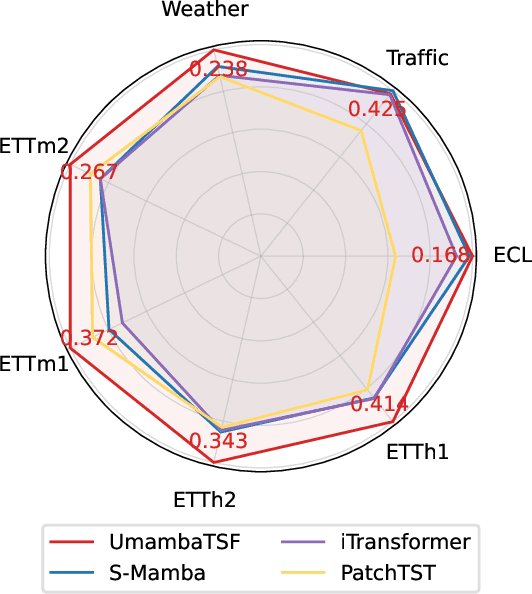
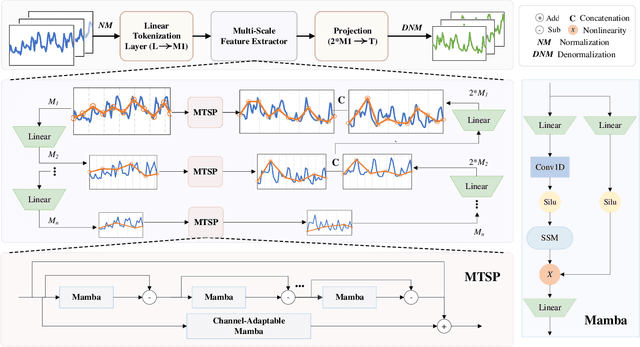
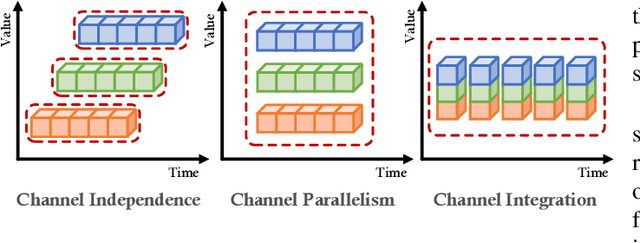
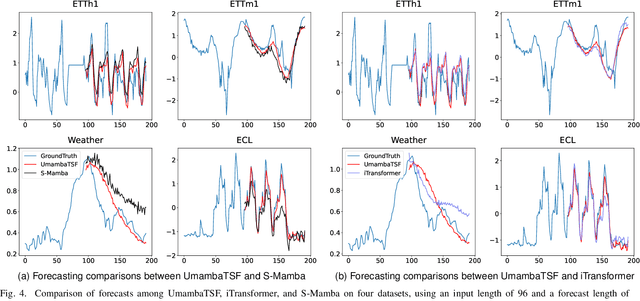
Multivariate Time series forecasting is crucial in domains such as transportation, meteorology, and finance, especially for predicting extreme weather events. State-of-the-art methods predominantly rely on Transformer architectures, which utilize attention mechanisms to capture temporal dependencies. However, these methods are hindered by quadratic time complexity, limiting the model's scalability with respect to input sequence length. This significantly restricts their practicality in the real world. Mamba, based on state space models (SSM), provides a solution with linear time complexity, increasing the potential for efficient forecasting of sequential data. In this study, we propose UmambaTSF, a novel long-term time series forecasting framework that integrates multi-scale feature extraction capabilities of U-shaped encoder-decoder multilayer perceptrons (MLP) with Mamba's long sequence representation. To improve performance and efficiency, the Mamba blocks introduced in the framework adopt a refined residual structure and adaptable design, enabling the capture of unique temporal signals and flexible channel processing. In the experiments, UmambaTSF achieves state-of-the-art performance and excellent generality on widely used benchmark datasets while maintaining linear time complexity and low memory consumption.