 Add to Chrome
 Add to Firefox
 Add to Edge
Reducing the Complexity of Matrix Multiplication to $O(N^2log_2N)$ by an Asymptotically Optimal Quantum Algorithm
Feb 05, 2026
Matrix multiplication is a fundamental classical computing operation whose efficiency becomes a major challenge at scale, especially for machine learning applications. Quantum computing, with its inherent parallelism and exponential storage capacity, offers a potential solution to these limitations. This work presents a quantum kernel-based matrix multiplication algorithm (QKMM) that achieves an asymptotically optimal computational complexity of $ O(N^2 \log_2 N) $, outperforming the classical optimal complexity of $ O(N^{2.371552}) $, where $N$ denotes the matrix dimension. Through noiseless and noisy quantum simulation experiments, we demonstrate that the proposed algorithm not only exhibits superior theoretical efficiency but also shows practical advantages in runtime performance and stability.

360-GeoGS: Geometrically Consistent Feed-Forward 3D Gaussian Splatting Reconstruction for 360 Images
Jan 05, 20263D scene reconstruction is fundamental for spatial intelligence applications such as AR, robotics, and digital twins. Traditional multi-view stereo struggles with sparse viewpoints or low-texture regions, while neural rendering approaches, though capable of producing high-quality results, require per-scene optimization and lack real-time efficiency. Explicit 3D Gaussian Splatting (3DGS) enables efficient rendering, but most feed-forward variants focus on visual quality rather than geometric consistency, limiting accurate surface reconstruction and overall reliability in spatial perception tasks. This paper presents a novel feed-forward 3DGS framework for 360 images, capable of generating geometrically consistent Gaussian primitives while maintaining high rendering quality. A Depth-Normal geometric regularization is introduced to couple rendered depth gradients with normal information, supervising Gaussian rotation, scale, and position to improve point cloud and surface accuracy. Experimental results show that the proposed method maintains high rendering quality while significantly improving geometric consistency, providing an effective solution for 3D reconstruction in spatial perception tasks.
Data Denoising and Derivative Estimation for Data-Driven Modeling of Nonlinear Dynamical Systems
Sep 17, 2025Data-driven modeling of nonlinear dynamical systems is often hampered by measurement noise. We propose a denoising framework, called Runge-Kutta and Total Variation Based Implicit Neural Representation (RKTV-INR), that represents the state trajectory with an implicit neural representation (INR) fitted directly to noisy observations. Runge-Kutta integration and total variation are imposed as constraints to ensure that the reconstructed state is a trajectory of a dynamical system that remains close to the original data. The trained INR yields a clean, continuous trajectory and provides accurate first-order derivatives via automatic differentiation. These denoised states and derivatives are then supplied to Sparse Identification of Nonlinear Dynamics (SINDy) to recover the governing equations. Experiments demonstrate effective noise suppression, precise derivative estimation, and reliable system identification.
Matrix Multiplication on Quantum Computer
Aug 06, 2024This paper introduces an innovative and practical approach to universal quantum matrix multiplication. We designed optimized quantum adders and multipliers based on Quantum Fourier Transform (QFT), which significantly reduced the number of gates used compared to classical adders and multipliers. Subsequently, we construct a basic universal quantum matrix multiplication and extend it to the Strassen algorithm. We conduct comparative experiments to analyze the performance of the quantum matrix multiplication and evaluate the acceleration provided by the optimized quantum adder and multiplier. Furthermore, we investigate the advantages and disadvantages of the quantum Strassen algorithm compared to basic quantum matrix multiplication.
ChatRadio-Valuer: A Chat Large Language Model for Generalizable Radiology Report Generation Based on Multi-institution and Multi-system Data
Oct 10, 2023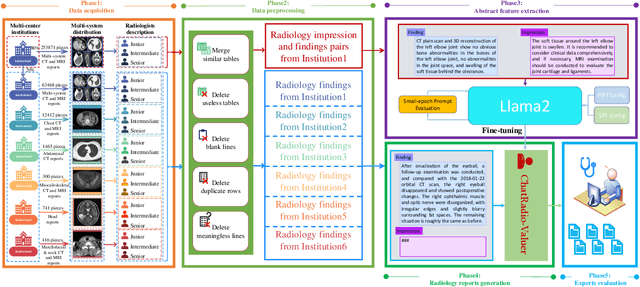
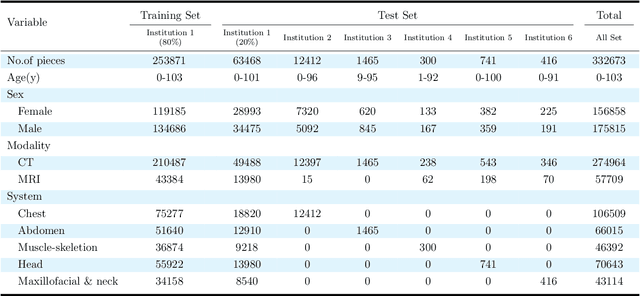
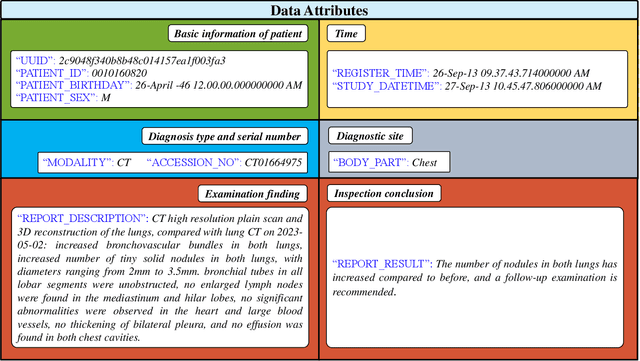
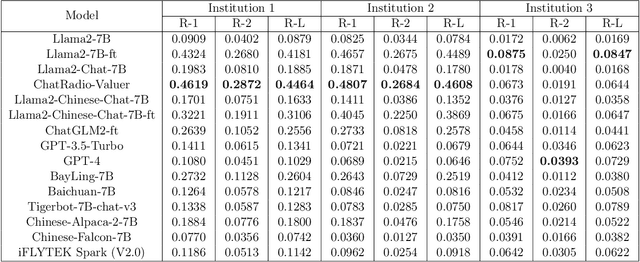
Radiology report generation, as a key step in medical image analysis, is critical to the quantitative analysis of clinically informed decision-making levels. However, complex and diverse radiology reports with cross-source heterogeneity pose a huge generalizability challenge to the current methods under massive data volume, mainly because the style and normativity of radiology reports are obviously distinctive among institutions, body regions inspected and radiologists. Recently, the advent of large language models (LLM) offers great potential for recognizing signs of health conditions. To resolve the above problem, we collaborate with the Second Xiangya Hospital in China and propose ChatRadio-Valuer based on the LLM, a tailored model for automatic radiology report generation that learns generalizable representations and provides a basis pattern for model adaptation in sophisticated analysts' cases. Specifically, ChatRadio-Valuer is trained based on the radiology reports from a single institution by means of supervised fine-tuning, and then adapted to disease diagnosis tasks for human multi-system evaluation (i.e., chest, abdomen, muscle-skeleton, head, and maxillofacial $\&$ neck) from six different institutions in clinical-level events. The clinical dataset utilized in this study encompasses a remarkable total of \textbf{332,673} observations. From the comprehensive results on engineering indicators, clinical efficacy and deployment cost metrics, it can be shown that ChatRadio-Valuer consistently outperforms state-of-the-art models, especially ChatGPT (GPT-3.5-Turbo) and GPT-4 et al., in terms of the diseases diagnosis from radiology reports. ChatRadio-Valuer provides an effective avenue to boost model generalization performance and alleviate the annotation workload of experts to enable the promotion of clinical AI applications in radiology reports.