 Add to Chrome
 Add to Firefox
 Add to Edge
Learning the Mechanism of Catastrophic Forgetting: A Perspective from Gradient Similarity
Jan 29, 2026
Catastrophic forgetting during knowledge injection severely undermines the continual learning capability of large language models (LLMs). Although existing methods attempt to mitigate this issue, they often lack a foundational theoretical explanation. We establish a gradient-based theoretical framework to explain catastrophic forgetting. We first prove that strongly negative gradient similarity is a fundamental cause of forgetting. We then use gradient similarity to identify two types of neurons: conflicting neurons that induce forgetting and account for 50%-75% of neurons, and collaborative neurons that mitigate forgetting and account for 25%-50%. Based on this analysis, we propose a knowledge injection method, Collaborative Neural Learning (CNL). By freezing conflicting neurons and updating only collaborative neurons, CNL theoretically eliminates catastrophic forgetting under an infinitesimal learning rate eta and an exactly known mastered set. Experiments on five LLMs, four datasets, and four optimizers show that CNL achieves zero forgetting in in-set settings and reduces forgetting by 59.1%-81.7% in out-of-set settings.

CoScale-RL: Efficient Post-Training by Co-Scaling Data and Computation
Jan 21, 2026Training Large Reasoning Model (LRM) is usually unstable and unpredictable, especially on hard problems or weak foundation models. We found that the current post-training scaling strategy can still improve on these cases. We propose CoScale-RL, a novel scaling strategy with better data and computational efficiency. We first scale up solutions to make problems solvable. The core idea is to collect multiple solutions for each problem, rather than simply enlarging the dataset. Then, we scale up rollout computation to stabilize Reinforcement Learning. We further leverage a model merge technique called Re-distillation to sustain or even improve computational efficiency when scaling up. Our method significantly improves data and computational efficiency, with an average 3.76$\times$ accuracy improvement on four benchmarks. CoScale-RL is able to improve an LRM's ability boundary without an extensive SFT dataset. Our method provides a new scaling direction to further improve LRM's reasoning ability.
Towards Revealing the Effectiveness of Small-Scale Fine-tuning in R1-style Reinforcement Learning
May 23, 2025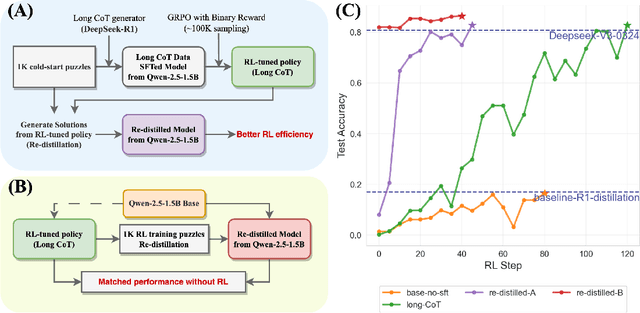
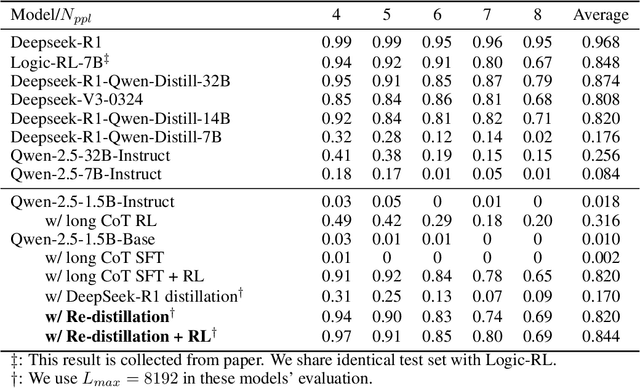
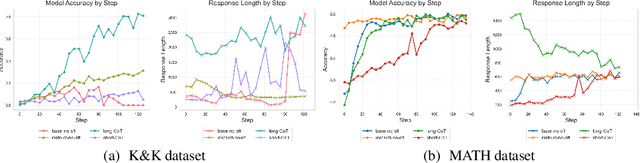
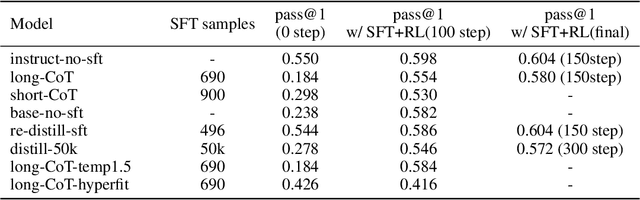
R1-style Reinforcement Learning (RL) significantly enhances Large Language Models' reasoning capabilities, yet the mechanism behind rule-based RL remains unclear. We found that small-scale SFT has significant influence on RL but shows poor efficiency. To explain our observations, we propose an analytical framework and compare the efficiency of SFT and RL by measuring sample effect. Hypothetical analysis show that SFT efficiency is limited by training data. Guided by our analysis, we propose Re-distillation, a technique that fine-tunes pretrain model through small-scale distillation from the RL-trained policy. Experiments on Knight & Knave and MATH datasets demonstrate re-distillation's surprising efficiency: re-distilled models match RL performance with far fewer samples and less computation. Empirical verification shows that sample effect is a good indicator of performance improvements. As a result, on K&K dataset, our re-distilled Qwen2.5-1.5B model surpasses DeepSeek-V3-0324 with only 1K SFT samples. On MATH, Qwen2.5-1.5B fine-tuned with re-distilled 500 samples matches its instruct-tuned variant without RL. Our work explains several interesting phenomena in R1-style RL, shedding light on the mechanisms behind its empirical success. Code is available at: https://github.com/on1262/deep-reasoning
Dynamic feature selection in medical predictive monitoring by reinforcement learning
May 30, 2024In this paper, we investigate dynamic feature selection within multivariate time-series scenario, a common occurrence in clinical prediction monitoring where each feature corresponds to a bio-test result. Many existing feature selection methods fall short in effectively leveraging time-series information, primarily because they are designed for static data. Our approach addresses this limitation by enabling the selection of time-varying feature subsets for each patient. Specifically, we employ reinforcement learning to optimize a policy under maximum cost restrictions. The prediction model is subsequently updated using synthetic data generated by trained policy. Our method can seamlessly integrate with non-differentiable prediction models. We conducted experiments on a sizable clinical dataset encompassing regression and classification tasks. The results demonstrate that our approach outperforms strong feature selection baselines, particularly when subjected to stringent cost limitations. Code will be released once paper is accepted.