 Add to Chrome
 Add to Firefox
 Add to Edge
Toward Culturally Aligned LLMs through Ontology-Guided Multi-Agent Reasoning
Jan 29, 2026
Large Language Models (LLMs) increasingly support culturally sensitive decision making, yet often exhibit misalignment due to skewed pretraining data and the absence of structured value representations. Existing methods can steer outputs, but often lack demographic grounding and treat values as independent, unstructured signals, reducing consistency and interpretability. We propose OG-MAR, an Ontology-Guided Multi-Agent Reasoning framework. OG-MAR summarizes respondent-specific values from the World Values Survey (WVS) and constructs a global cultural ontology by eliciting relations over a fixed taxonomy via competency questions. At inference time, it retrieves ontology-consistent relations and demographically similar profiles to instantiate multiple value-persona agents, whose outputs are synthesized by a judgment agent that enforces ontology consistency and demographic proximity. Experiments on regional social-survey benchmarks across four LLM backbones show that OG-MAR improves cultural alignment and robustness over competitive baselines, while producing more transparent reasoning traces.

High Pileup Particle Tracking with Object Condensation
Dec 06, 2023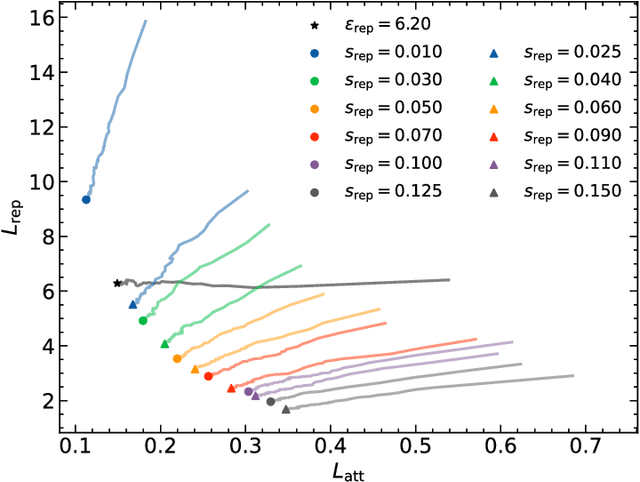
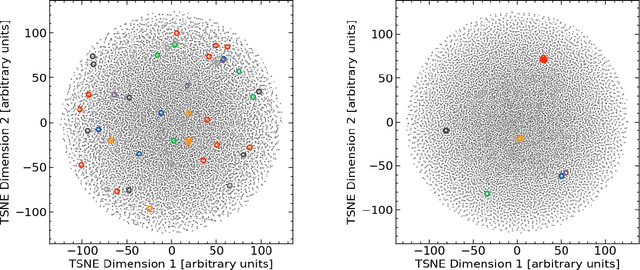
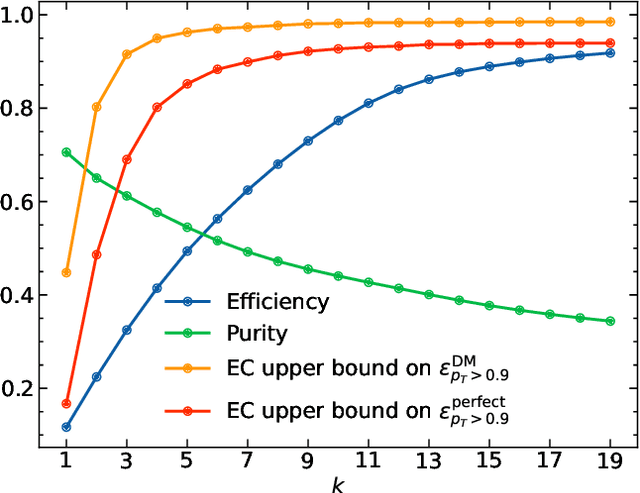
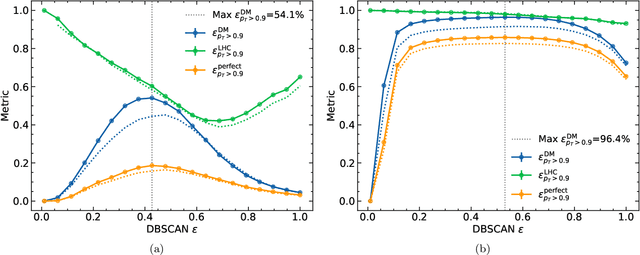
Recent work has demonstrated that graph neural networks (GNNs) can match the performance of traditional algorithms for charged particle tracking while improving scalability to meet the computing challenges posed by the HL-LHC. Most GNN tracking algorithms are based on edge classification and identify tracks as connected components from an initial graph containing spurious connections. In this talk, we consider an alternative based on object condensation (OC), a multi-objective learning framework designed to cluster points (hits) belonging to an arbitrary number of objects (tracks) and regress the properties of each object. Building on our previous results, we present a streamlined model and show progress toward a one-shot OC tracking algorithm in a high-pileup environment.