 Add to Chrome
 Add to Firefox
 Add to Edge
MiCA: A Mobility-Informed Causal Adapter for Lightweight Epidemic Forecasting
Jan 16, 2026
Accurate forecasting of infectious disease dynamics is critical for public health planning and intervention. Human mobility plays a central role in shaping the spatial spread of epidemics, but mobility data are noisy, indirect, and difficult to integrate reliably with disease records. Meanwhile, epidemic case time series are typically short and reported at coarse temporal resolution. These conditions limit the effectiveness of parameter-heavy mobility-aware forecasters that rely on clean and abundant data. In this work, we propose the Mobility-Informed Causal Adapter (MiCA), a lightweight and architecture-agnostic module for epidemic forecasting. MiCA infers mobility relations through causal discovery and integrates them into temporal forecasting models via gated residual mixing. This design allows lightweight forecasters to selectively exploit mobility-derived spatial structure while remaining robust under noisy and data-limited conditions, without introducing heavy relational components such as graph neural networks or full attention. Extensive experiments on four real-world epidemic datasets, including COVID-19 incidence, COVID-19 mortality, influenza, and dengue, show that MiCA consistently improves lightweight temporal backbones, achieving an average relative error reduction of 7.5\% across forecasting horizons. Moreover, MiCA attains performance competitive with SOTA spatio-temporal models while remaining lightweight.

SPAT: Sensitivity-based Multihead-attention Pruning on Time Series Forecasting Models
May 13, 2025Attention-based architectures have achieved superior performance in multivariate time series forecasting but are computationally expensive. Techniques such as patching and adaptive masking have been developed to reduce their sizes and latencies. In this work, we propose a structured pruning method, SPAT ($\textbf{S}$ensitivity $\textbf{P}$runer for $\textbf{At}$tention), which selectively removes redundant attention mechanisms and yields highly effective models. Different from previous approaches, SPAT aims to remove the entire attention module, which reduces the risk of overfitting and enables speed-up without demanding specialized hardware. We propose a dynamic sensitivity metric, $\textbf{S}$ensitivity $\textbf{E}$nhanced $\textbf{N}$ormalized $\textbf{D}$ispersion (SEND) that measures the importance of each attention module during the pre-training phase. Experiments on multivariate datasets demonstrate that SPAT-pruned models achieve reductions of 2.842% in MSE, 1.996% in MAE, and 35.274% in FLOPs. Furthermore, SPAT-pruned models outperform existing lightweight, Mamba-based and LLM-based SOTA methods in both standard and zero-shot inference, highlighting the importance of retaining only the most effective attention mechanisms. We have made our code publicly available https://anonymous.4open.science/r/SPAT-6042.
Approximate attention with MLP: a pruning strategy for attention-based model in multivariate time series forecasting
Oct 31, 2024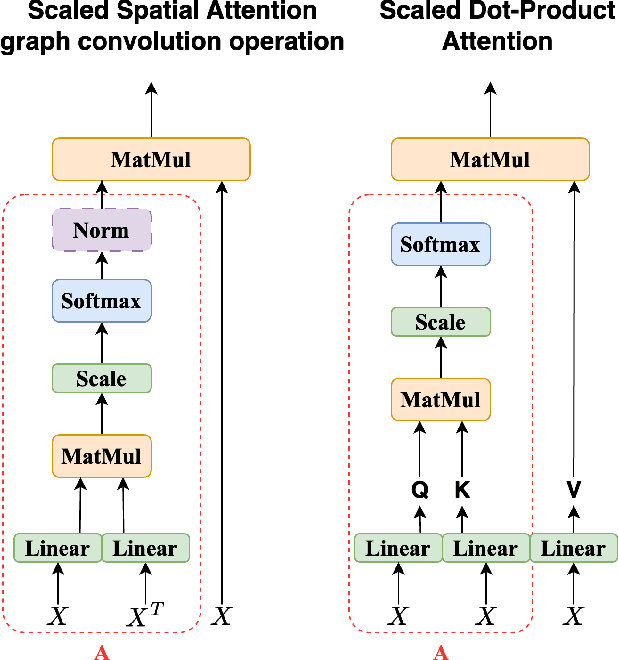
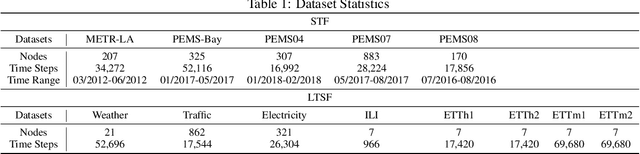
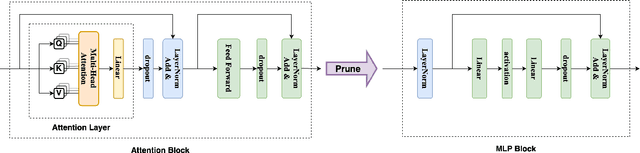
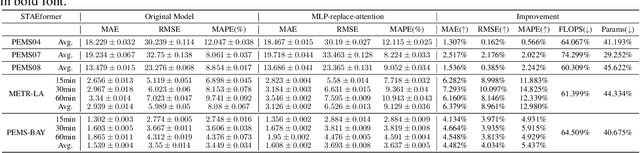
Attention-based architectures have become ubiquitous in time series forecasting tasks, including spatio-temporal (STF) and long-term time series forecasting (LTSF). Yet, our understanding of the reasons for their effectiveness remains limited. This work proposes a new way to understand self-attention networks: we have shown empirically that the entire attention mechanism in the encoder can be reduced to an MLP formed by feedforward, skip-connection, and layer normalization operations for temporal and/or spatial modeling in multivariate time series forecasting. Specifically, the Q, K, and V projection, the attention score calculation, the dot-product between the attention score and the V, and the final projection can be removed from the attention-based networks without significantly degrading the performance that the given network remains the top-tier compared to other SOTA methods. For spatio-temporal networks, the MLP-replace-attention network achieves a reduction in FLOPS of $62.579\%$ with a loss in performance less than $2.5\%$; for LTSF, a reduction in FLOPs of $42.233\%$ with a loss in performance less than $2\%$.