 Add to Chrome
 Add to Firefox
 Add to Edge
iSight: Towards expert-AI co-assessment for improved immunohistochemistry staining interpretation
Feb 03, 2026
Immunohistochemistry (IHC) provides information on protein expression in tissue sections and is commonly used to support pathology diagnosis and disease triage. While AI models for H\&E-stained slides show promise, their applicability to IHC is limited due to domain-specific variations. Here we introduce HPA10M, a dataset that contains 10,495,672 IHC images from the Human Protein Atlas with comprehensive metadata included, and encompasses 45 normal tissue types and 20 major cancer types. Based on HPA10M, we trained iSight, a multi-task learning framework for automated IHC staining assessment. iSight combines visual features from whole-slide images with tissue metadata through a token-level attention mechanism, simultaneously predicting staining intensity, location, quantity, tissue type, and malignancy status. On held-out data, iSight achieved 85.5\% accuracy for location, 76.6\% for intensity, and 75.7\% for quantity, outperforming fine-tuned foundation models (PLIP, CONCH) by 2.5--10.2\%. In addition, iSight demonstrates well-calibrated predictions with expected calibration errors of 0.0150-0.0408. Furthermore, in a user study with eight pathologists evaluating 200 images from two datasets, iSight outperformed initial pathologist assessments on the held-out HPA dataset (79\% vs 68\% for location, 70\% vs 57\% for intensity, 68\% vs 52\% for quantity). Inter-pathologist agreement also improved after AI assistance in both held-out HPA (Cohen's $κ$ increased from 0.63 to 0.70) and Stanford TMAD datasets (from 0.74 to 0.76), suggesting expert--AI co-assessment can improve IHC interpretation. This work establishes a foundation for AI systems that can improve IHC diagnostic accuracy and highlights the potential for integrating iSight into clinical workflows to enhance the consistency and reliability of IHC assessment.

μ-Bench: A Vision-Language Benchmark for Microscopy Understanding
Jul 01, 2024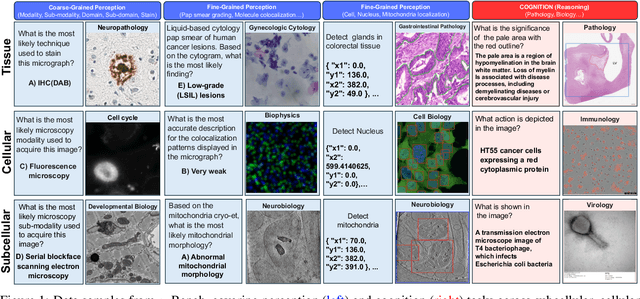
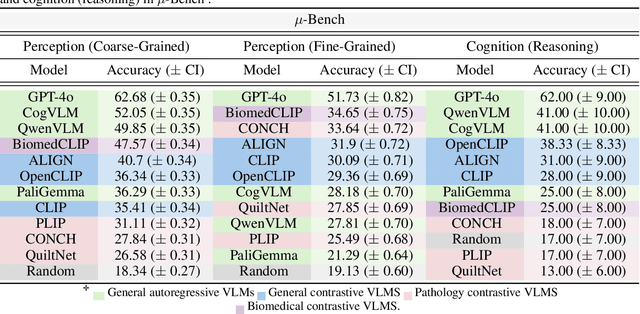
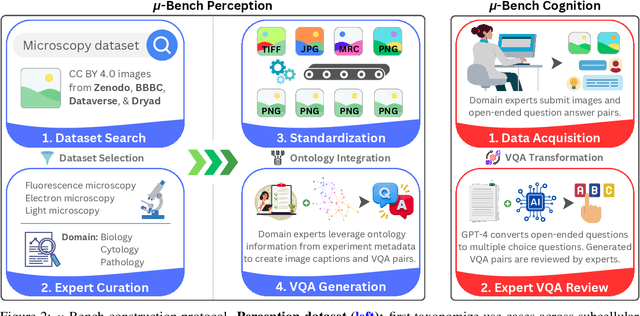
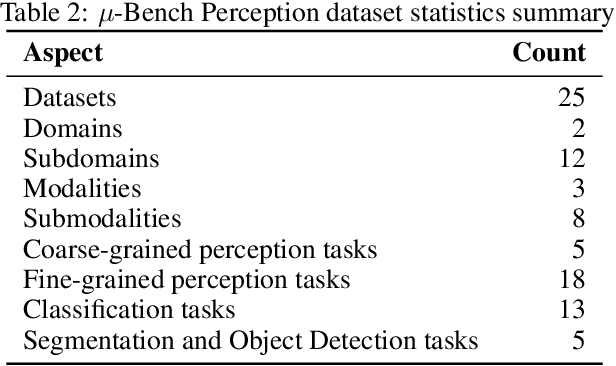
Recent advances in microscopy have enabled the rapid generation of terabytes of image data in cell biology and biomedical research. Vision-language models (VLMs) offer a promising solution for large-scale biological image analysis, enhancing researchers' efficiency, identifying new image biomarkers, and accelerating hypothesis generation and scientific discovery. However, there is a lack of standardized, diverse, and large-scale vision-language benchmarks to evaluate VLMs' perception and cognition capabilities in biological image understanding. To address this gap, we introduce {\mu}-Bench, an expert-curated benchmark encompassing 22 biomedical tasks across various scientific disciplines (biology, pathology), microscopy modalities (electron, fluorescence, light), scales (subcellular, cellular, tissue), and organisms in both normal and abnormal states. We evaluate state-of-the-art biomedical, pathology, and general VLMs on {\mu}-Bench and find that: i) current models struggle on all categories, even for basic tasks such as distinguishing microscopy modalities; ii) current specialist models fine-tuned on biomedical data often perform worse than generalist models; iii) fine-tuning in specific microscopy domains can cause catastrophic forgetting, eroding prior biomedical knowledge encoded in their base model. iv) weight interpolation between fine-tuned and pre-trained models offers one solution to forgetting and improves general performance across biomedical tasks. We release {\mu}-Bench under a permissive license to accelerate the research and development of microscopy foundation models.