 Add to Chrome
 Add to Firefox
 Add to Edge
Towards Agentic Intelligence for Materials Science
Jan 29, 2026
The convergence of artificial intelligence and materials science presents a transformative opportunity, but achieving true acceleration in discovery requires moving beyond task-isolated, fine-tuned models toward agentic systems that plan, act, and learn across the full discovery loop. This survey advances a unique pipeline-centric view that spans from corpus curation and pretraining, through domain adaptation and instruction tuning, to goal-conditioned agents interfacing with simulation and experimental platforms. Unlike prior reviews, we treat the entire process as an end-to-end system to be optimized for tangible discovery outcomes rather than proxy benchmarks. This perspective allows us to trace how upstream design choices-such as data curation and training objectives-can be aligned with downstream experimental success through effective credit assignment. To bridge communities and establish a shared frame of reference, we first present an integrated lens that aligns terminology, evaluation, and workflow stages across AI and materials science. We then analyze the field through two focused lenses: From the AI perspective, the survey details LLM strengths in pattern recognition, predictive analytics, and natural language processing for literature mining, materials characterization, and property prediction; from the materials science perspective, it highlights applications in materials design, process optimization, and the acceleration of computational workflows via integration with external tools (e.g., DFT, robotic labs). Finally, we contrast passive, reactive approaches with agentic design, cataloging current contributions while motivating systems that pursue long-horizon goals with autonomy, memory, and tool use. This survey charts a practical roadmap towards autonomous, safety-aware LLM agents aimed at discovering novel and useful materials.

Generative Inverse Design of Crystal Structures via Diffusion Models with Transformers
Jun 14, 2024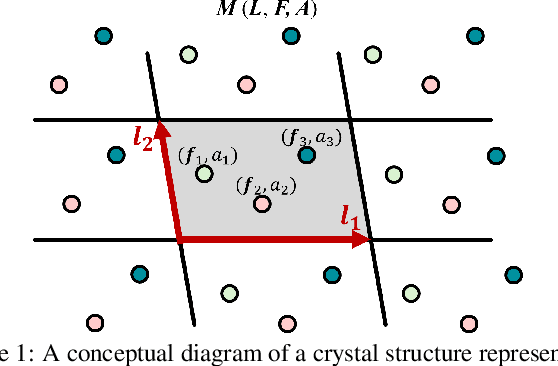
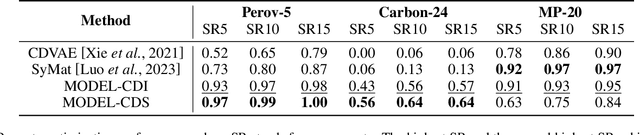
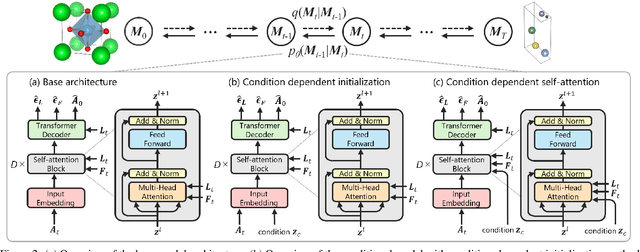
Recent advances in deep learning have enabled the generation of realistic data by training generative models on large datasets of text, images, and audio. While these models have demonstrated exceptional performance in generating novel and plausible data, it remains an open question whether they can effectively accelerate scientific discovery through the data generation and drive significant advancements across various scientific fields. In particular, the discovery of new inorganic materials with promising properties poses a critical challenge, both scientifically and for industrial applications. However, unlike textual or image data, materials, or more specifically crystal structures, consist of multiple types of variables - including lattice vectors, atom positions, and atomic species. This complexity in data give rise to a variety of approaches for representing and generating such data. Consequently, the design choices of generative models for crystal structures remain an open question. In this study, we explore a new type of diffusion model for the generative inverse design of crystal structures, with a backbone based on a Transformer architecture. We demonstrate our models are superior to previous methods in their versatility for generating crystal structures with desired properties. Furthermore, our empirical results suggest that the optimal conditioning methods vary depending on the dataset.