 Add to Chrome
 Add to Firefox
 Add to Edge
Benchmarking Concept-Spilling Across Languages in LLMs
Jan 18, 2026
Multilingual Large Language Models (LLMs) exhibit remarkable cross-lingual abilities, yet often exhibit a systematic bias toward the representations from other languages, resulting in semantic interference when generating content in non-English languages$-$a phenomenon we define as language spilling. This paper presents a novel comparative framework for evaluating multilingual semantic robustness by systematically measuring how models handle polysemous words across languages. Our methodology provides a relative measure of model performance: when required to generate exactly five meanings, both strong and weak models may resort to meanings from dominant languages, but semantically stronger models do so later in the generation sequence, producing more true meanings from the target language before failing, while weaker models resort to dominant-language meanings earlier in the sequence. We evaluate a diverse set of open and closed multilingual LLMs using a structured meaning generation task across nine languages, employing a carefully curated benchmark of 100 high-polysemy English words. Our findings reveal significant variation in semantic robustness across both models and languages, providing a principled ranking system for model comparison without requiring definitive causal attribution of error sources. We contribute both a scalable comparative benchmark for multilingual semantic evaluation and a rigorous validation pipeline$-$critical tools for developing more linguistically balanced AI systems.

Apertus: Democratizing Open and Compliant LLMs for Global Language Environments
Sep 17, 2025
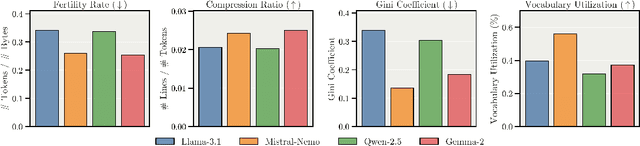

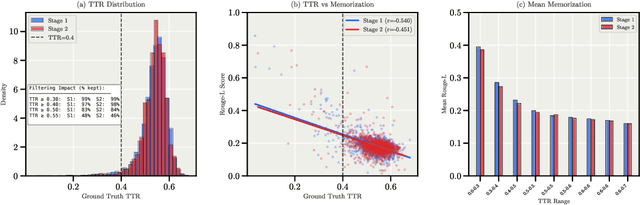
We present Apertus, a fully open suite of large language models (LLMs) designed to address two systemic shortcomings in today's open model ecosystem: data compliance and multilingual representation. Unlike many prior models that release weights without reproducible data pipelines or regard for content-owner rights, Apertus models are pretrained exclusively on openly available data, retroactively respecting robots.txt exclusions and filtering for non-permissive, toxic, and personally identifiable content. To mitigate risks of memorization, we adopt the Goldfish objective during pretraining, strongly suppressing verbatim recall of data while retaining downstream task performance. The Apertus models also expand multilingual coverage, training on 15T tokens from over 1800 languages, with ~40% of pretraining data allocated to non-English content. Released at 8B and 70B scales, Apertus approaches state-of-the-art results among fully open models on multilingual benchmarks, rivalling or surpassing open-weight counterparts. Beyond model weights, we release all scientific artifacts from our development cycle with a permissive license, including data preparation scripts, checkpoints, evaluation suites, and training code, enabling transparent audit and extension.
Occlusion Resilient 3D Human Pose Estimation
Feb 16, 2024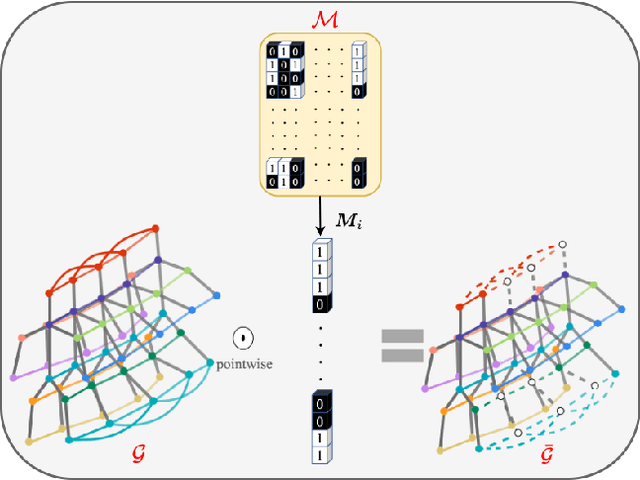
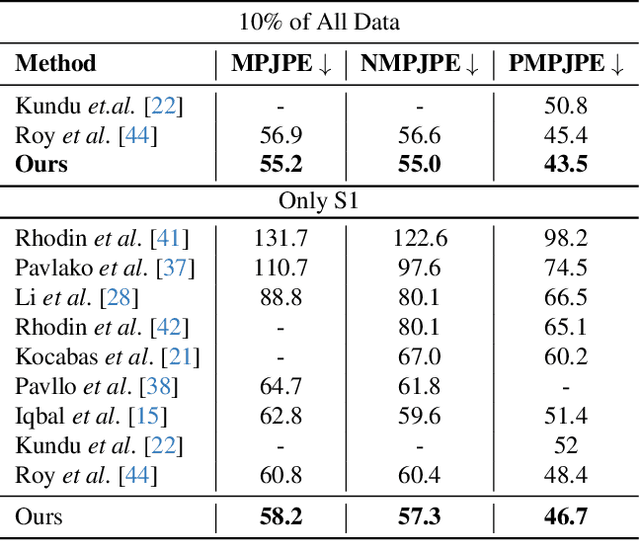
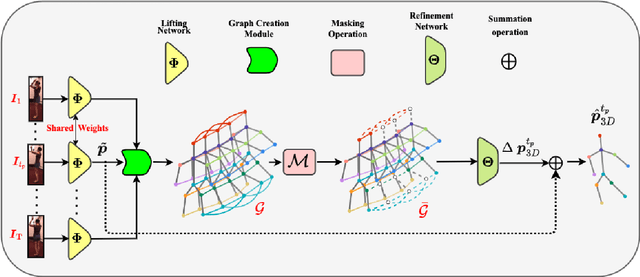
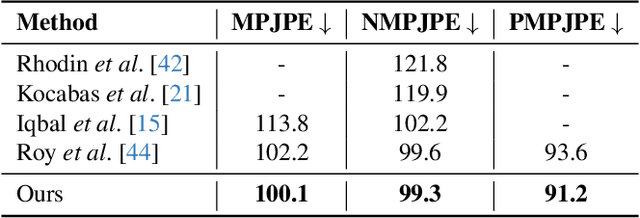
Occlusions remain one of the key challenges in 3D body pose estimation from single-camera video sequences. Temporal consistency has been extensively used to mitigate their impact but the existing algorithms in the literature do not explicitly model them. Here, we apply this by representing the deforming body as a spatio-temporal graph. We then introduce a refinement network that performs graph convolutions over this graph to output 3D poses. To ensure robustness to occlusions, we train this network with a set of binary masks that we use to disable some of the edges as in drop-out techniques. In effect, we simulate the fact that some joints can be hidden for periods of time and train the network to be immune to that. We demonstrate the effectiveness of this approach compared to state-of-the-art techniques that infer poses from single-camera sequences.