 Add to Chrome
 Add to Firefox
 Add to Edge
Multi-Agent Learning Path Planning via LLMs
Jan 24, 2026
The integration of large language models (LLMs) into intelligent tutoring systems offers transformative potential for personalized learning in higher education. However, most existing learning path planning approaches lack transparency, adaptability, and learner-centered explainability. To address these challenges, this study proposes a novel Multi-Agent Learning Path Planning (MALPP) framework that leverages a role- and rule-based collaboration mechanism among intelligent agents, each powered by LLMs. The framework includes three task-specific agents: a learner analytics agent, a path planning agent, and a reflection agent. These agents collaborate via structured prompts and predefined rules to analyze learning profiles, generate tailored learning paths, and iteratively refine them with interpretable feedback. Grounded in Cognitive Load Theory and Zone of Proximal Development, the system ensures that recommended paths are cognitively aligned and pedagogically meaningful. Experiments conducted on the MOOCCubeX dataset using seven LLMs show that MALPP significantly outperforms baseline models in path quality, knowledge sequence consistency, and cognitive load alignment. Ablation studies further validate the effectiveness of the collaborative mechanism and theoretical constraints. This research contributes to the development of trustworthy, explainable AI in education and demonstrates a scalable approach to learner-centered adaptive instruction powered by LLMs.

3D Face Reconstruction Using A Spectral-Based Graph Convolution Encoder
Mar 08, 2024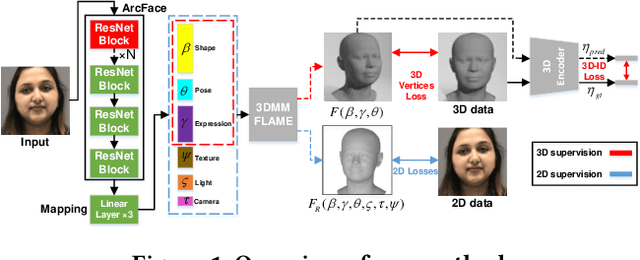
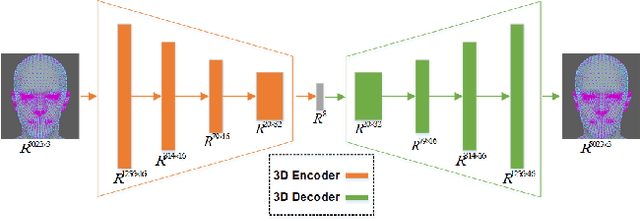
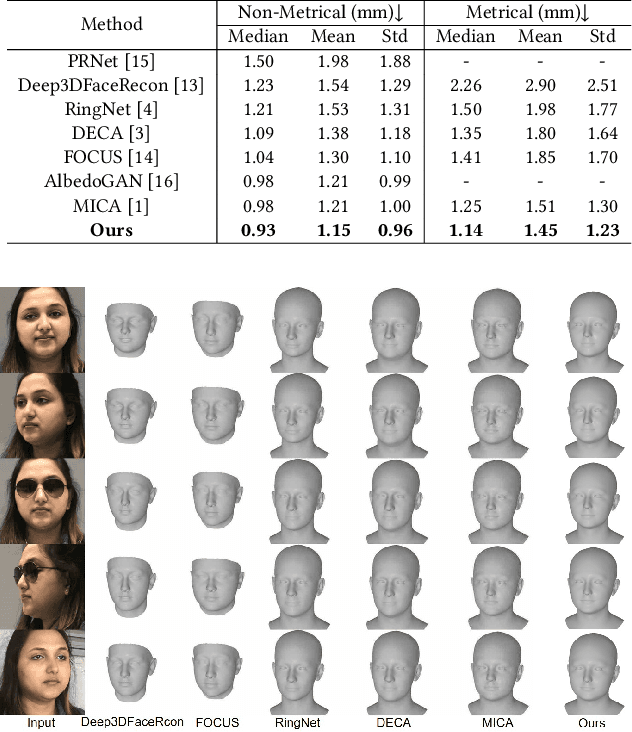
Monocular 3D face reconstruction plays a crucial role in avatar generation, with significant demand in web-related applications such as generating virtual financial advisors in FinTech. Current reconstruction methods predominantly rely on deep learning techniques and employ 2D self-supervision as a means to guide model learning. However, these methods encounter challenges in capturing the comprehensive 3D structural information of the face due to the utilization of 2D images for model training purposes. To overcome this limitation and enhance the reconstruction of 3D structural features, we propose an innovative approach that integrates existing 2D features with 3D features to guide the model learning process. Specifically, we introduce the 3D-ID Loss, which leverages the high-dimensional structure features extracted from a Spectral-Based Graph Convolution Encoder applied to the facial mesh. This approach surpasses the sole reliance on the 3D information provided by the facial mesh vertices coordinates. Our model is trained using 2D-3D data pairs from a combination of datasets and achieves state-of-the-art performance on the NoW benchmark.