 Add to Chrome
 Add to Firefox
 Add to Edge
Toward Reliable Sim-to-Real Predictability for MoE-based Robust Quadrupedal Locomotion
Jan 31, 2026
Reinforcement learning has shown strong promise for quadrupedal agile locomotion, even with proprioception-only sensing. In practice, however, sim-to-real gap and reward overfitting in complex terrains can produce policies that fail to transfer, while physical validation remains risky and inefficient. To address these challenges, we introduce a unified framework encompassing a Mixture-of-Experts (MoE) locomotion policy for robust multi-terrain representation with RoboGauge, a predictive assessment suite that quantifies sim-to-real transferability. The MoE policy employs a gated set of specialist experts to decompose latent terrain and command modeling, achieving superior deployment robustness and generalization via proprioception alone. RoboGauge further provides multi-dimensional proprioception-based metrics via sim-to-sim tests over terrains, difficulty levels, and domain randomizations, enabling reliable MoE policy selection without extensive physical trials. Experiments on a Unitree Go2 demonstrate robust locomotion on unseen challenging terrains, including snow, sand, stairs, slopes, and 30 cm obstacles. In dedicated high-speed tests, the robot reaches 4 m/s and exhibits an emergent narrow-width gait associated with improved stability at high velocity.

Bootstrapped Model Predictive Control
Mar 24, 2025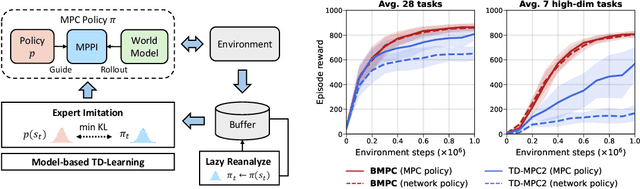
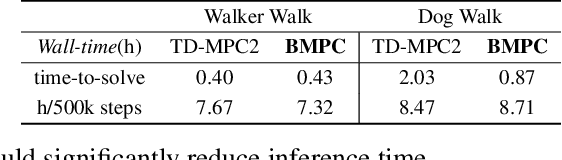
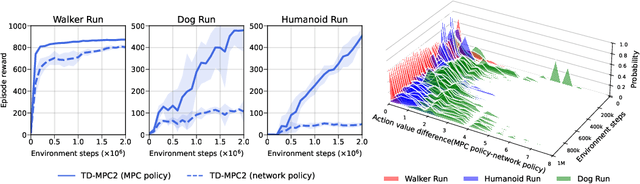
Model Predictive Control (MPC) has been demonstrated to be effective in continuous control tasks. When a world model and a value function are available, planning a sequence of actions ahead of time leads to a better policy. Existing methods typically obtain the value function and the corresponding policy in a model-free manner. However, we find that such an approach struggles with complex tasks, resulting in poor policy learning and inaccurate value estimation. To address this problem, we leverage the strengths of MPC itself. In this work, we introduce Bootstrapped Model Predictive Control (BMPC), a novel algorithm that performs policy learning in a bootstrapped manner. BMPC learns a network policy by imitating an MPC expert, and in turn, uses this policy to guide the MPC process. Combined with model-based TD-learning, our policy learning yields better value estimation and further boosts the efficiency of MPC. We also introduce a lazy reanalyze mechanism, which enables computationally efficient imitation learning. Our method achieves superior performance over prior works on diverse continuous control tasks. In particular, on challenging high-dimensional locomotion tasks, BMPC significantly improves data efficiency while also enhancing asymptotic performance and training stability, with comparable training time and smaller network sizes. Code is available at https://github.com/wertyuilife2/bmpc.