 Add to Chrome
 Add to Firefox
 Add to Edge
Modeling Cascaded Delay Feedback for Online Net Conversion Rate Prediction: Benchmark, Insights and Solutions
Jan 29, 2026
In industrial recommender systems, conversion rate (CVR) is widely used for traffic allocation, but it fails to fully reflect recommendation effectiveness because it ignores refund behavior. To better capture true user satisfaction and business value, net conversion rate (NetCVR), defined as the probability that a clicked item is purchased and not refunded, has been proposed.Unlike CVR, NetCVR prediction involves a more complex multi-stage cascaded delayed feedback process. The two cascaded delays from click to conversion and from conversion to refund have opposite effects, making traditional CVR modeling methods inapplicable. Moreover, the lack of open-source datasets and online continuous training schemes further hinders progress in this area.To address these challenges, we introduce CASCADE (Cascaded Sequences of Conversion and Delayed Refund), the first large-scale open dataset derived from the Taobao app for online continuous NetCVR prediction. Through an in-depth analysis of CASCADE, we identify three key insights: (1) NetCVR exhibits strong temporal dynamics, necessitating online continuous modeling; (2) cascaded modeling of CVR and refund rate outperforms direct NetCVR modeling; and (3) delay time, which correlates with both CVR and refund rate, is an important feature for NetCVR prediction.Based on these insights, we propose TESLA, a continuous NetCVR modeling framework featuring a CVR-refund-rate cascaded architecture, stage-wise debiasing, and a delay-time-aware ranking loss. Extensive experiments demonstrate that TESLA consistently outperforms state-of-the-art methods on CASCADE, achieving absolute improvements of 12.41 percent in RI-AUC and 14.94 percent in RI-PRAUC on NetCVR prediction. The code and dataset are publicly available at https://github.com/alimama-tech/NetCVR.

Delayed Feedback Modeling for Post-Click Gross Merchandise Volume Prediction: Benchmark, Insights and Approaches
Jan 28, 2026The prediction objectives of online advertisement ranking models are evolving from probabilistic metrics like conversion rate (CVR) to numerical business metrics like post-click gross merchandise volume (GMV). Unlike the well-studied delayed feedback problem in CVR prediction, delayed feedback modeling for GMV prediction remains unexplored and poses greater challenges, as GMV is a continuous target, and a single click can lead to multiple purchases that cumulatively form the label. To bridge the research gap, we establish TRACE, a GMV prediction benchmark containing complete transaction sequences rising from each user click, which supports delayed feedback modeling in an online streaming manner. Our analysis and exploratory experiments on TRACE reveal two key insights: (1) the rapid evolution of the GMV label distribution necessitates modeling delayed feedback under online streaming training; (2) the label distribution of repurchase samples substantially differs from that of single-purchase samples, highlighting the need for separate modeling. Motivated by these findings, we propose RepurchasE-Aware Dual-branch prEdictoR (READER), a novel GMV modeling paradigm that selectively activates expert parameters according to repurchase predictions produced by a router. Moreover, READER dynamically calibrates the regression target to mitigate under-estimation caused by incomplete labels. Experimental results show that READER yields superior performance on TRACE over baselines, achieving a 2.19% improvement in terms of accuracy. We believe that our study will open up a new avenue for studying online delayed feedback modeling for GMV prediction, and our TRACE benchmark with the gathered insights will facilitate future research and application in this promising direction. Our code and dataset are available at https://github.com/alimama-tech/OnlineGMV .
Improving Multi-modal Recommender Systems by Denoising and Aligning Multi-modal Content and User Feedback
Jun 18, 2024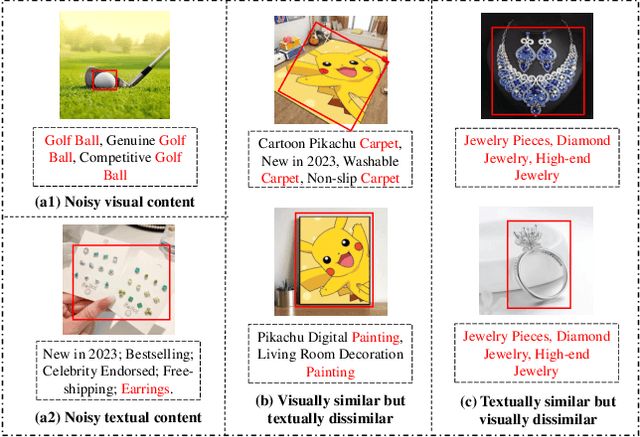
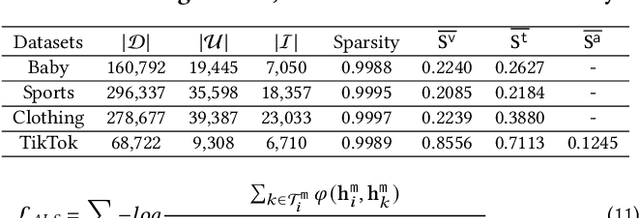
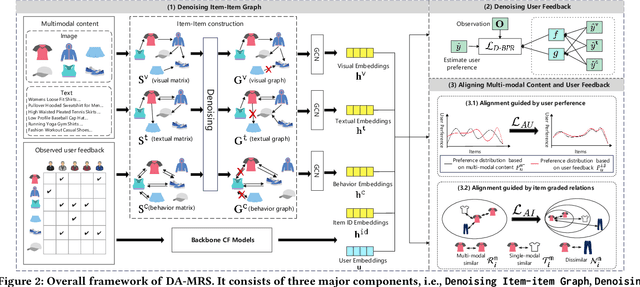
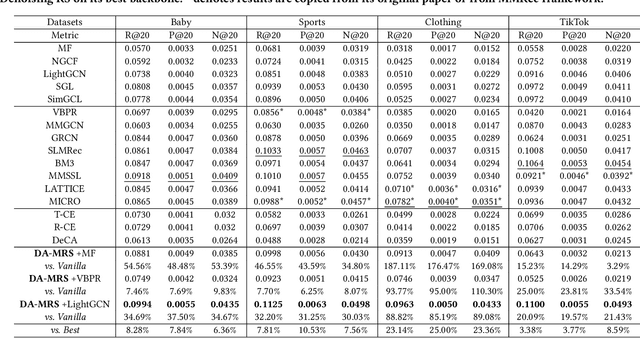
Multi-modal recommender systems (MRSs) are pivotal in diverse online web platforms and have garnered considerable attention in recent years. However, previous studies overlook the challenges of (1) noisy multi-modal content, (2) noisy user feedback, and (3) aligning multi-modal content with user feedback. In order to tackle these challenges, we propose Denoising and Aligning Multi-modal Recommender System (DA-MRS). To mitigate multi-modal noise, DA-MRS first constructs item-item graphs determined by consistent content similarity across modalities. To denoise user feedback, DA-MRS associates the probability of observed feedback with multi-modal content and devises a denoised BPR loss. Furthermore, DA-MRS implements Alignment guided by User preference to enhance task-specific item representation and Alignment guided by graded Item relations to provide finer-grained alignment. Extensive experiments verify that DA-MRS is a plug-and-play framework and achieves significant and consistent improvements across various datasets, backbone models, and noisy scenarios.