 Add to Chrome
 Add to Firefox
 Add to Edge
From Density Matrices to Phase Transitions in Deep Learning: Spectral Early Warnings and Interpretability
Apr 01, 2026
A key problem in the modern study of AI is predicting and understanding emergent capabilities in models during training. Inspired by methods for studying reactions in quantum chemistry, we present the ``2-datapoint reduced density matrix". We show that this object provides a computationally efficient, unified observable of phase transitions during training. By tracking the eigenvalue statistics of the 2RDM over a sliding window, we derive two complementary signals: the spectral heat capacity, which we prove provides early warning of second-order phase transitions via critical slowing down, and the participation ratio, which reveals the dimensionality of the underlying reorganization. Remarkably, the top eigenvectors of the 2RDM are directly interpretable making it straightforward to study the nature of the transitions. We validate across four distinct settings: deep linear networks, induction head formation, grokking, and emergent misalignment. We then discuss directions for future work using the 2RDM.

Structured World Representations in Maze-Solving Transformers
Dec 05, 2023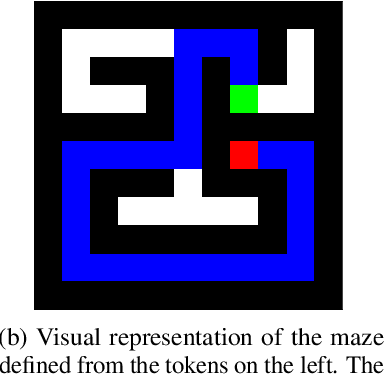
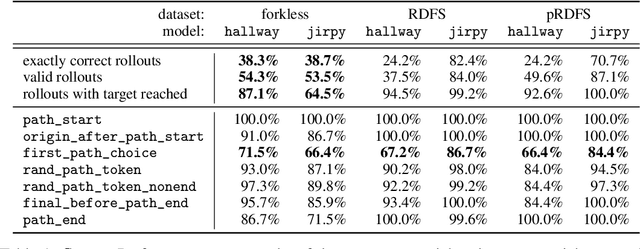
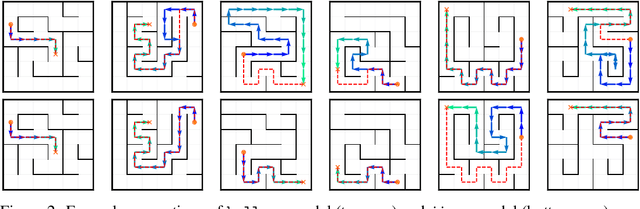

Transformer models underpin many recent advances in practical machine learning applications, yet understanding their internal behavior continues to elude researchers. Given the size and complexity of these models, forming a comprehensive picture of their inner workings remains a significant challenge. To this end, we set out to understand small transformer models in a more tractable setting: that of solving mazes. In this work, we focus on the abstractions formed by these models and find evidence for the consistent emergence of structured internal representations of maze topology and valid paths. We demonstrate this by showing that the residual stream of only a single token can be linearly decoded to faithfully reconstruct the entire maze. We also find that the learned embeddings of individual tokens have spatial structure. Furthermore, we take steps towards deciphering the circuity of path-following by identifying attention heads (dubbed $\textit{adjacency heads}$), which are implicated in finding valid subsequent tokens.
A Configurable Library for Generating and Manipulating Maze Datasets
Sep 19, 2023
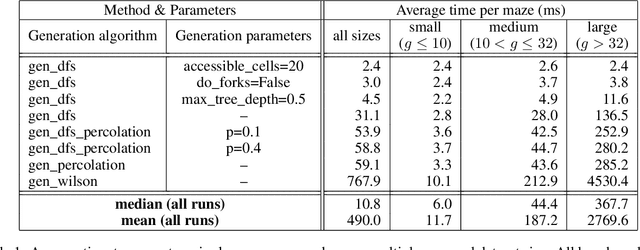
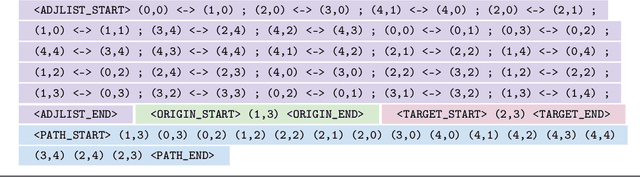

Understanding how machine learning models respond to distributional shifts is a key research challenge. Mazes serve as an excellent testbed due to varied generation algorithms offering a nuanced platform to simulate both subtle and pronounced distributional shifts. To enable systematic investigations of model behavior on out-of-distribution data, we present $\texttt{maze-dataset}$, a comprehensive library for generating, processing, and visualizing datasets consisting of maze-solving tasks. With this library, researchers can easily create datasets, having extensive control over the generation algorithm used, the parameters fed to the algorithm of choice, and the filters that generated mazes must satisfy. Furthermore, it supports multiple output formats, including rasterized and text-based, catering to convolutional neural networks and autoregressive transformer models. These formats, along with tools for visualizing and converting between them, ensure versatility and adaptability in research applications.