 Add to Chrome
 Add to Firefox
 Add to Edge
DeltaDorsal: Enhancing Hand Pose Estimation with Dorsal Features in Egocentric Views
Jan 26, 2026
The proliferation of XR devices has made egocentric hand pose estimation a vital task, yet this perspective is inherently challenged by frequent finger occlusions. To address this, we propose a novel approach that leverages the rich information in dorsal hand skin deformation, unlocked by recent advances in dense visual featurizers. We introduce a dual-stream delta encoder that learns pose by contrasting features from a dynamic hand with a baseline relaxed position. Our evaluation demonstrates that, using only cropped dorsal images, our method reduces the Mean Per Joint Angle Error (MPJAE) by 18% in self-occluded scenarios (fingers >= 50% occluded) compared to state-of-the-art techniques that depend on the whole hand's geometry and large model backbones. Consequently, our method not only enhances the reliability of downstream tasks like index finger pinch and tap estimation in occluded scenarios but also unlocks new interaction paradigms, such as detecting isometric force for a surface "click" without visible movement while minimizing model size.

Augmented Object Intelligence: Making the Analog World Interactable with XR-Objects
Apr 23, 2024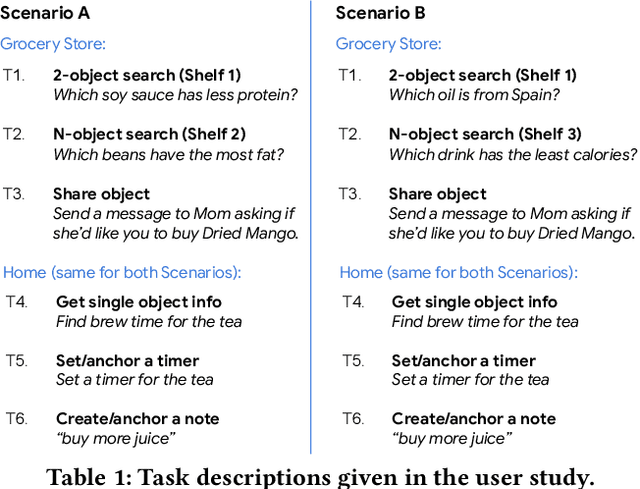

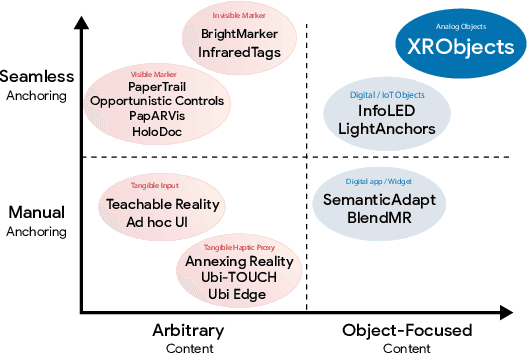
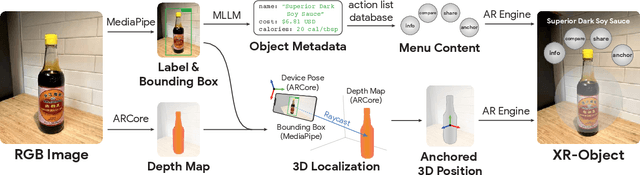
Seamless integration of physical objects as interactive digital entities remains a challenge for spatial computing. This paper introduces Augmented Object Intelligence (AOI), a novel XR interaction paradigm designed to blur the lines between digital and physical by equipping real-world objects with the ability to interact as if they were digital, where every object has the potential to serve as a portal to vast digital functionalities. Our approach utilizes object segmentation and classification, combined with the power of Multimodal Large Language Models (MLLMs), to facilitate these interactions. We implement the AOI concept in the form of XR-Objects, an open-source prototype system that provides a platform for users to engage with their physical environment in rich and contextually relevant ways. This system enables analog objects to not only convey information but also to initiate digital actions, such as querying for details or executing tasks. Our contributions are threefold: (1) we define the AOI concept and detail its advantages over traditional AI assistants, (2) detail the XR-Objects system's open-source design and implementation, and (3) show its versatility through a variety of use cases and a user study.