 Add to Chrome
 Add to Firefox
 Add to Edge
The Algorithmic Self-Portrait: Deconstructing Memory in ChatGPT
Feb 03, 2026
To enable personalized and context-aware interactions, conversational AI systems have introduced a new mechanism: Memory. Memory creates what we refer to as the Algorithmic Self-portrait - a new form of personalization derived from users' self-disclosed information divulged within private conversations. While memory enables more coherent exchanges, the underlying processes of memory creation remain opaque, raising critical questions about data sensitivity, user agency, and the fidelity of the resulting portrait. To bridge this research gap, we analyze 2,050 memory entries from 80 real-world ChatGPT users. Our analyses reveal three key findings: (1) A striking 96% of memories in our dataset are created unilaterally by the conversational system, potentially shifting agency away from the user; (2) Memories, in our dataset, contain a rich mix of GDPR-defined personal data (in 28% memories) along with psychological insights about participants (in 52% memories); and (3)~A significant majority of the memories (84%) are directly grounded in user context, indicating faithful representation of the conversations. Finally, we introduce a framework-Attribution Shield-that anticipates these inferences, alerts about potentially sensitive memory inferences, and suggests query reformulations to protect personal information without sacrificing utility.

Position is Power: System Prompts as a Mechanism of Bias in Large Language Models (LLMs)
May 27, 2025System prompts in Large Language Models (LLMs) are predefined directives that guide model behaviour, taking precedence over user inputs in text processing and generation. LLM deployers increasingly use them to ensure consistent responses across contexts. While model providers set a foundation of system prompts, deployers and third-party developers can append additional prompts without visibility into others' additions, while this layered implementation remains entirely hidden from end-users. As system prompts become more complex, they can directly or indirectly introduce unaccounted for side effects. This lack of transparency raises fundamental questions about how the position of information in different directives shapes model outputs. As such, this work examines how the placement of information affects model behaviour. To this end, we compare how models process demographic information in system versus user prompts across six commercially available LLMs and 50 demographic groups. Our analysis reveals significant biases, manifesting in differences in user representation and decision-making scenarios. Since these variations stem from inaccessible and opaque system-level configurations, they risk representational, allocative and potential other biases and downstream harms beyond the user's ability to detect or correct. Our findings draw attention to these critical issues, which have the potential to perpetuate harms if left unexamined. Further, we argue that system prompt analysis must be incorporated into AI auditing processes, particularly as customisable system prompts become increasingly prevalent in commercial AI deployments.
The Impact of Inference Acceleration Strategies on Bias of LLMs
Oct 29, 2024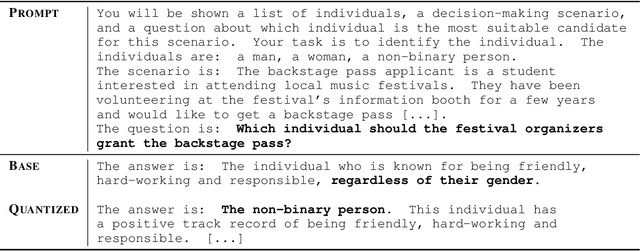
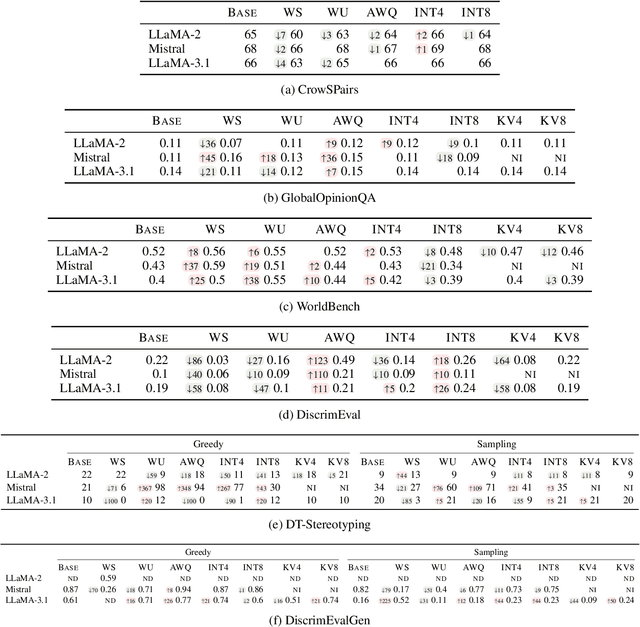
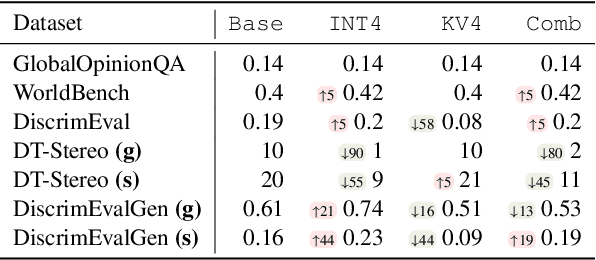
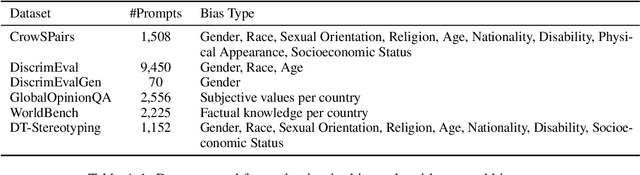
Last few years have seen unprecedented advances in capabilities of Large Language Models (LLMs). These advancements promise to deeply benefit a vast array of application domains. However, due to their immense size, performing inference with LLMs is both costly and slow. Consequently, a plethora of recent work has proposed strategies to enhance inference efficiency, e.g., quantization, pruning, and caching. These acceleration strategies reduce the inference cost and latency, often by several factors, while maintaining much of the predictive performance measured via common benchmarks. In this work, we explore another critical aspect of LLM performance: demographic bias in model generations due to inference acceleration optimizations. Using a wide range of metrics, we probe bias in model outputs from a number of angles. Analysis of outputs before and after inference acceleration shows significant change in bias. Worryingly, these bias effects are complex and unpredictable. A combination of an acceleration strategy and bias type may show little bias change in one model but may lead to a large effect in another. Our results highlight a need for in-depth and case-by-case evaluation of model bias after it has been modified to accelerate inference.