 Add to Chrome
 Add to Firefox
 Add to Edge
Equity by Design: Fairness-Driven Recommendation in Heterogeneous Two-Sided Markets
Feb 12, 2026
Two-sided marketplaces embody heterogeneity in incentives: producers seek exposure while consumers seek relevance, and balancing these competing objectives through constrained optimization is now a standard practice. Yet real platforms face finer-grained complexity: consumers differ in preferences and engagement patterns, producers vary in catalog value and capacity, and business objectives impose additional constraints beyond raw relevance. We formalize two-sided fairness under these realistic conditions, extending prior work from soft single-item allocations to discrete multi-item recommendations. We introduce Conditional Value-at-Risk (CVaR) as a consumer-side objective that compresses group-level utility disparities, and integrate business constraints directly into the optimization. Our experiments reveal that the "free fairness" regime, where producer constraints impose no consumer cost, disappears in multi item settings. Strikingly, moderate fairness constraints can improve business metrics by diversifying exposure away from saturated producers. Scalable solvers match exact solutions at a fraction of the runtime, making fairness-aware allocation practical at scale. These findings reframe fairness not as a tax on platform efficiency but as a lever for sustainable marketplace health.

No More, No Less: Least-Privilege Language Models
Jan 30, 2026Least privilege is a core security principle: grant each request only the minimum access needed to achieve its goal. Deployed language models almost never follow it, instead being exposed through a single API endpoint that serves all users and requests. This gap exists not because least privilege would be unhelpful; deployments would benefit greatly from reducing unnecessary capability exposure. The real obstacle is definitional and mechanistic: what does "access" mean inside a language model, and how can we enforce it without retraining or deploying multiple models? We take inspiration from least privilege in computer systems and define a class of models called least-privilege language models, where privilege is reachable internal computation during the forward pass. In this view, lowering privilege literally shrinks the model's accessible function class, as opposed to denying access via learned policies. We formalize deployment-time control as a monitor-allocator-enforcer stack, separating (i) request-time signals, (ii) a decision rule that allocates privilege, and (iii) an inference-time mechanism that selects privilege. We then propose Nested Least-Privilege Networks, a shape-preserving, rank-indexed intervention that provides a smooth, reversible control knob. We show that this knob yields policy-usable privilege-utility frontiers and enables selective suppression of targeted capabilities with limited collateral degradation across various policies. Most importantly, we argue for a new deployment paradigm that challenges the premise that language models can only be controlled at the output level.
Rethinking the Privacy of Text Embeddings: A Reproducibility Study of "Text Embeddings Reveal (Almost) As Much As Text"
Jul 10, 2025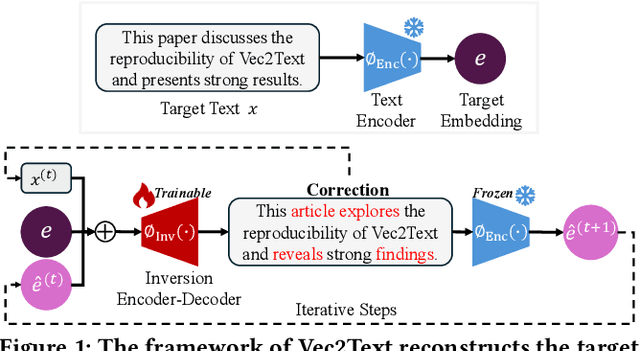
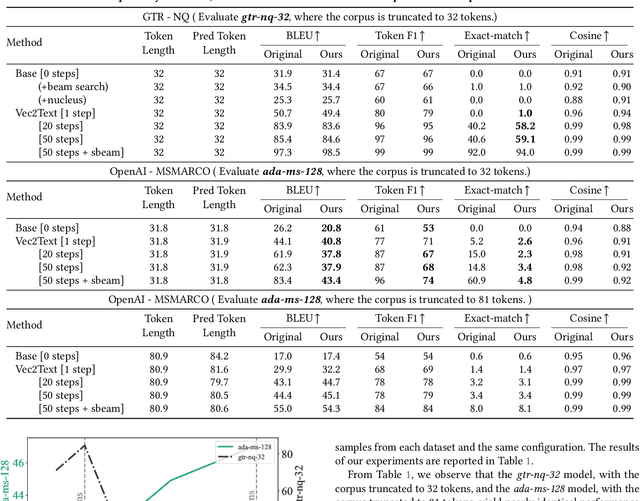
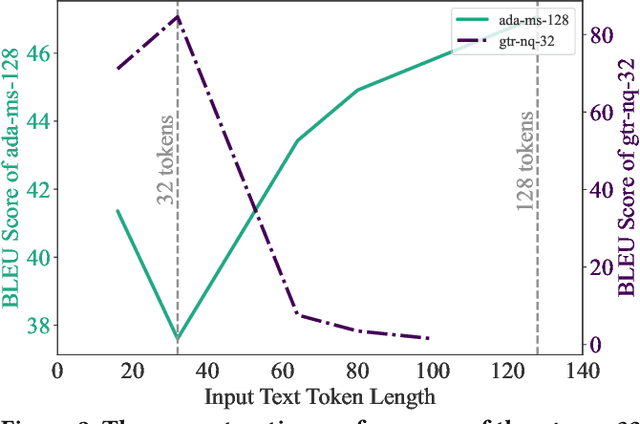
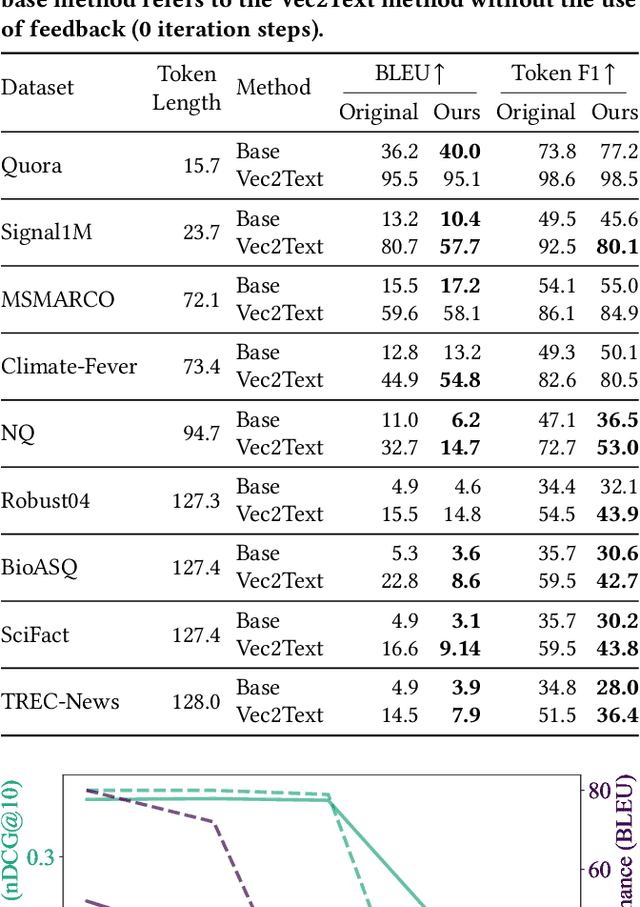
Text embeddings are fundamental to many natural language processing (NLP) tasks, extensively applied in domains such as recommendation systems and information retrieval (IR). Traditionally, transmitting embeddings instead of raw text has been seen as privacy-preserving. However, recent methods such as Vec2Text challenge this assumption by demonstrating that controlled decoding can successfully reconstruct original texts from black-box embeddings. The unexpectedly strong results reported by Vec2Text motivated us to conduct further verification, particularly considering the typically non-intuitive and opaque structure of high-dimensional embedding spaces. In this work, we reproduce the Vec2Text framework and evaluate it from two perspectives: (1) validating the original claims, and (2) extending the study through targeted experiments. First, we successfully replicate the original key results in both in-domain and out-of-domain settings, with only minor discrepancies arising due to missing artifacts, such as model checkpoints and dataset splits. Furthermore, we extend the study by conducting a parameter sensitivity analysis, evaluating the feasibility of reconstructing sensitive inputs (e.g., passwords), and exploring embedding quantization as a lightweight privacy defense. Our results show that Vec2Text is effective under ideal conditions, capable of reconstructing even password-like sequences that lack clear semantics. However, we identify key limitations, including its sensitivity to input sequence length. We also find that Gaussian noise and quantization techniques can mitigate the privacy risks posed by Vec2Text, with quantization offering a simpler and more widely applicable solution. Our findings emphasize the need for caution in using text embeddings and highlight the importance of further research into robust defense mechanisms for NLP systems.
Multi-Modal Adapter for Vision-Language Models
Sep 03, 2024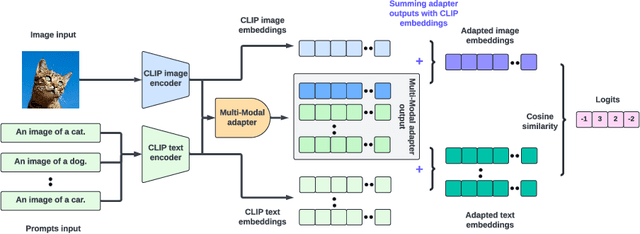
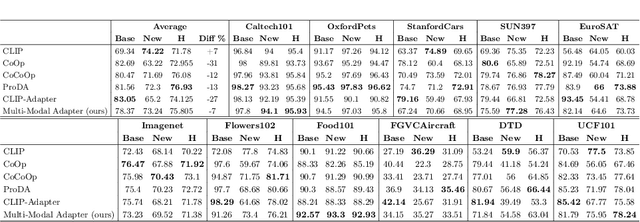
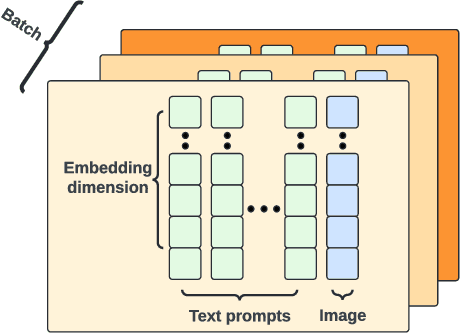

Large pre-trained vision-language models, such as CLIP, have demonstrated state-of-the-art performance across a wide range of image classification tasks, without requiring retraining. Few-shot CLIP is competitive with existing specialized architectures that were trained on the downstream tasks. Recent research demonstrates that the performance of CLIP can be further improved using lightweight adaptation approaches. However, previous methods adapt different modalities of the CLIP model individually, ignoring the interactions and relationships between visual and textual representations. In this work, we propose Multi-Modal Adapter, an approach for Multi-Modal adaptation of CLIP. Specifically, we add a trainable Multi-Head Attention layer that combines text and image features to produce an additive adaptation of both. Multi-Modal Adapter demonstrates improved generalizability, based on its performance on unseen classes compared to existing adaptation methods. We perform additional ablations and investigations to validate and interpret the proposed approach.