 Add to Chrome
 Add to Firefox
 Add to Edge
Purification Before Fusion: Toward Mask-Free Speech Enhancement for Robust Audio-Visual Speech Recognition
Jan 18, 2026
Audio-visual speech recognition (AVSR) typically improves recognition accuracy in noisy environments by integrating noise-immune visual cues with audio signals. Nevertheless, high-noise audio inputs are prone to introducing adverse interference into the feature fusion process. To mitigate this, recent AVSR methods often adopt mask-based strategies to filter audio noise during feature interaction and fusion, yet such methods risk discarding semantically relevant information alongside noise. In this work, we propose an end-to-end noise-robust AVSR framework coupled with speech enhancement, eliminating the need for explicit noise mask generation. This framework leverages a Conformer-based bottleneck fusion module to implicitly refine noisy audio features with video assistance. By reducing modality redundancy and enhancing inter-modal interactions, our method preserves speech semantic integrity to achieve robust recognition performance. Experimental evaluations on the public LRS3 benchmark suggest that our method outperforms prior advanced mask-based baselines under noisy conditions.

Landmark-Guided Cross-Speaker Lip Reading with Mutual Information Regularization
Mar 24, 2024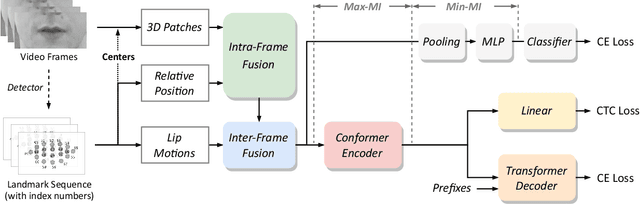
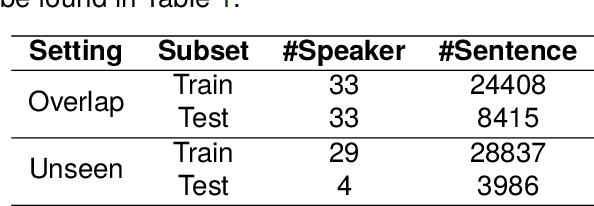
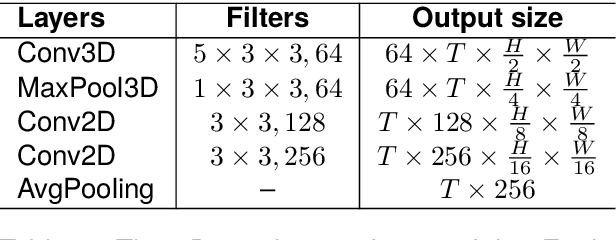
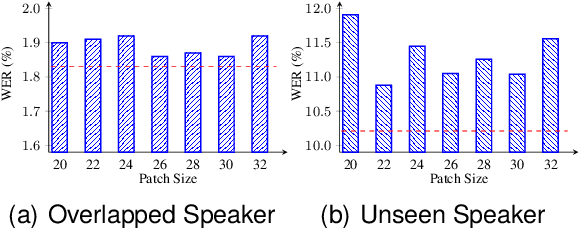
Lip reading, the process of interpreting silent speech from visual lip movements, has gained rising attention for its wide range of realistic applications. Deep learning approaches greatly improve current lip reading systems. However, lip reading in cross-speaker scenarios where the speaker identity changes, poses a challenging problem due to inter-speaker variability. A well-trained lip reading system may perform poorly when handling a brand new speaker. To learn a speaker-robust lip reading model, a key insight is to reduce visual variations across speakers, avoiding the model overfitting to specific speakers. In this work, in view of both input visual clues and latent representations based on a hybrid CTC/attention architecture, we propose to exploit the lip landmark-guided fine-grained visual clues instead of frequently-used mouth-cropped images as input features, diminishing speaker-specific appearance characteristics. Furthermore, a max-min mutual information regularization approach is proposed to capture speaker-insensitive latent representations. Experimental evaluations on public lip reading datasets demonstrate the effectiveness of the proposed approach under the intra-speaker and inter-speaker conditions.
* To appear in LREC-COLING 2024