 Add to Chrome
 Add to Firefox
 Add to Edge
SparVAR: Exploring Sparsity in Visual AutoRegressive Modeling for Training-Free Acceleration
Feb 04, 2026
Visual AutoRegressive (VAR) modeling has garnered significant attention for its innovative next-scale prediction paradigm. However, mainstream VAR paradigms attend to all tokens across historical scales at each autoregressive step. As the next scale resolution grows, the computational complexity of attention increases quartically with resolution, causing substantial latency. Prior accelerations often skip high-resolution scales, which speeds up inference but discards high-frequency details and harms image quality. To address these problems, we present SparVAR, a training-free acceleration framework that exploits three properties of VAR attention: (i) strong attention sinks, (ii) cross-scale activation similarity, and (iii) pronounced locality. Specifically, we dynamically predict the sparse attention pattern of later high-resolution scales from a sparse decision scale, and construct scale self-similar sparse attention via an efficient index-mapping mechanism, enabling high-efficiency sparse attention computation at large scales. Furthermore, we propose cross-scale local sparse attention and implement an efficient block-wise sparse kernel, which achieves $\mathbf{> 5\times}$ faster forward speed than FlashAttention. Extensive experiments demonstrate that the proposed SparseVAR can reduce the generation time of an 8B model producing $1024\times1024$ high-resolution images to the 1s, without skipping the last scales. Compared with the VAR baseline accelerated by FlashAttention, our method achieves a $\mathbf{1.57\times}$ speed-up while preserving almost all high-frequency details. When combined with existing scale-skipping strategies, SparseVAR attains up to a $\mathbf{2.28\times}$ acceleration, while maintaining competitive visual generation quality. Code is available at https://github.com/CAS-CLab/SparVAR.

FireFlow: Fast Inversion of Rectified Flow for Image Semantic Editing
Dec 10, 2024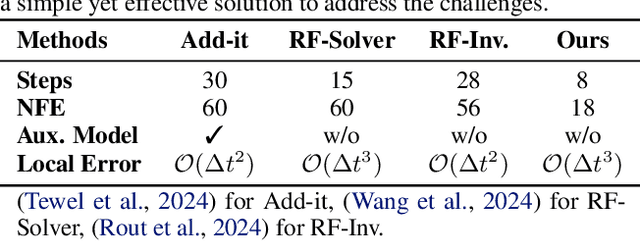
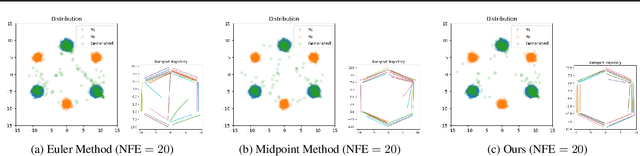
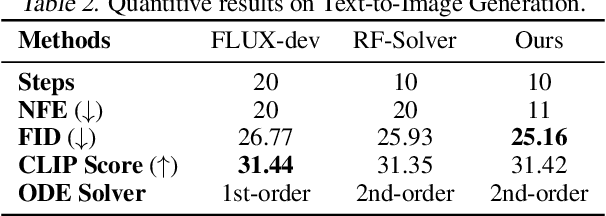
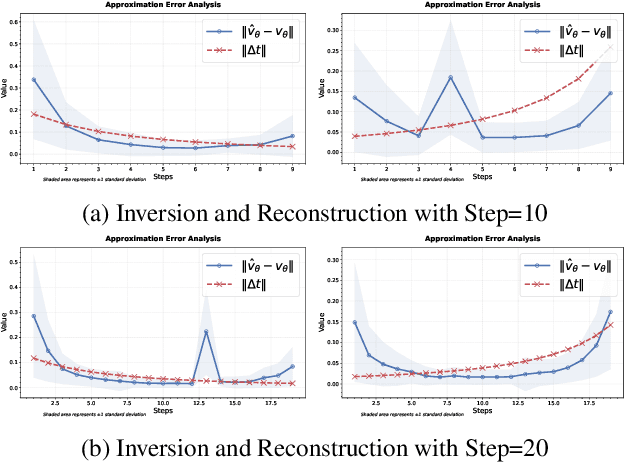
Though Rectified Flows (ReFlows) with distillation offers a promising way for fast sampling, its fast inversion transforms images back to structured noise for recovery and following editing remains unsolved. This paper introduces FireFlow, a simple yet effective zero-shot approach that inherits the startling capacity of ReFlow-based models (such as FLUX) in generation while extending its capabilities to accurate inversion and editing in $8$ steps. We first demonstrate that a carefully designed numerical solver is pivotal for ReFlow inversion, enabling accurate inversion and reconstruction with the precision of a second-order solver while maintaining the practical efficiency of a first-order Euler method. This solver achieves a $3\times$ runtime speedup compared to state-of-the-art ReFlow inversion and editing techniques, while delivering smaller reconstruction errors and superior editing results in a training-free mode. The code is available at $\href{https://github.com/HolmesShuan/FireFlow}{this URL}$.