 Add to Chrome
 Add to Firefox
 Add to Edge
SparVAR: Exploring Sparsity in Visual AutoRegressive Modeling for Training-Free Acceleration
Feb 04, 2026
Visual AutoRegressive (VAR) modeling has garnered significant attention for its innovative next-scale prediction paradigm. However, mainstream VAR paradigms attend to all tokens across historical scales at each autoregressive step. As the next scale resolution grows, the computational complexity of attention increases quartically with resolution, causing substantial latency. Prior accelerations often skip high-resolution scales, which speeds up inference but discards high-frequency details and harms image quality. To address these problems, we present SparVAR, a training-free acceleration framework that exploits three properties of VAR attention: (i) strong attention sinks, (ii) cross-scale activation similarity, and (iii) pronounced locality. Specifically, we dynamically predict the sparse attention pattern of later high-resolution scales from a sparse decision scale, and construct scale self-similar sparse attention via an efficient index-mapping mechanism, enabling high-efficiency sparse attention computation at large scales. Furthermore, we propose cross-scale local sparse attention and implement an efficient block-wise sparse kernel, which achieves $\mathbf{> 5\times}$ faster forward speed than FlashAttention. Extensive experiments demonstrate that the proposed SparseVAR can reduce the generation time of an 8B model producing $1024\times1024$ high-resolution images to the 1s, without skipping the last scales. Compared with the VAR baseline accelerated by FlashAttention, our method achieves a $\mathbf{1.57\times}$ speed-up while preserving almost all high-frequency details. When combined with existing scale-skipping strategies, SparseVAR attains up to a $\mathbf{2.28\times}$ acceleration, while maintaining competitive visual generation quality. Code is available at https://github.com/CAS-CLab/SparVAR.

Correlation-Aware Select and Merge Attention for Efficient Fine-Tuning and Context Length Extension
Oct 05, 2024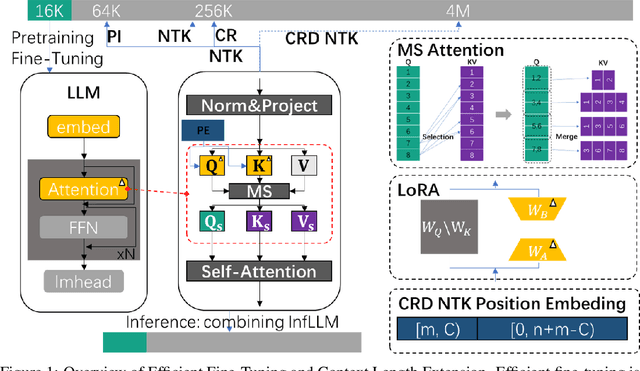
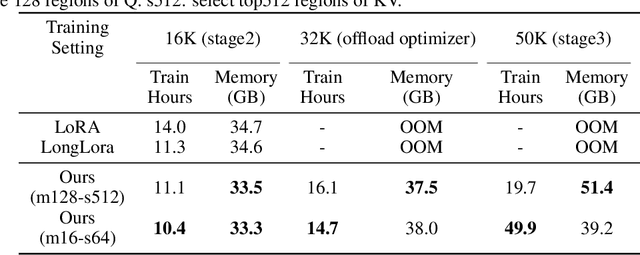
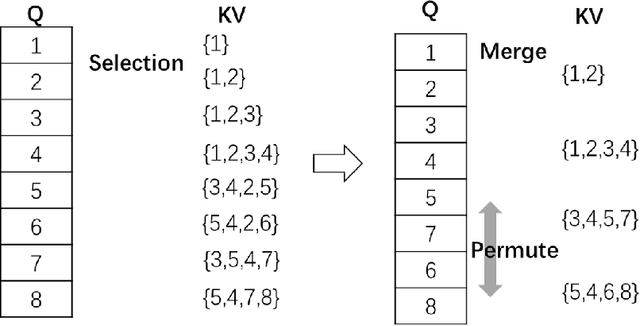

Modeling long sequences is crucial for various large-scale models; however, extending existing architectures to handle longer sequences presents significant technical and resource challenges. In this paper, we propose an efficient and flexible attention architecture that enables the extension of context lengths in large language models with reduced computational resources and fine-tuning time compared to other excellent methods. Specifically, we introduce correlation-aware selection and merging mechanisms to facilitate efficient sparse attention. In addition, we also propose a novel data augmentation technique involving positional encodings to enhance generalization to unseen positions. The results are as follows: First, using a single A100, we achieve fine-tuning on Llama2-7B with a sequence length of 32K, which is more efficient than other methods that rely on subsets for regression. Second, we present a comprehensive method for extending context lengths across the pre-training, fine-tuning, and inference phases. During pre-training, our attention mechanism partially breaks translation invariance during token selection, so we apply positional encodings only to the selected tokens. This approach achieves relatively high performance and significant extrapolation capabilities. For fine-tuning, we introduce Cyclic, Randomly Truncated, and Dynamically Growing NTK Positional Embedding (CRD NTK). This design allows fine-tuning with a sequence length of only 16K, enabling models such as Llama2-7B and Mistral-7B to perform inference with context lengths of up to 1M or even arbitrary lengths. Our method achieves 100\% accuracy on the passkey task with a context length of 4M and maintains stable perplexity at a 1M context length. This represents at least a 64-fold reduction in resource requirements compared to traditional full-attention mechanisms, while still achieving competitive performance.