 Add to Chrome
 Add to Firefox
 Add to Edge
BladeSDF : Unconditional and Conditional Generative Modeling of Representative Blade Geometries Using Signed Distance Functions
Jan 19, 2026
Generative AI has emerged as a transformative paradigm in engineering design, enabling automated synthesis and reconstruction of complex 3D geometries while preserving feasibility and performance relevance. This paper introduces a domain-specific implicit generative framework for turbine blade geometry using DeepSDF, addressing critical gaps in performance-aware modeling and manufacturable design generation. The proposed method leverages a continuous signed distance function (SDF) representation to reconstruct and generate smooth, watertight geometries with quantified accuracy. It establishes an interpretable, near-Gaussian latent space that aligns with blade-relevant parameters, such as taper and chord ratios, enabling controlled exploration and unconditional synthesis through interpolation and Gaussian sampling. In addition, a compact neural network maps engineering descriptors, such as maximum directional strains, to latent codes, facilitating the generation of performance-informed geometry. The framework achieves high reconstruction fidelity, with surface distance errors concentrated within $1\%$ of the maximum blade dimension, and demonstrates robust generalization to unseen designs. By integrating constraints, objectives, and performance metrics, this approach advances beyond traditional 2D-guided or unconstrained 3D pipelines, offering a practical and interpretable solution for data-driven turbine blade modeling and concept generation.

E-PINNs: Epistemic Physics-Informed Neural Networks
Mar 25, 2025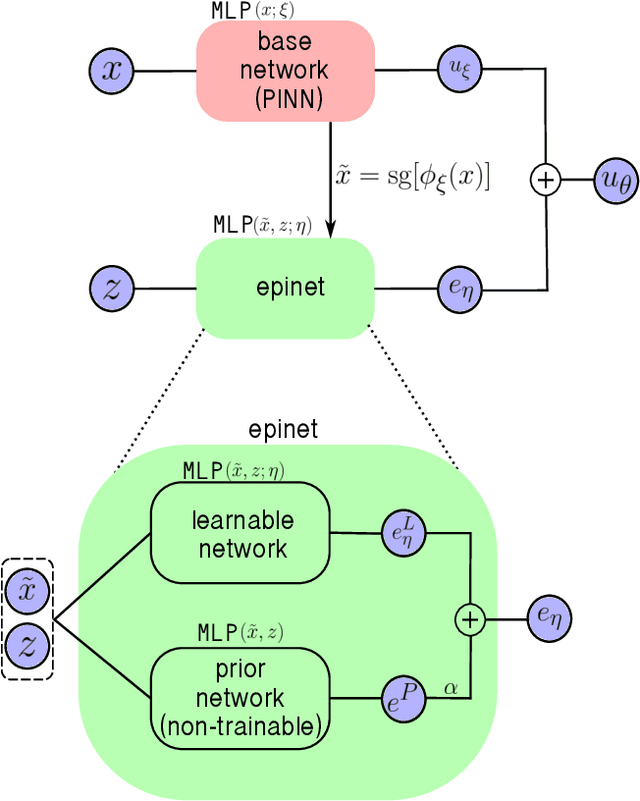

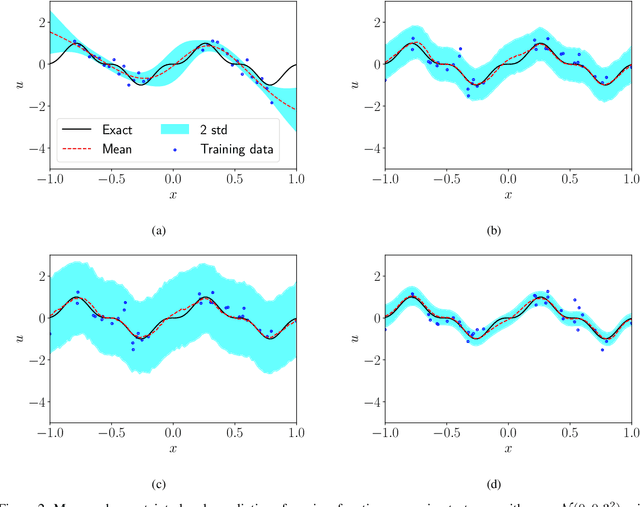

Physics-informed neural networks (PINNs) have demonstrated promise as a framework for solving forward and inverse problems involving partial differential equations. Despite recent progress in the field, it remains challenging to quantify uncertainty in these networks. While approaches such as Bayesian PINNs (B-PINNs) provide a principled approach to capturing uncertainty through Bayesian inference, they can be computationally expensive for large-scale applications. In this work, we propose Epistemic Physics-Informed Neural Networks (E-PINNs), a framework that leverages a small network, the \emph{epinet}, to efficiently quantify uncertainty in PINNs. The proposed approach works as an add-on to existing, pre-trained PINNs with a small computational overhead. We demonstrate the applicability of the proposed framework in various test cases and compare the results with B-PINNs using Hamiltonian Monte Carlo (HMC) posterior estimation and dropout-equipped PINNs (Dropout-PINNs). Our experiments show that E-PINNs provide similar coverage to B-PINNs, with often comparable sharpness, while being computationally more efficient. This observation, combined with E-PINNs' more consistent uncertainty estimates and better calibration compared to Dropout-PINNs for the examples presented, indicates that E-PINNs offer a promising approach in terms of accuracy-efficiency trade-off.