 Add to Chrome
 Add to Firefox
 Add to Edge
SOMBRERO: Measuring and Steering Boundary Placement in End-to-End Hierarchical Sequence Models
Jan 30, 2026
Hierarchical sequence models replace fixed tokenization with learned segmentations that compress long byte sequences for efficient autoregressive modeling. While recent end-to-end methods can learn meaningful boundaries from the language-modeling objective alone, it remains difficult to quantitatively assess and systematically steer where compute is spent. We introduce a router-agnostic metric of boundary quality, boundary enrichment B, which measures how strongly chunk starts concentrate on positions with high next-byte surprisal. Guided by this metric, we propose Sombrero, which steers boundary placement toward predictive difficulty via a confidence-alignment boundary loss and stabilizes boundary learning by applying confidence-weighted smoothing at the input level rather than on realized chunks. On 1B scale, across UTF-8 corpora covering English and German text as well as code and mathematical content, Sombrero improves the accuracy-efficiency trade-off and yields boundaries that more consistently align compute with hard-to-predict positions.

The Emotions of the Crowd: Learning Image Sentiment from Tweets via Cross-modal Distillation
Apr 28, 2023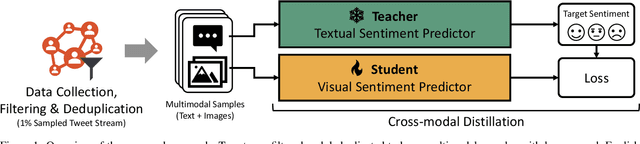
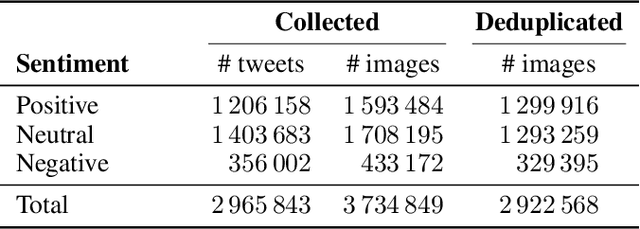
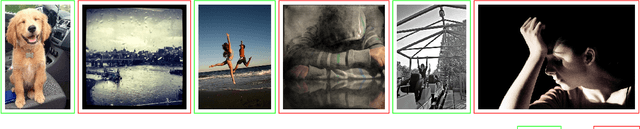

Trends and opinion mining in social media increasingly focus on novel interactions involving visual media, like images and short videos, in addition to text. In this work, we tackle the problem of visual sentiment analysis of social media images -- specifically, the prediction of image sentiment polarity. While previous work relied on manually labeled training sets, we propose an automated approach for building sentiment polarity classifiers based on a cross-modal distillation paradigm; starting from scraped multimodal (text + images) data, we train a student model on the visual modality based on the outputs of a textual teacher model that analyses the sentiment of the corresponding textual modality. We applied our method to randomly collected images crawled from Twitter over three months and produced, after automatic cleaning, a weakly-labeled dataset of $\sim$1.5 million images. Despite exploiting noisy labeled samples, our training pipeline produces classifiers showing strong generalization capabilities and outperforming the current state of the art on five manually labeled benchmarks for image sentiment polarity prediction.