 Add to Chrome
 Add to Firefox
 Add to Edge
A Dataset and Benchmark for Consumer Healthcare Question Summarization
Dec 29, 2025
The quest for seeking health information has swamped the web with consumers health-related questions. Generally, consumers use overly descriptive and peripheral information to express their medical condition or other healthcare needs, contributing to the challenges of natural language understanding. One way to address this challenge is to summarize the questions and distill the key information of the original question. Recently, large-scale datasets have significantly propelled the development of several summarization tasks, such as multi-document summarization and dialogue summarization. However, a lack of a domain-expert annotated dataset for the consumer healthcare questions summarization task inhibits the development of an efficient summarization system. To address this issue, we introduce a new dataset, CHQ-Sum,m that contains 1507 domain-expert annotated consumer health questions and corresponding summaries. The dataset is derived from the community question answering forum and therefore provides a valuable resource for understanding consumer health-related posts on social media. We benchmark the dataset on multiple state-of-the-art summarization models to show the effectiveness of the dataset

Calibration-Aware Prompt Learning for Medical Vision-Language Models
Sep 18, 2025Medical Vision-Language Models (Med-VLMs) have demonstrated remarkable performance across diverse medical imaging tasks by leveraging large-scale image-text pretraining. However, their confidence calibration is largely unexplored, and so remains a significant challenge. As such, miscalibrated predictions can lead to overconfident errors, undermining clinical trust and decision-making reliability. To address this, we introduce CalibPrompt, the first framework to calibrate Med-VLMs during prompt tuning. CalibPrompt optimizes a small set of learnable prompts with carefully designed calibration objectives under scarce labeled data regime. First, we study a regularizer that attempts to align the smoothed accuracy with the predicted model confidences. Second, we introduce an angular separation loss to maximize textual feature proximity toward improving the reliability in confidence estimates of multimodal Med-VLMs. Extensive experiments on four publicly available Med-VLMs and five diverse medical imaging datasets reveal that CalibPrompt consistently improves calibration without drastically affecting clean accuracy. Our code is available at https://github.com/iabh1shekbasu/CalibPrompt.
XDT-CXR: Investigating Cross-Disease Transferability in Zero-Shot Binary Classification of Chest X-Rays
Aug 21, 2024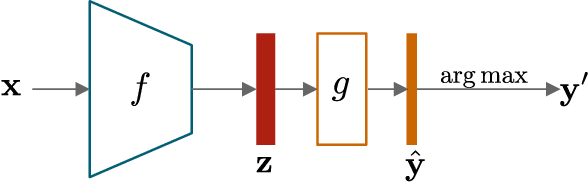

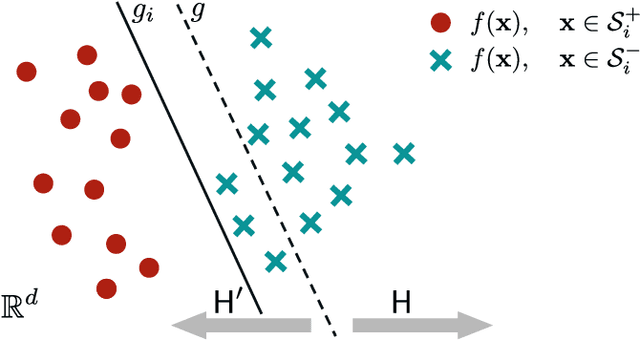
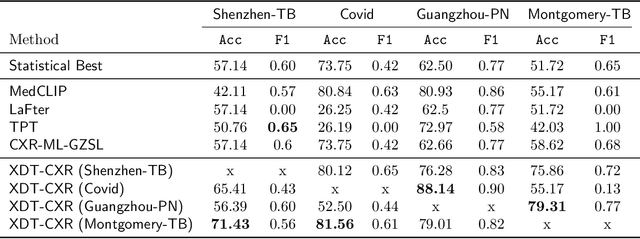
This study explores the concept of cross-disease transferability (XDT) in medical imaging, focusing on the potential of binary classifiers trained on one disease to perform zero-shot classification on another disease affecting the same organ. Utilizing chest X-rays (CXR) as the primary modality, we investigate whether a model trained on one pulmonary disease can make predictions about another novel pulmonary disease, a scenario with significant implications for medical settings with limited data on emerging diseases. The XDT framework leverages the embedding space of a vision encoder, which, through kernel transformation, aids in distinguishing between diseased and non-diseased classes in the latent space. This capability is especially beneficial in resource-limited environments or in regions with low prevalence of certain diseases, where conventional diagnostic practices may fail. However, the XDT framework is currently limited to binary classification, determining only the presence or absence of a disease rather than differentiating among multiple diseases. This limitation underscores the supplementary role of XDT to traditional diagnostic tests in clinical settings. Furthermore, results show that XDT-CXR as a framework is able to make better predictions compared to other zero-shot learning (ZSL) baselines.