 Add to Chrome
 Add to Firefox
 Add to Edge
Multi-Agent Coordinated Rename Refactoring
Jan 01, 2026
The primary value of AI agents in software development lies in their ability to extend the developer's capacity for reasoning and action, not to supplant human involvement. To showcase how to use agents working in tandem with developers, we designed a novel approach for carrying out coordinated renaming. Coordinated renaming, where a single rename refactoring triggers refactorings in multiple, related identifiers, is a frequent yet challenging task. Developers must manually propagate these rename refactorings across numerous files and contexts, a process that is both tedious and highly error-prone. State-of-the-art heuristic-based approaches produce an overwhelming number of false positives, while vanilla Large Language Models (LLMs) provide incomplete suggestions due to their limited context and inability to interact with refactoring tools. This leaves developers with incomplete refactorings or burdens them with filtering too many false positives. Coordinated renaming is exactly the kind of repetitive task that agents can significantly reduce the developers' burden while keeping them in the driver's seat. We designed, implemented, and evaluated the first multi-agent framework that automates coordinated renaming. It operates on a key insight: a developer's initial refactoring is a clue to infer the scope of related refactorings. Our Scope Inference Agent first transforms this clue into an explicit, natural-language Declared Scope. The Planned Execution Agent then uses this as a strict plan to identify program elements that should undergo refactoring and safely executes the changes by invoking the IDE's own trusted refactoring APIs. Finally, the Replication Agent uses it to guide the project-wide search. We first conducted a formative study on the practice of coordinated renaming in 609K commits in 100 open-source projects and surveyed 205 developers ...

EM-Assist: Safe Automated ExtractMethod Refactoring with LLMs
May 31, 2024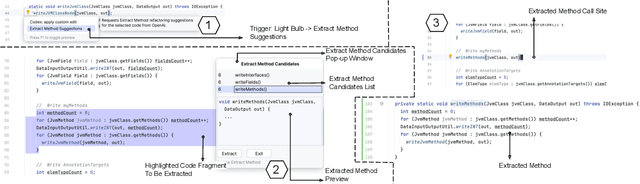
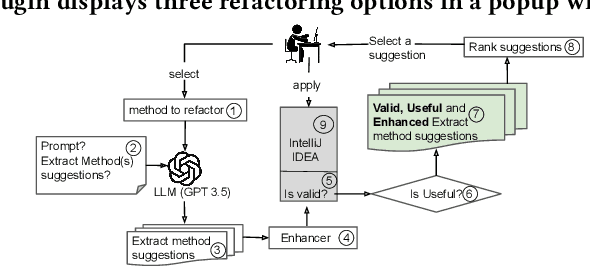
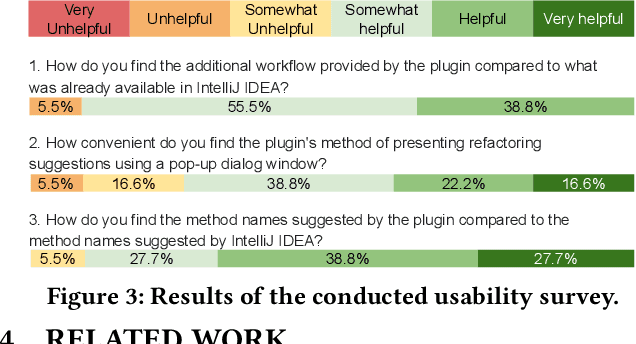
Excessively long methods, loaded with multiple responsibilities, are challenging to understand, debug, reuse, and maintain. The solution lies in the widely recognized Extract Method refactoring. While the application of this refactoring is supported in modern IDEs, recommending which code fragments to extract has been the topic of many research tools. However, they often struggle to replicate real-world developer practices, resulting in recommendations that do not align with what a human developer would do in real life. To address this issue, we introduce EM-Assist, an IntelliJ IDEA plugin that uses LLMs to generate refactoring suggestions and subsequently validates, enhances, and ranks them. Finally, EM-Assist uses the IntelliJ IDE to apply the user-selected recommendation. In our extensive evaluation of 1,752 real-world refactorings that actually took place in open-source projects, EM-Assist's recall rate was 53.4% among its top-5 recommendations, compared to 39.4% for the previous best-in-class tool that relies solely on static analysis. Moreover, we conducted a usability survey with 18 industrial developers and 94.4% gave a positive rating.