 Add to Chrome
 Add to Firefox
 Add to Edge
Optimizing Retrieval Components for a Shared Backbone via Component-Wise Multi-Stage Training
Jan 31, 2026
Recent advances in embedding-based retrieval have enabled dense retrievers to serve as core infrastructure in many industrial systems, where a single retrieval backbone is often shared across multiple downstream applications. In such settings, retrieval quality directly constrains system performance and extensibility, while coupling model selection, deployment, and rollback decisions across applications. In this paper, we present empirical findings and a system-level solution for optimizing retrieval components deployed as a shared backbone in production legal retrieval systems. We adopt a multi-stage optimization framework for dense retrievers and rerankers, and show that different retrieval components exhibit stage-dependent trade-offs. These observations motivate a component-wise, mixed-stage configuration rather than relying on a single uniformly optimal checkpoint. The resulting backbone is validated through end-to-end evaluation and deployed as a shared retrieval service supporting multiple industrial applications.

LegalMALR:Multi-Agent Query Understanding and LLM-Based Reranking for Chinese Statute Retrieval
Jan 25, 2026Statute retrieval is essential for legal assistance and judicial decision support, yet real-world legal queries are often implicit, multi-issue, and expressed in colloquial or underspecified forms. These characteristics make it difficult for conventional retrieval-augmented generation pipelines to recover the statutory elements required for accurate retrieval. Dense retrievers focus primarily on the literal surface form of the query, whereas lightweight rerankers lack the legal-reasoning capacity needed to assess statutory applicability. We present LegalMALR, a retrieval framework that integrates a Multi-Agent Query Understanding System (MAS) with a zero-shot large-language-model-based reranking module (LLM Reranker). MAS generates diverse, legally grounded reformulations and conducts iterative dense retrieval to broaden candidate coverage. To stabilise the stochastic behaviour of LLM-generated rewrites, we optimise a unified MAS policy using Generalized Reinforcement Policy Optimization(GRPO). The accumulated candidate set is subsequently evaluated by the LLM Reranker, which performs natural-language legal reasoning to produce the final ranking. We further construct CSAID, a dataset of 118 difficult Chinese legal queries annotated with multiple statutory labels, and evaluate LegalMALR on both CSAID and the public STARD benchmark. Experiments show that LegalMALR substantially outperforms strong Retrieval-augmented generation(RAG) baselines in both in-distribution and out-of-distribution settings, demonstrating the effectiveness of combining multi-perspective query interpretation, reinforcement-based policy optimisation, and large-model reranking for statute retrieval.
AgentCourt: Simulating Court with Adversarial Evolvable Lawyer Agents
Aug 15, 2024
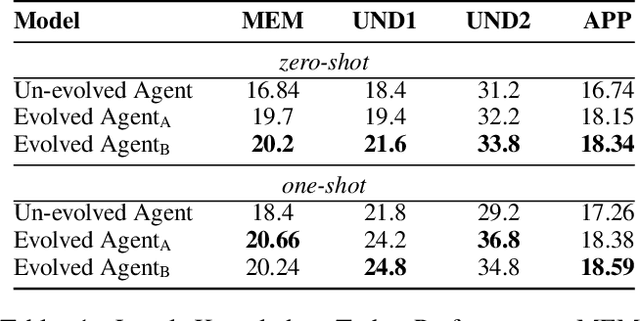

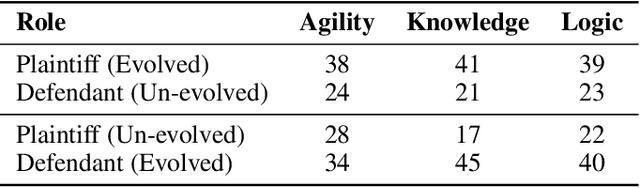
In this paper, we present a simulation system called AgentCourt that simulates the entire courtroom process. The judge, plaintiff's lawyer, defense lawyer, and other participants are autonomous agents driven by large language models (LLMs). Our core goal is to enable lawyer agents to learn how to argue a case, as well as improving their overall legal skills, through courtroom process simulation. To achieve this goal, we propose an adversarial evolutionary approach for the lawyer-agent. Since AgentCourt can simulate the occurrence and development of court hearings based on a knowledge base and LLM, the lawyer agents can continuously learn and accumulate experience from real court cases. The simulation experiments show that after two lawyer-agents have engaged in a thousand adversarial legal cases in AgentCourt (which can take a decade for real-world lawyers), compared to their pre-evolutionary state, the evolved lawyer agents exhibit consistent improvement in their ability to handle legal tasks. To enhance the credibility of our experimental results, we enlisted a panel of professional lawyers to evaluate our simulations. The evaluation indicates that the evolved lawyer agents exhibit notable advancements in responsiveness, as well as expertise and logical rigor. This work paves the way for advancing LLM-driven agent technology in legal scenarios. Code is available at https://github.com/relic-yuexi/AgentCourt.