 Add to Chrome
 Add to Firefox
 Add to Edge
Boosting Maximum Entropy Reinforcement Learning via One-Step Flow Matching
Feb 02, 2026
Diffusion policies are expressive yet incur high inference latency. Flow Matching (FM) enables one-step generation, but integrating it into Maximum Entropy Reinforcement Learning (MaxEnt RL) is challenging: the optimal policy is an intractable energy-based distribution, and the efficient log-likelihood estimation required to balance exploration and exploitation suffers from severe discretization bias. We propose \textbf{F}low-based \textbf{L}og-likelihood-\textbf{A}ware \textbf{M}aximum \textbf{E}ntropy RL (\textbf{FLAME}), a principled framework that addresses these challenges. First, we derive a Q-Reweighted FM objective that bypasses partition function estimation via importance reweighting. Second, we design a decoupled entropy estimator that rigorously corrects bias, which enables efficient exploration and brings the policy closer to the optimal MaxEnt policy. Third, we integrate the MeanFlow formulation to achieve expressive and efficient one-step control. Empirical results on MuJoCo show that FLAME outperforms Gaussian baselines and matches multi-step diffusion policies with significantly lower inference cost. Code is available at https://github.com/lzqw/FLAME.

RAPO: An Adaptive Ranking Paradigm for Bilingual Lexicon Induction
Oct 18, 2022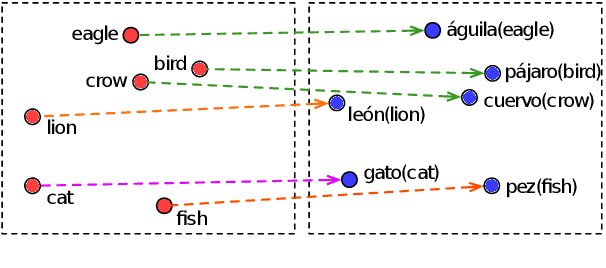
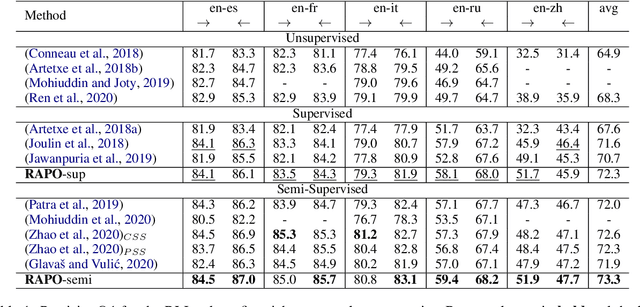
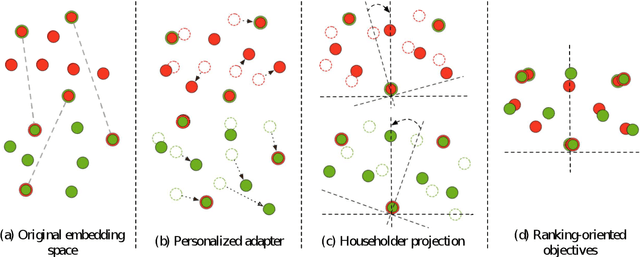
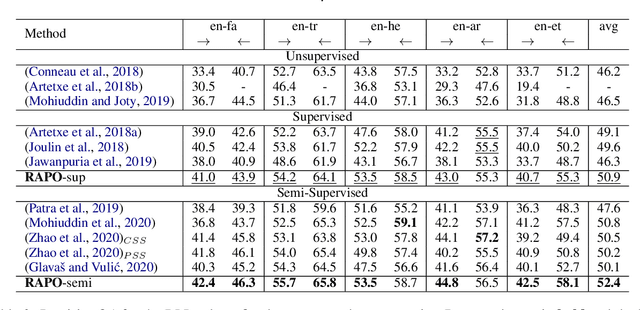
Bilingual lexicon induction induces the word translations by aligning independently trained word embeddings in two languages. Existing approaches generally focus on minimizing the distances between words in the aligned pairs, while suffering from low discriminative capability to distinguish the relative orders between positive and negative candidates. In addition, the mapping function is globally shared by all words, whose performance might be hindered by the deviations in the distributions of different languages. In this work, we propose a novel ranking-oriented induction model RAPO to learn personalized mapping function for each word. RAPO is capable of enjoying the merits from the unique characteristics of a single word and the cross-language isomorphism simultaneously. Extensive experimental results on public datasets including both rich-resource and low-resource languages demonstrate the superiority of our proposal. Our code is publicly available in \url{https://github.com/Jlfj345wf/RAPO}.