 Add to Chrome
 Add to Firefox
 Add to Edge
Non-volatile Programmable Photonic Integrated Circuits using Mechanically Latched MEMS: A System-Level Scheme Enabling Power-Connection-Free Operation Without Performance Compromise
Jan 10, 2026
Programmable photonic integrated circuits (PPICs) offer a versatile platform for implementing diverse optical functions on a generic hardware mesh. However, the scalability of PPICs faces critical power consumption barriers. Therefore, we propose a novel non-volatile PPIC architecture utilizing MEMS with mechanical latching, enabling stable passive operation without any power connection once configured. To ensure practical applicability, we present a system-level solution including both this hardware innovation and an accompanying automatic error-resilient configuration algorithm. The algorithm compensates for the lack of continuous tunability inherent in the non-volatile hardware design, thereby enabling such new operational paradigm without compromising performance, and also ensuring robustness against fabrication errors. Functional simulations were performed to validate the proposed scheme by configuring five distinct functionalities of varying complexity, including a Mach-Zehnder interferometer (MZI), a MZI lattice filter, a ring resonator (ORR), a double ORR ring-loaded MZI, and a triple ORR coupled resonator waveguide filter. The results demonstrate that our non-volatile scheme achieves performance equivalent to conventional PPICs. Robustness analysis was also conducted, and the results demonstrated that our scheme exhibits strong robustness against various fabrication errors. Furthermore, we explored the trade-off between the hardware design complexity of such non-volatile scheme and its performance. This study establishes a viable pathway to a new generation of power-connection-free PPICs, providing a practical and scalable solution for future photonic systems.

LLM-based MOFs Synthesis Condition Extraction using Few-Shot Demonstrations
Aug 06, 2024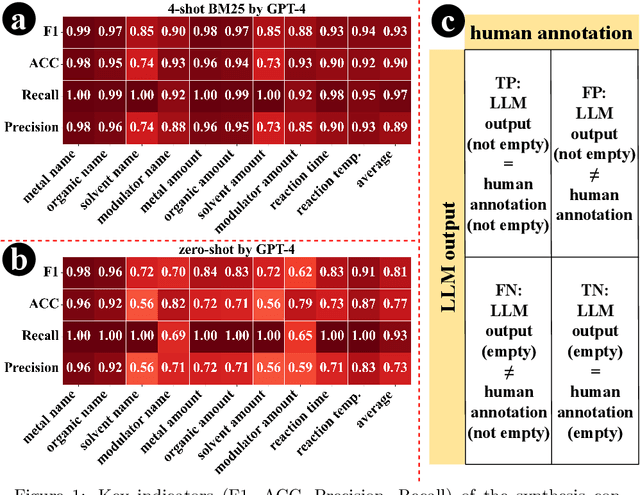
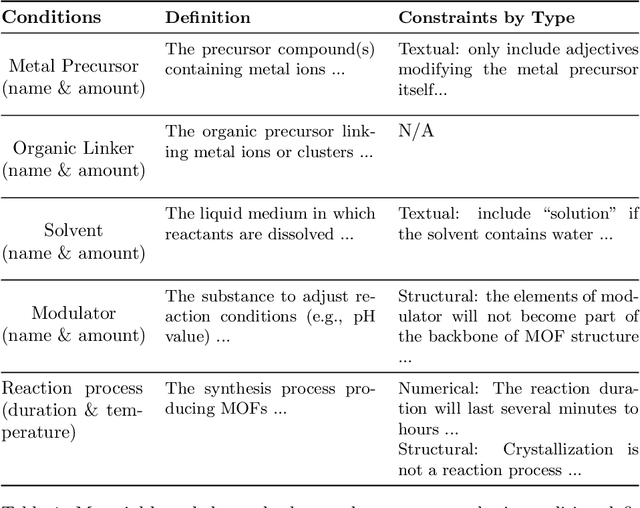
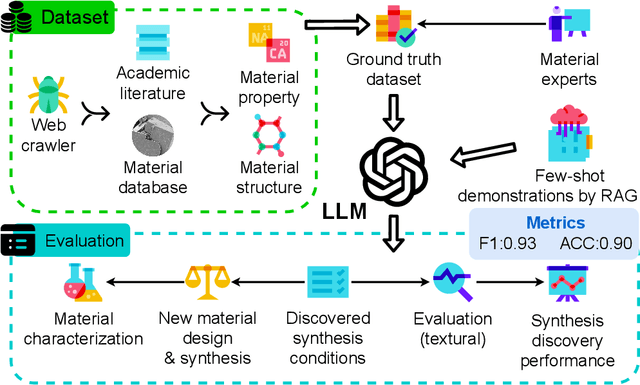
The extraction of Metal-Organic Frameworks (MOFs) synthesis conditions from literature text has been challenging but crucial for the logical design of new MOFs with desirable functionality. The recent advent of large language models (LLMs) provides disruptively new solution to this long-standing problem and latest researches have reported over 90% F1 in extracting correct conditions from MOFs literature. We argue in this paper that most existing synthesis extraction practices with LLMs stay with the primitive zero-shot learning, which could lead to downgraded extraction and application performance due to the lack of specialized knowledge. This work pioneers and optimizes the few-shot in-context learning paradigm for LLM extraction of material synthesis conditions. First, we propose a human-AI joint data curation process to secure high-quality ground-truth demonstrations for few-shot learning. Second, we apply a BM25 algorithm based on the retrieval-augmented generation (RAG) technique to adaptively select few-shot demonstrations for each MOF's extraction. Over a dataset randomly sampled from 84,898 well-defined MOFs, the proposed few-shot method achieves much higher average F1 performance (0.93 vs. 0.81, +14.8%) than the native zero-shot LLM using the same GPT-4 model, under fully automatic evaluation that are more objective than the previous human evaluation. The proposed method is further validated through real-world material experiments: compared with the baseline zero-shot LLM, the proposed few-shot approach increases the MOFs structural inference performance (R^2) by 29.4% in average.