 Add to Chrome
 Add to Firefox
 Add to Edge
Not All Negative Samples Are Equal: LLMs Learn Better from Plausible Reasoning
Feb 03, 2026
Learning from negative samples holds great promise for improving Large Language Model (LLM) reasoning capability, yet existing methods treat all incorrect responses as equally informative, overlooking the crucial role of sample quality. To address this, we propose Plausible Negative Samples (PNS), a method that synthesizes high-quality negative samples exhibiting expected format and structural coherence while ultimately yielding incorrect answers. PNS trains a dedicated model via reverse reinforcement learning (RL) guided by a composite reward combining format compliance, accuracy inversion, reward model assessment, and chain-of-thought evaluation, generating responses nearly indistinguishable from correct solutions. We further validate PNS as a plug-and-play data source for preference optimization across three backbone models on seven mathematical reasoning benchmarks. Results demonstrate that PNS consistently outperforms other negative sample synthesis methods, achieving an average improvement of 2.03% over RL-trained models.

From Atoms to Chains: Divergence-Guided Reasoning Curriculum for Unlabeled LLM Domain Adaptation
Jan 27, 2026Adapting Large Language Models (LLMs) to specialized domains without human-annotated data is a crucial yet formidable challenge. Widely adopted knowledge distillation methods often devolve into coarse-grained mimicry, where the student model inefficiently targets its own weaknesses and risks inheriting the teacher's reasoning flaws. This exposes a critical pedagogical dilemma: how to devise a reliable curriculum when the teacher itself is not an infallible expert. Our work resolves this by capitalizing on a key insight: while LLMs may exhibit fallibility in complex, holistic reasoning, they often exhibit high fidelity on focused, atomic sub-problems. Based on this, we propose Divergence-Guided Reasoning Curriculum (DGRC), which constructs a learning path from atomic knowledge to reasoning chains by dynamically deriving two complementary curricula from disagreements in reasoning pathways. When a student and teacher produce conflicting results, DGRC directs the teacher to perform a diagnostic analysis: it analyzes both reasoning paths to formulate atomic queries that target the specific points of divergence, and then self-answers these queries to create high-confidence atomic question-answer pairs. These pairs then serve a dual purpose: (1) providing an atomic curriculum to rectify the student's knowledge gaps, and (2) serving as factual criteria to filter the teacher's original reasoning chains, yielding a verified CoT curriculum that teaches the student how to integrate atomic knowledge into complete reasoning paths. Experiments across the medical and legal domains on student models of various sizes demonstrate the effectiveness of our DGRC framework. Notably, our method achieves a 7.76% relative improvement for the 1.5B student model in the medical domain over strong unlabeled baseline.
Mimic Human Cognition, Master Multi-Image Reasoning: A Meta-Action Framework for Enhanced Visual Understanding
Jan 12, 2026While Multimodal Large Language Models (MLLMs) excel at single-image understanding, they exhibit significantly degraded performance in multi-image reasoning scenarios. Multi-image reasoning presents fundamental challenges including complex inter-relationships between images and scattered critical information across image sets. Inspired by human cognitive processes, we propose the Cognition-Inspired Meta-Action Framework (CINEMA), a novel approach that decomposes multi-image reasoning into five structured meta-actions: Global, Focus, Hint, Think, and Answer which explicitly modeling the sequential cognitive steps humans naturally employ. For cold-start training, we introduce a Retrieval-Based Tree Sampling strategy that generates high-quality meta-action trajectories to bootstrap the model with reasoning patterns. During reinforcement learning, we adopt a two-stage paradigm: an exploration phase with Diversity-Preserving Strategy to avoid entropy collapse, followed by an annealed exploitation phase with DAPO to gradually strengthen exploitation. To train our model, we construct a dataset of 57k cold-start and 58k reinforcement learning instances spanning multi-image, multi-frame, and single-image tasks. We conduct extensive evaluations on multi-image reasoning benchmarks, video understanding benchmarks, and single-image benchmarks, achieving competitive state-of-the-art performance on several key benchmarks. Our model surpasses GPT-4o on the MUIR and MVMath benchmarks and notably outperforms specialized video reasoning models on video understanding benchmarks, demonstrating the effectiveness and generalizability of our human cognition-inspired reasoning framework.
AIVD: Adaptive Edge-Cloud Collaboration for Accurate and Efficient Industrial Visual Detection
Jan 08, 2026Multimodal large language models (MLLMs) demonstrate exceptional capabilities in semantic understanding and visual reasoning, yet they still face challenges in precise object localization and resource-constrained edge-cloud deployment. To address this, this paper proposes the AIVD framework, which achieves unified precise localization and high-quality semantic generation through the collaboration between lightweight edge detectors and cloud-based MLLMs. To enhance the cloud MLLM's robustness against edge cropped-box noise and scenario variations, we design an efficient fine-tuning strategy with visual-semantic collaborative augmentation, significantly improving classification accuracy and semantic consistency. Furthermore, to maintain high throughput and low latency across heterogeneous edge devices and dynamic network conditions, we propose a heterogeneous resource-aware dynamic scheduling algorithm. Experimental results demonstrate that AIVD substantially reduces resource consumption while improving MLLM classification performance and semantic generation quality. The proposed scheduling strategy also achieves higher throughput and lower latency across diverse scenarios.
ThinkDrive: Chain-of-Thought Guided Progressive Reinforcement Learning Fine-Tuning for Autonomous Driving
Jan 08, 2026With the rapid advancement of large language models (LLMs) technologies, their application in the domain of autonomous driving has become increasingly widespread. However, existing methods suffer from unstructured reasoning, poor generalization, and misalignment with human driving intent. While Chain-of-Thought (CoT) reasoning enhances decision transparency, conventional supervised fine-tuning (SFT) fails to fully exploit its potential, and reinforcement learning (RL) approaches face instability and suboptimal reasoning depth. We propose ThinkDrive, a CoT guided progressive RL fine-tuning framework for autonomous driving that synergizes explicit reasoning with difficulty-aware adaptive policy optimization. Our method employs a two-stage training strategy. First, we perform SFT using CoT explanations. Then, we apply progressive RL with a difficulty-aware adaptive policy optimizer that dynamically adjusts learning intensity based on sample complexity. We evaluate our approach on a public dataset. The results show that ThinkDrive outperforms strong RL baselines by 1.45%, 1.95%, and 1.01% on exam, easy-exam, and accuracy, respectively. Moreover, a 2B-parameter model trained with our method surpasses the much larger GPT-4o by 3.28% on the exam metric.
SearchAttack: Red-Teaming LLMs against Real-World Threats via Framing Unsafe Web Information-Seeking Tasks
Jan 07, 2026Recently, people have suffered and become increasingly aware of the unreliability gap in LLMs for open and knowledge-intensive tasks, and thus turn to search-augmented LLMs to mitigate this issue. However, when the search engine is triggered for harmful tasks, the outcome is no longer under the LLM's control. Once the returned content directly contains targeted, ready-to-use harmful takeaways, the LLM's safeguards cannot withdraw that exposure. Motivated by this dilemma, we identify web search as a critical attack surface and propose \textbf{\textit{SearchAttack}} for red-teaming. SearchAttack outsources the harmful semantics to web search, retaining only the query's skeleton and fragmented clues, and further steers LLMs to reconstruct the retrieved content via structural rubrics to achieve malicious goals. Extensive experiments are conducted to red-team the search-augmented LLMs for responsible vulnerability assessment. Empirically, SearchAttack demonstrates strong effectiveness in attacking these systems.
Reinforced MLLM: A Survey on RL-Based Reasoning in Multimodal Large Language Models
Apr 30, 2025The integration of reinforcement learning (RL) into the reasoning capabilities of Multimodal Large Language Models (MLLMs) has rapidly emerged as a transformative research direction. While MLLMs significantly extend Large Language Models (LLMs) to handle diverse modalities such as vision, audio, and video, enabling robust reasoning across multimodal inputs remains a major challenge. This survey systematically reviews recent advances in RL-based reasoning for MLLMs, covering key algorithmic designs, reward mechanism innovations, and practical applications. We highlight two main RL paradigms--value-free and value-based methods--and analyze how RL enhances reasoning abilities by optimizing reasoning trajectories and aligning multimodal information. Furthermore, we provide an extensive overview of benchmark datasets, evaluation protocols, and existing limitations, and propose future research directions to address current bottlenecks such as sparse rewards, inefficient cross-modal reasoning, and real-world deployment constraints. Our goal is to offer a comprehensive and structured guide to researchers interested in advancing RL-based reasoning in the multimodal era.
DSP: Dynamic Sequence Parallelism for Multi-Dimensional Transformers
Mar 15, 2024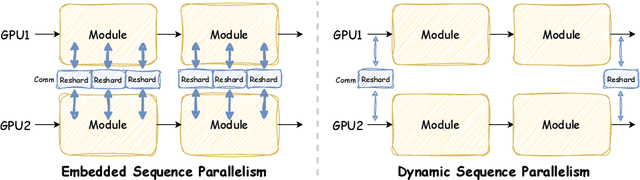
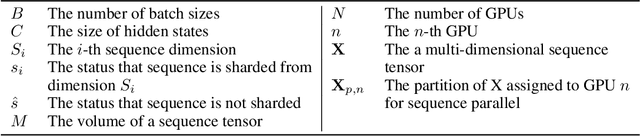

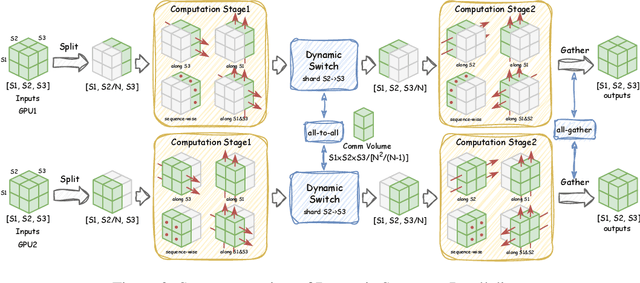
Scaling large models with long sequences across applications like language generation, video generation and multimodal tasks requires efficient sequence parallelism. However, existing sequence parallelism methods all assume a single sequence dimension and fail to adapt to multi-dimensional transformer architectures that perform attention calculations across different dimensions. This paper introduces Dynamic Sequence Parallelism (DSP), a novel approach to enable efficient sequence parallelism for multi-dimensional transformer models. The key idea is to dynamically switch the parallelism dimension according to the current computation stage, leveraging the potential characteristics of multi-dimensional attention. This dynamic dimension switching allows sequence parallelism with minimal communication overhead compared to applying traditional single-dimension parallelism to multi-dimensional models. Experiments show DSP improves end-to-end throughput by 42.0% to 216.8% over prior sequence parallelism methods.