 Add to Chrome
 Add to Firefox
 Add to Edge
SemLoc: Structured Grounding of Free-Form LLM Reasoning for Fault Localization
Mar 31, 2026
Fault localization identifies program locations responsible for observed failures. Existing techniques rank suspicious code using syntactic spectra--signals derived from execution structure such as statement coverage, control-flow divergence, or dependency reachability. These signals collapse for semantic bugs, where failing and passing executions follow identical code paths and differ only in whether semantic intent is satisfied. Recent LLM-based approaches introduce semantic reasoning but produce stochastic, unverifiable outputs that cannot be systematically cross-referenced across tests or distinguish root causes from cascading effects. We present SemLoc, a fault localization framework based on structured semantic grounding. SemLoc converts free-form LLM reasoning into a closed intermediate representation that binds each inferred property to a typed program anchor, enabling runtime checking and attribution to program structure. It executes instrumented programs to construct a semantic violation spectrum--a constraint-by-test matrix--from which suspiciousness scores are derived analogously to coverage-based methods. A counterfactual verification step further prunes over-approximate constraints and isolates primary causal violations. We evaluate SemLoc on SemFault-250, a corpus of 250 Python programs with single semantic faults. SemLoc outperforms five coverage-, reduction-, and LLM-based baselines, achieving Top-1 accuracy of 42.8% and Top-3 of 68%, while reducing inspection to 7.6% of executable lines. Counterfactual verification provides an additional 12% accuracy gain and identifies primary causal semantic constraints.

Needle in the Repo: A Benchmark for Maintainability in AI-Generated Repository Edits
Mar 29, 2026AI coding agents can now complete complex programming tasks, but existing evaluations largely emphasize behavioral correctness and often overlook maintainability risks such as weak modularity or testability. We present Needle in the Repo (NITR), a diagnostic probe-and-oracle framework for evaluating whether behaviorally correct repository edits preserve maintainable structure. NITR distills recurring software engineering wisdom into controlled probes embedded in small, realistic multi-file codebases, each designed so that success depends primarily on one targeted maintainability dimension. Each probe is paired with a hidden evaluation harness that combines functional tests for required behavior with structural oracles that encode the targeted maintainability constraint and return interpretable diagnoses. Using NITR, we evaluate 23 coding configurations across GPT, Claude, Gemini, and Qwen families in both direct-inference and agent-based settings. Current AI coding systems remain far from robust: on average, configurations solve only 36.2% of cases, the best reaches 57.1%, and performance drops from 53.5% on micro cases to 20.6% on multi-step cases. The hardest pressures are architectural rather than local edits, especially dependency control (4.3%) and responsibility decomposition (15.2%). Moreover, 64/483 outcomes (13.3%) pass all functional tests yet fail the structural oracle. Under our harness, agent-mode configurations improve average performance from 28.2% to 45.0%, but do not eliminate these architectural failures. These results show that progress in code generation is not yet progress in maintainable code evolution, and that NITR exposes a critical failure surface missed by conventional evaluation.
Learning Proposes, Geometry Disposes: A Modular Framework for Efficient Spatial Reasoning
Feb 16, 2026Spatial perception aims to estimate camera motion and scene structure from visual observations, a problem traditionally addressed through geometric modeling and physical consistency constraints. Recent learning-based methods have demonstrated strong representational capacity for geometric perception and are increasingly used to augment classical geometry-centric systems in practice. However, whether learning components should directly replace geometric estimation or instead serve as intermediate modules within such pipelines remains an open question. In this work, we address this gap and investigate an end-to-end modular framework for effective spatial reasoning, where learning proposes geometric hypotheses, while geometric algorithms dispose estimation decisions. In particular, we study this principle in the context of relative camera pose estimation on RGB-D sequences. Using VGGT as a representative learning model, we evaluate learning-based pose and depth proposals under varying motion magnitudes and scene dynamics, followed by a classical point-to-plane RGB-D ICP as the geometric backend. Our experiments on the TUM RGB-D benchmark reveal three consistent findings: (1) learning-based pose proposals alone are unreliable; (2) learning-proposed geometry, when improperly aligned with camera intrinsics, can degrade performance; and (3) when learning-proposed depth is geometrically aligned and followed by a geometric disposal stage, consistent improvements emerge in moderately challenging rigid settings. These results demonstrate that geometry is not merely a refinement component, but an essential arbiter that validates and absorbs learning-based geometric observations. Our study highlights the importance of modular, geometry-aware system design for robust spatial perception.
IDRBench: Interactive Deep Research Benchmark
Jan 10, 2026Deep research agents powered by Large Language Models (LLMs) can perform multi-step reasoning, web exploration, and long-form report generation. However, most existing systems operate in an autonomous manner, assuming fully specified user intent and evaluating only final outputs. In practice, research goals are often underspecified and evolve during exploration, making sustained interaction essential for robust alignment. Despite its importance, interaction remains largely invisible to existing deep research benchmarks, which neither model dynamic user feedback nor quantify its costs. We introduce IDRBench, the first benchmark for systematically evaluating interactive deep research. IDRBench combines a modular multi-agent research framework with on-demand interaction, a scalable reference-grounded user simulator, and an interaction-aware evaluation suite that jointly measures interaction benefits (quality and alignment) and costs (turns and tokens). Experiments across seven state-of-the-art LLMs show that interaction consistently improves research quality and robustness, often outweighing differences in model capacity, while revealing substantial trade-offs in interaction efficiency.
Self-Distillation Bridges Distribution Gap in Language Model Fine-Tuning
Feb 21, 2024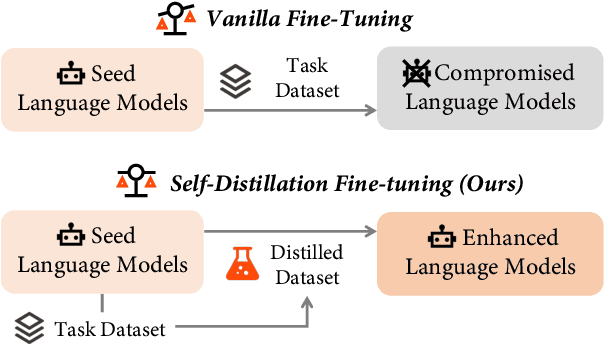
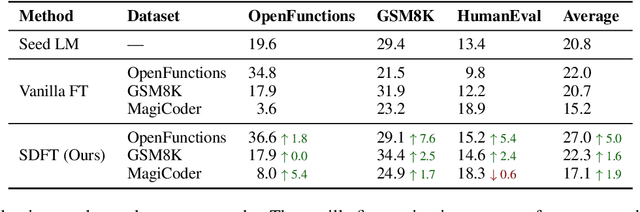
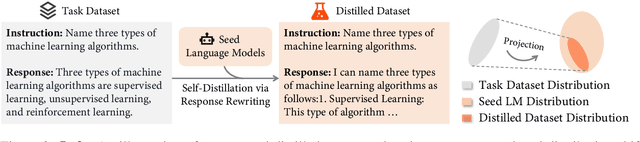
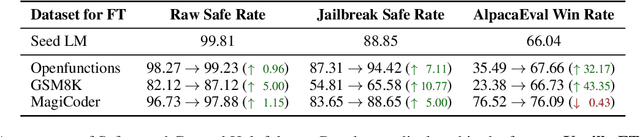
The surge in Large Language Models (LLMs) has revolutionized natural language processing, but fine-tuning them for specific tasks often encounters challenges in balancing performance and preserving general instruction-following abilities. In this paper, we posit that the distribution gap between task datasets and the LLMs serves as the primary underlying cause. To address the problem, we introduce Self-Distillation Fine-Tuning (SDFT), a novel approach that bridges the distribution gap by guiding fine-tuning with a distilled dataset generated by the model itself to match its original distribution. Experimental results on the Llama-2-chat model across various benchmarks demonstrate that SDFT effectively mitigates catastrophic forgetting while achieving comparable or superior performance on downstream tasks compared to the vanilla fine-tuning. Moreover, SDFT demonstrates the potential to maintain the helpfulness and safety alignment of LLMs. Our code is available at \url{https://github.com/sail-sg/sdft}.
CoSDA: Continual Source-Free Domain Adaptation
Apr 13, 2023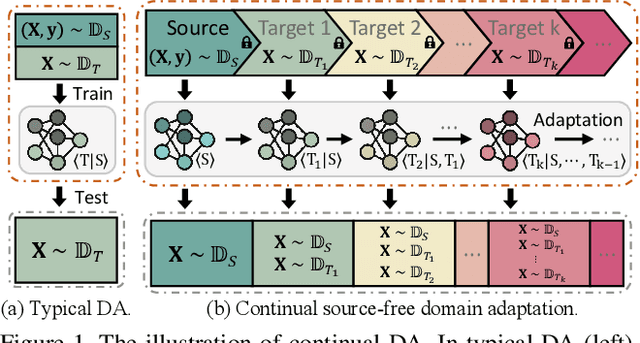
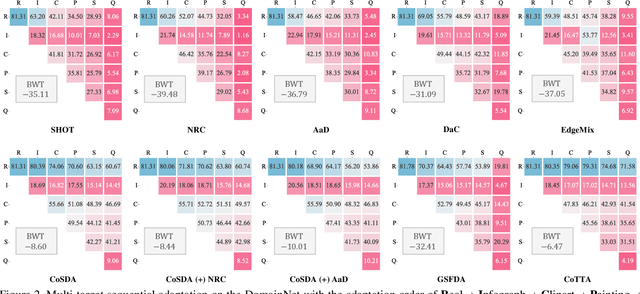
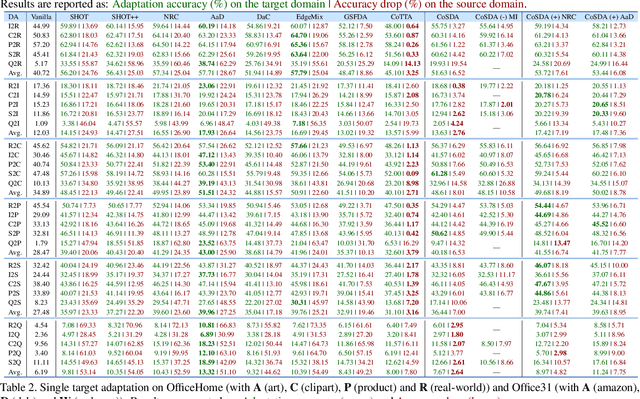
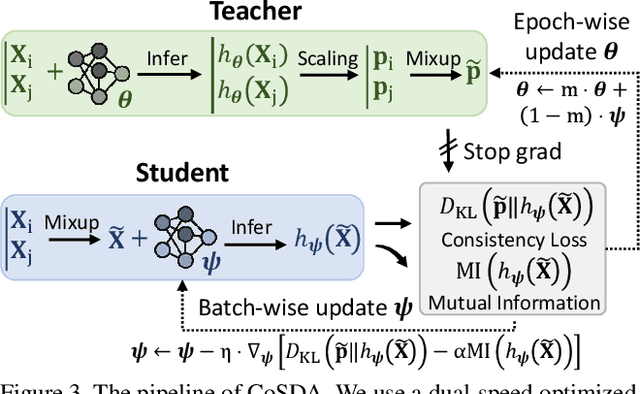
Without access to the source data, source-free domain adaptation (SFDA) transfers knowledge from a source-domain trained model to target domains. Recently, SFDA has gained popularity due to the need to protect the data privacy of the source domain, but it suffers from catastrophic forgetting on the source domain due to the lack of data. To systematically investigate the mechanism of catastrophic forgetting, we first reimplement previous SFDA approaches within a unified framework and evaluate them on four benchmarks. We observe that there is a trade-off between adaptation gain and forgetting loss, which motivates us to design a consistency regularization to mitigate forgetting. In particular, we propose a continual source-free domain adaptation approach named CoSDA, which employs a dual-speed optimized teacher-student model pair and is equipped with consistency learning capability. Our experiments demonstrate that CoSDA outperforms state-of-the-art approaches in continuous adaptation. Notably, our CoSDA can also be integrated with other SFDA methods to alleviate forgetting.