 Add to Chrome
 Add to Firefox
 Add to Edge
CoWork-X: Experience-Optimized Co-Evolution for Multi-Agent Collaboration System
Feb 04, 2026
Large language models are enabling language-conditioned agents in interactive environments, but highly cooperative tasks often impose two simultaneous constraints: sub-second real-time coordination and sustained multi-episode adaptation under a strict online token budget. Existing approaches either rely on frequent in-episode reasoning that induces latency and timing jitter, or deliver post-episode improvements through unstructured text that is difficult to compile into reliable low-cost execution. We propose CoWork-X, an active co-evolution framework that casts peer collaboration as a closed-loop optimization problem across episodes, inspired by fast--slow memory separation. CoWork-X instantiates a Skill-Agent that executes via HTN (hierarchical task network)-based skill retrieval from a structured, interpretable, and compositional skill library, and a post-episode Co-Optimizer that performs patch-style skill consolidation with explicit budget constraints and drift regularization. Experiments in challenging Overcooked-AI-like realtime collaboration benchmarks demonstrate that CoWork-X achieves stable, cumulative performance gains while steadily reducing online latency and token usage.

GameGPT: Multi-agent Collaborative Framework for Game Development
Oct 12, 2023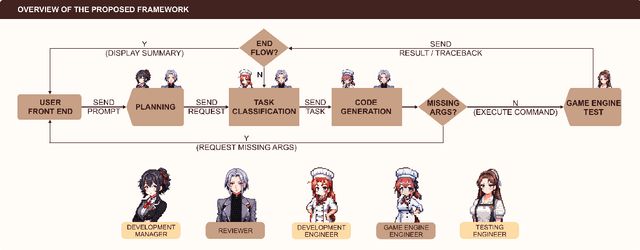
The large language model (LLM) based agents have demonstrated their capacity to automate and expedite software development processes. In this paper, we focus on game development and propose a multi-agent collaborative framework, dubbed GameGPT, to automate game development. While many studies have pinpointed hallucination as a primary roadblock for deploying LLMs in production, we identify another concern: redundancy. Our framework presents a series of methods to mitigate both concerns. These methods include dual collaboration and layered approaches with several in-house lexicons, to mitigate the hallucination and redundancy in the planning, task identification, and implementation phases. Furthermore, a decoupling approach is also introduced to achieve code generation with better precision.