 Add to Chrome
 Add to Firefox
 Add to Edge
Learning Whole-Body Human-Humanoid Interaction from Human-Human Demonstrations
Jan 14, 2026
Enabling humanoid robots to physically interact with humans is a critical frontier, but progress is hindered by the scarcity of high-quality Human-Humanoid Interaction (HHoI) data. While leveraging abundant Human-Human Interaction (HHI) data presents a scalable alternative, we first demonstrate that standard retargeting fails by breaking the essential contacts. We address this with PAIR (Physics-Aware Interaction Retargeting), a contact-centric, two-stage pipeline that preserves contact semantics across morphology differences to generate physically consistent HHoI data. This high-quality data, however, exposes a second failure: conventional imitation learning policies merely mimic trajectories and lack interactive understanding. We therefore introduce D-STAR (Decoupled Spatio-Temporal Action Reasoner), a hierarchical policy that disentangles when to act from where to act. In D-STAR, Phase Attention (when) and a Multi-Scale Spatial module (where) are fused by the diffusion head to produce synchronized whole-body behaviors beyond mimicry. By decoupling these reasoning streams, our model learns robust temporal phases without being distracted by spatial noise, leading to responsive, synchronized collaboration. We validate our framework through extensive and rigorous simulations, demonstrating significant performance gains over baseline approaches and a complete, effective pipeline for learning complex whole-body interactions from HHI data.

Deep Learning-Assisted Simultaneous Targets Sensing and Super-Resolution Imaging
May 02, 2023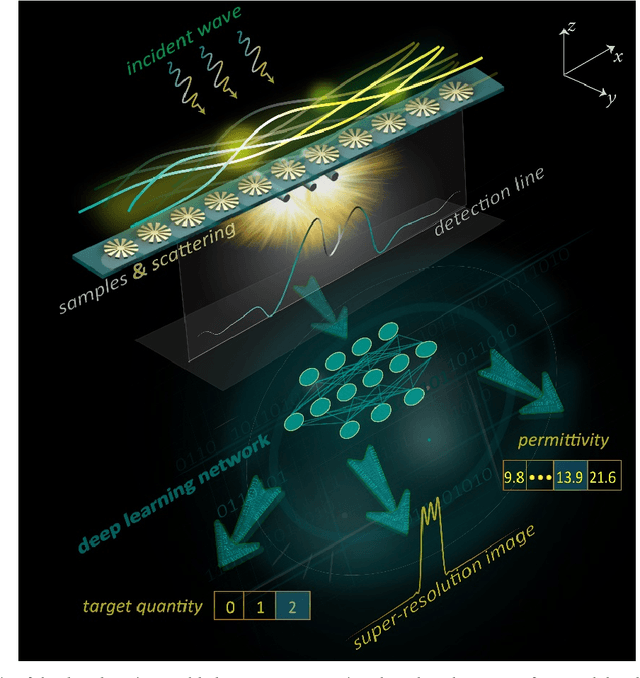
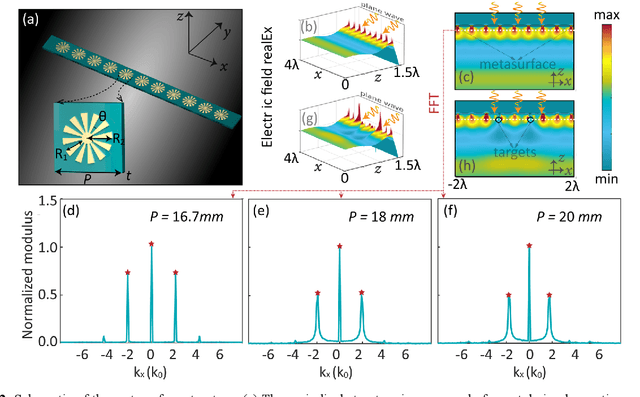
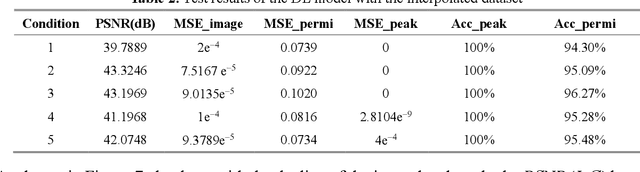
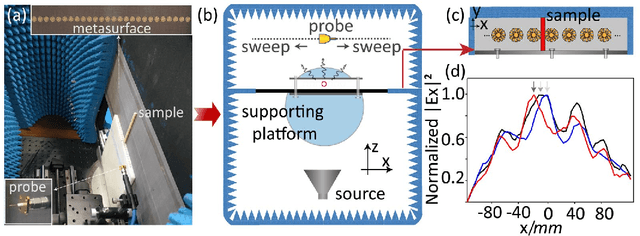
Recently, metasurfaces have experienced revolutionary growth in the sensing and superresolution imaging field, due to their enabling of subwavelength manipulation of electromagnetic waves. However, the addition of metasurfaces multiplies the complexity of retrieving target information from the detected fields. Besides, although the deep learning method affords a compelling platform for a series of electromagnetic problems, many studies mainly concentrate on resolving one single function and limit the research's versatility. In this study, a multifunctional deep neural network is demonstrated to reconstruct target information in a metasurface targets interactive system. Firstly, the interactive scenario is confirmed to tolerate the system noises in a primary verification experiment. Then, fed with the electric field distributions, the multitask deep neural network can not only sense the quantity and permittivity of targets but also generate superresolution images with high precision. The deep learning method provides another way to recover targets' diverse information in metasurface based target detection, accelerating the progression of target reconstruction areas. This methodology may also hold promise for inverse reconstruction or forward prediction problems in other electromagnetic scenarios.