 Add to Chrome
 Add to Firefox
 Add to Edge
Human-AI Co-Evolution and Epistemic Collapse: A Dynamical Systems Perspective
May 07, 2026
Large language models (LLMs) are reshaping how knowledge is produced, with increasing reliance on AI systems for generation, summarization, and reasoning. While prior work has studied cognitive offloading in humans and model collapse in recursive training, these effects are typically considered in isolation. We propose a unified perspective: humans and language models form a coupled dynamical system linked by a feedback loop of usage, generation, and retraining. We introduce a minimal model with three variables -- human cognition, data quality, and model capability -- and show that this feedback can give rise to distinct dynamical regimes. Our analysis identifies three regimes: co-evolutionary enhancement, fragile equilibrium, and degenerative convergence. Through a simple simulation, we demonstrate that increasing reliance on AI can induce a transition toward a low-diversity, suboptimal equilibrium. From an information-theoretic perspective, this transition corresponds to an emergent information bottleneck in the human-AI loop, where entropy reduction reflects loss of diversity and support under closed-loop feedback rather than beneficial compression. These results suggest that the trajectory of AI systems is shaped not only by model design, but by the dynamics of human-AI co-evolution.

Learning Locomotion on Complex Terrain for Quadrupedal Robots with Foot Position Maps and Stability Rewards
Apr 03, 2026Quadrupedal locomotion over complex terrain has been a long-standing research topic in robotics. While recent reinforcement learning-based locomotion methods improve generalizability and foot-placement precision, they rely on implicit inference of foot positions from joint angles, lacking the explicit precision and stability guarantees of optimization-based approaches. To address this, we introduce a foot position map integrated into the heightmap, and a dynamic locomotion-stability reward within an attention-based framework to achieve locomotion on complex terrain. We validate our method extensively on terrains seen during training as well as out-of-domain (OOD) terrains. Our results demonstrate that the proposed method enables precise and stable movement, resulting in improved locomotion success rates on both in-domain and OOD terrains.
ScanDP: Generalizable 3D Scanning with Diffusion Policy
Mar 11, 2026Learning-based 3D Scanning plays a crucial role in enabling efficient and accurate scanning of target objects. However, recent reinforcement learning-based methods often require large-scale training data and still struggle to generalize to unseen object categories.In this work, we propose a data-efficient 3D scanning framework that uses Diffusion Policy to imitate human-like scanning strategies. To enhance robustness and generalization, we adopt the Occupancy Grid Mapping instead of direct point cloud processing, offering improved noise resilience and handling of diverse object geometries. We also introduce a hybrid approach combining a sphere-based space representation with a path optimization procedure that ensures path safety and scanning efficiency. This approach addresses limitations in conventional imitation learning, such as redundant or unpredictable behavior. We evaluate our method on diverse unseen objects in both shape and scale. Ours achieves higher coverage and shorter paths than baselines, while remaining robust to sensor noise. We further confirm practical feasibility and stable operation in real-world execution.
M2I2HA: Multi-modal Object Detection Based on Intra- and Inter-Modal Hypergraph Attention
Jan 24, 2026Recent advances in multi-modal detection have significantly improved detection accuracy in challenging environments (e.g., low light, overexposure). By integrating RGB with modalities such as thermal and depth, multi-modal fusion increases data redundancy and system robustness. However, significant challenges remain in effectively extracting task-relevant information both within and across modalities, as well as in achieving precise cross-modal alignment. While CNNs excel at feature extraction, they are limited by constrained receptive fields, strong inductive biases, and difficulty in capturing long-range dependencies. Transformer-based models offer global context but suffer from quadratic computational complexity and are confined to pairwise correlation modeling. Mamba and other State Space Models (SSMs), on the other hand, are hindered by their sequential scanning mechanism, which flattens 2D spatial structures into 1D sequences, disrupting topological relationships and limiting the modeling of complex higher-order dependencies. To address these issues, we propose a multi-modal perception network based on hypergraph theory called M2I2HA. Our architecture includes an Intra-Hypergraph Enhancement module to capture global many-to-many high-order relationships within each modality, and an Inter-Hypergraph Fusion module to align, enhance, and fuse cross-modal features by bridging configuration and spatial gaps between data sources. We further introduce a M2-FullPAD module to enable adaptive multi-level fusion of multi-modal enhanced features within the network, meanwhile enhancing data distribution and flow across the architecture. Extensive object detection experiments on multiple public datasets against baselines demonstrate that M2I2HA achieves state-of-the-art performance in multi-modal object detection tasks.
M2I2HA: A Multi-modal Object Detection Method Based on Intra- and Inter-Modal Hypergraph Attention
Jan 21, 2026Recent advances in multi-modal detection have significantly improved detection accuracy in challenging environments (e.g., low light, overexposure). By integrating RGB with modalities such as thermal and depth, multi-modal fusion increases data redundancy and system robustness. However, significant challenges remain in effectively extracting task-relevant information both within and across modalities, as well as in achieving precise cross-modal alignment. While CNNs excel at feature extraction, they are limited by constrained receptive fields, strong inductive biases, and difficulty in capturing long-range dependencies. Transformer-based models offer global context but suffer from quadratic computational complexity and are confined to pairwise correlation modeling. Mamba and other State Space Models (SSMs), on the other hand, are hindered by their sequential scanning mechanism, which flattens 2D spatial structures into 1D sequences, disrupting topological relationships and limiting the modeling of complex higher-order dependencies. To address these issues, we propose a multi-modal perception network based on hypergraph theory called M2I2HA. Our architecture includes an Intra-Hypergraph Enhancement module to capture global many-to-many high-order relationships within each modality, and an Inter-Hypergraph Fusion module to align, enhance, and fuse cross-modal features by bridging configuration and spatial gaps between data sources. We further introduce a M2-FullPAD module to enable adaptive multi-level fusion of multi-modal enhanced features within the network, meanwhile enhancing data distribution and flow across the architecture. Extensive object detection experiments on multiple public datasets against baselines demonstrate that M2I2HA achieves state-of-the-art performance in multi-modal object detection tasks.
Location-Routing Planning for Last-Mile Deliveries Using Mobile Parcel Lockers: A Hybrid Q-Learning Network Approach
Sep 09, 2022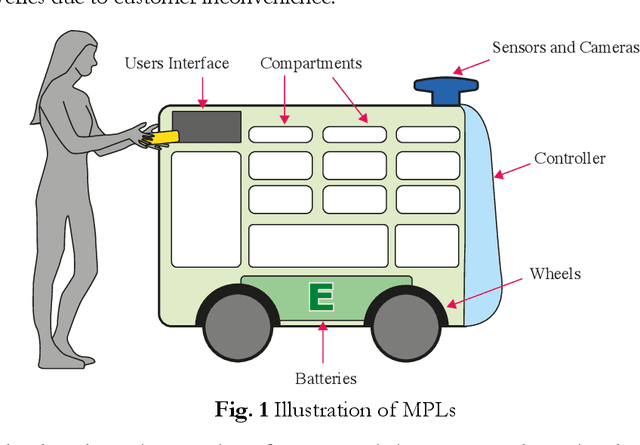
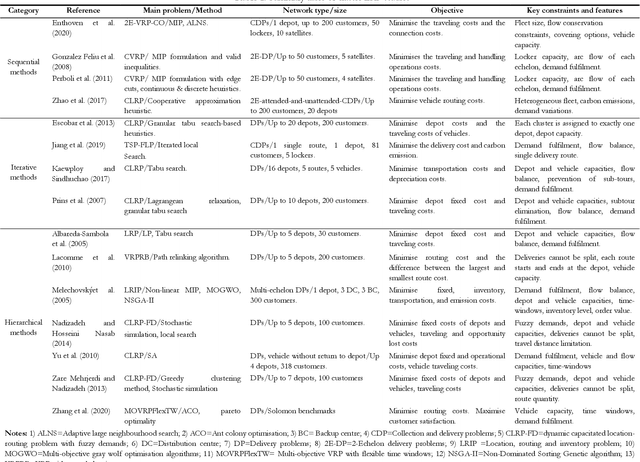

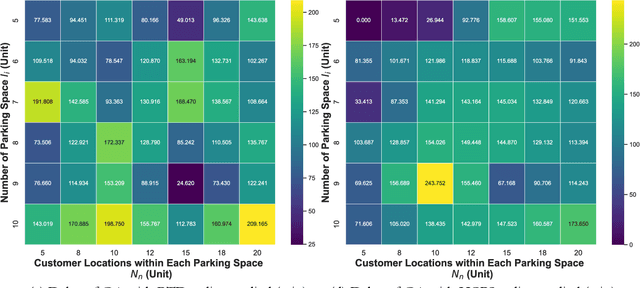
Mobile parcel lockers (MPLs) have been recently proposed by logistics operators as a technology that could help reduce traffic congestion and operational costs in urban freight distribution. Given their ability to relocate throughout their area of deployment, they hold the potential to improve customer accessibility and convenience. In this study, we formulate the Mobile Parcel Locker Problem (MPLP), a special case of the Location-Routing Problem (LRP) which determines the optimal stopover location for MPLs throughout the day and plans corresponding delivery routes. A Hybrid Q-Learning-Network-based Method (HQM) is developed to resolve the computational complexity of the resulting large problem instances while escaping local optima. In addition, the HQM is integrated with global and local search mechanisms to resolve the dilemma of exploration and exploitation faced by classic reinforcement learning (RL) methods. We examine the performance of HQM under different problem sizes (up to 200 nodes) and benchmarked it against the Genetic Algorithm (GA). Our results indicate that the average reward obtained by HQM is 1.96 times greater than GA, which demonstrates that HQM has a better optimisation ability. Finally, we identify critical factors that contribute to fleet size requirements, travel distances, and service delays. Our findings outline that the efficiency of MPLs is mainly contingent on the length of time windows and the deployment of MPL stopovers.
Location-routing Optimisation for Urban Logistics Using Mobile Parcel Locker Based on Hybrid Q-Learning Algorithm
Oct 29, 2021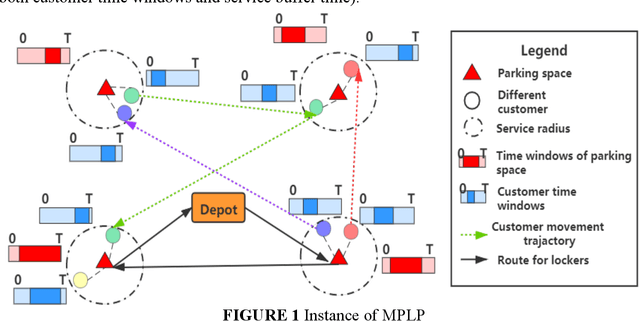
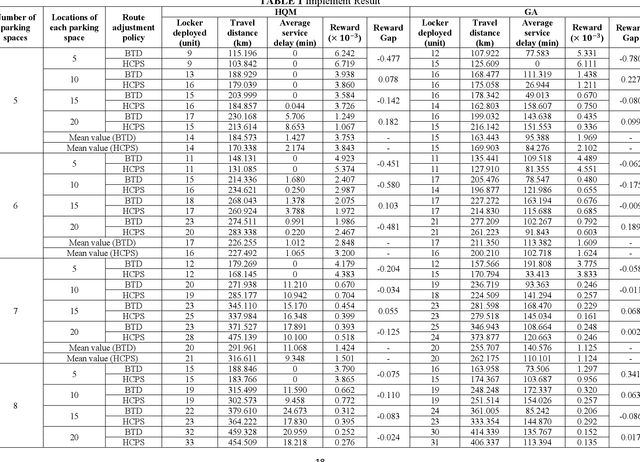
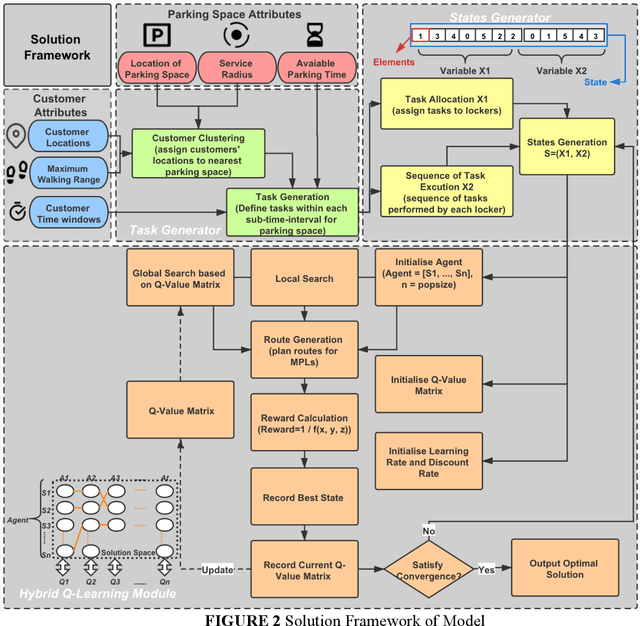
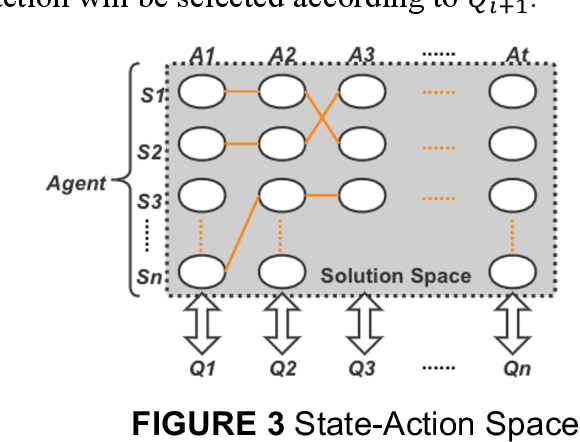
Mobile parcel lockers (MPLs) have been recently introduced by urban logistics operators as a means to reduce traffic congestion and operational cost. Their capability to relocate their position during the day has the potential to improve customer accessibility and convenience (if deployed and planned accordingly), allowing customers to collect parcels at their preferred time among one of the multiple locations. This paper proposes an integer programming model to solve the Location Routing Problem for MPLs to determine the optimal configuration and locker routes. In solving this model, a Hybrid Q-Learning algorithm-based Method (HQM) integrated with global and local search mechanisms is developed, the performance of which is examined for different problem sizes and benchmarked with genetic algorithms. Furthermore, we introduced two route adjustment strategies to resolve stochastic events that may cause delays. The results show that HQM achieves 443.41% improvement on average in solution improvement, compared with the 94.91% improvement of heuristic counterparts, suggesting HQM enables a more efficient search for better solutions. Finally, we identify critical factors that contribute to service delays and investigate their effects.