 Add to Chrome
 Add to Firefox
 Add to Edge
AutoRegressive Generation with B-rep Holistic Token Sequence Representation
Jan 23, 2026
Previous representation and generation approaches for the B-rep relied on graph-based representations that disentangle geometric and topological features through decoupled computational pipelines, thereby precluding the application of sequence-based generative frameworks, such as transformer architectures that have demonstrated remarkable performance. In this paper, we propose BrepARG, the first attempt to encode B-rep's geometry and topology into a holistic token sequence representation, enabling sequence-based B-rep generation with an autoregressive architecture. Specifically, BrepARG encodes B-rep into 3 types of tokens: geometry and position tokens representing geometric features, and face index tokens representing topology. Then the holistic token sequence is constructed hierarchically, starting with constructing the geometry blocks (i.e., faces and edges) using the above tokens, followed by geometry block sequencing. Finally, we assemble the holistic sequence representation for the entire B-rep. We also construct a transformer-based autoregressive model that learns the distribution over holistic token sequences via next-token prediction, using a multi-layer decoder-only architecture with causal masking. Experiments demonstrate that BrepARG achieves state-of-the-art (SOTA) performance. BrepARG validates the feasibility of representing B-rep as holistic token sequences, opening new directions for B-rep generation.

BrepLLM: Native Boundary Representation Understanding with Large Language Models
Dec 18, 2025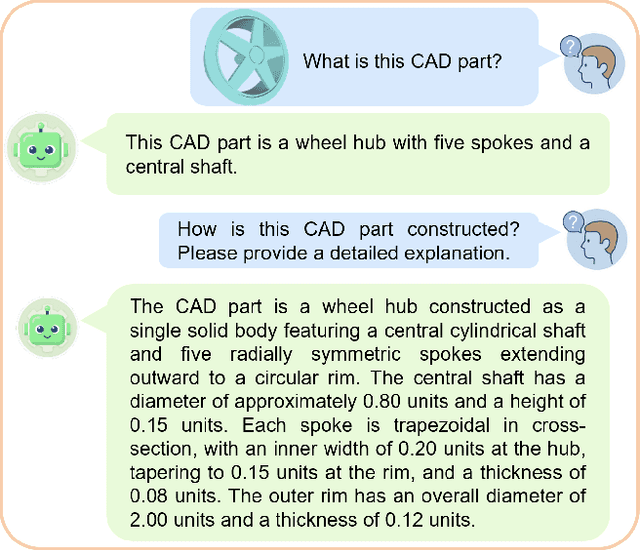
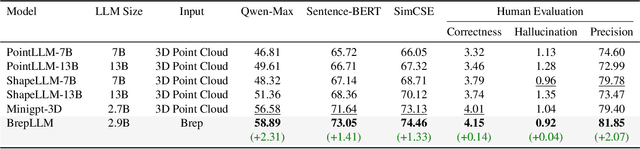
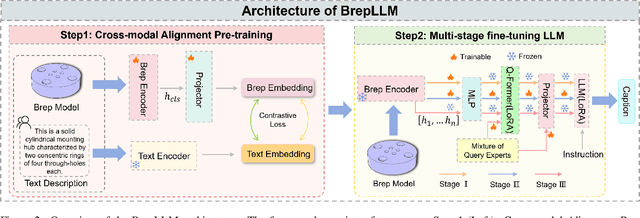

Current token-sequence-based Large Language Models (LLMs) are not well-suited for directly processing 3D Boundary Representation (Brep) models that contain complex geometric and topological information. We propose BrepLLM, the first framework that enables LLMs to parse and reason over raw Brep data, bridging the modality gap between structured 3D geometry and natural language. BrepLLM employs a two-stage training pipeline: Cross-modal Alignment Pre-training and Multi-stage LLM Fine-tuning. In the first stage, an adaptive UV sampling strategy converts Breps into graphs representation with geometric and topological information. We then design a hierarchical BrepEncoder to extract features from geometry (i.e., faces and edges) and topology, producing both a single global token and a sequence of node tokens. Then we align the global token with text embeddings from a frozen CLIP text encoder (ViT-L/14) via contrastive learning. In the second stage, we integrate the pretrained BrepEncoder into an LLM. We then align its sequence of node tokens using a three-stage progressive training strategy: (1) training an MLP-based semantic mapping from Brep representation to 2D with 2D-LLM priors. (2) performing fine-tuning of the LLM. (3) designing a Mixture-of-Query Experts (MQE) to enhance geometric diversity modeling. We also construct Brep2Text, a dataset comprising 269,444 Brep-text question-answer pairs. Experiments show that BrepLLM achieves state-of-the-art (SOTA) results on 3D object classification and captioning tasks.
BRepFormer: Transformer-Based B-rep Geometric Feature Recognition
Apr 10, 2025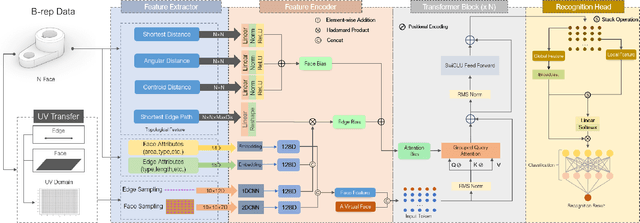
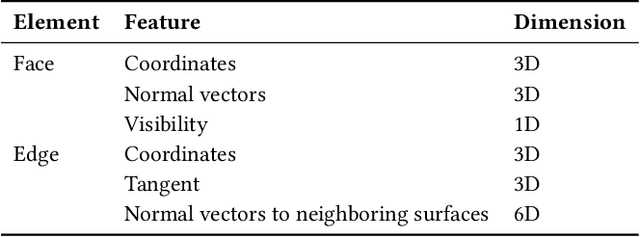
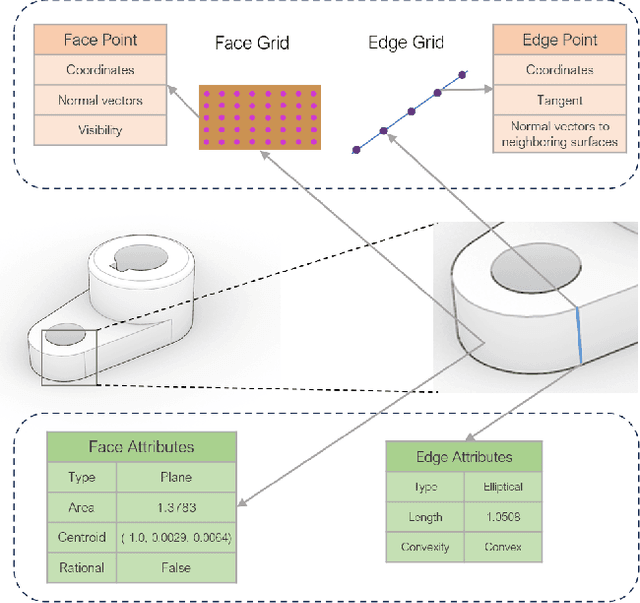
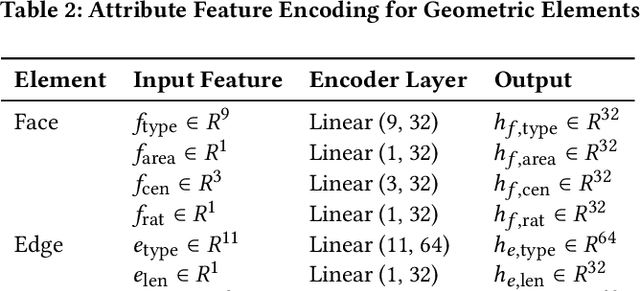
Recognizing geometric features on B-rep models is a cornerstone technique for multimedia content-based retrieval and has been widely applied in intelligent manufacturing. However, previous research often merely focused on Machining Feature Recognition (MFR), falling short in effectively capturing the intricate topological and geometric characteristics of complex geometry features. In this paper, we propose BRepFormer, a novel transformer-based model to recognize both machining feature and complex CAD models' features. BRepFormer encodes and fuses the geometric and topological features of the models. Afterwards, BRepFormer utilizes a transformer architecture for feature propagation and a recognition head to identify geometry features. During each iteration of the transformer, we incorporate a bias that combines edge features and topology features to reinforce geometric constraints on each face. In addition, we also proposed a dataset named Complex B-rep Feature Dataset (CBF), comprising 20,000 B-rep models. By covering more complex B-rep models, it is better aligned with industrial applications. The experimental results demonstrate that BRepFormer achieves state-of-the-art accuracy on the MFInstSeg, MFTRCAD, and our CBF datasets.