 Add to Chrome
 Add to Firefox
 Add to Edge
Hawk: Harnessing Hardware-Aware Knowledge for High-Performance NPU Kernel Generation
Jul 02, 2026
Developing high-performance kernels for Neural Processing Units (NPUs) is a critical industry bottleneck, requiring developers to manually navigate implicit hardware constraints and strict memory hierarchies. While large language models offer immense automation potential, they fail catastrophically on NPUs due to a fundamental lack of hardware-specific priors. Naively transplanting code snippets from similar NPU kernels may pass the compiler, but it consistently triggers runtime crashes and performance degradation by blindly violating underlying hardware constraints. To overcome this, we introduce Hawk, a training-free framework that harnesses hardware-aware knowledge through three core modules: (1) Run-Time Knowledge Synthesis Module, which employs a Triple-Part Executable Knowledge Representation to inherently couple the error context with executable semantics; (2) Bottleneck-Aware Knowledge Retrieval Module, which implements a 2D-Retrieval paradigm to project queries into orthogonal syntactic and hardware-aligned semantic spaces; and (3) Effect-Driven Knowledge Distillation Module, which leverages LLM-driven semantic arbitration to continuously distill the knowledge by pruning errors and consolidating redundancies based on the empirical execution feedback. Extensive evaluations on real-world NPU workloads demonstrate that Hawk elevates generation accuracy from 49.4% to 80.0%, while achieving up to a 2.2x execution speedup over state-of-the-art baselines.

Iterative self-transfer learning: A general methodology for response time-history prediction based on small dataset
Jun 14, 2023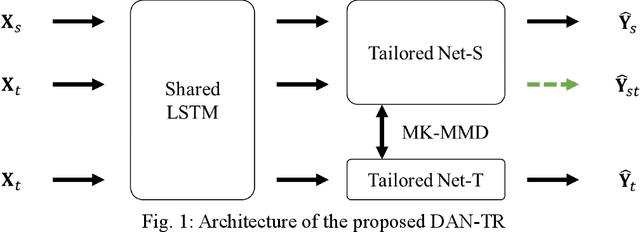
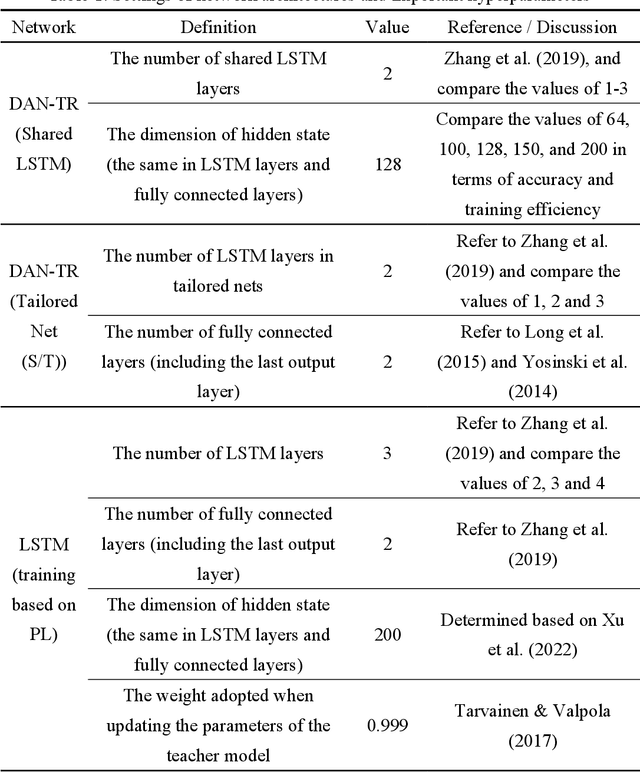
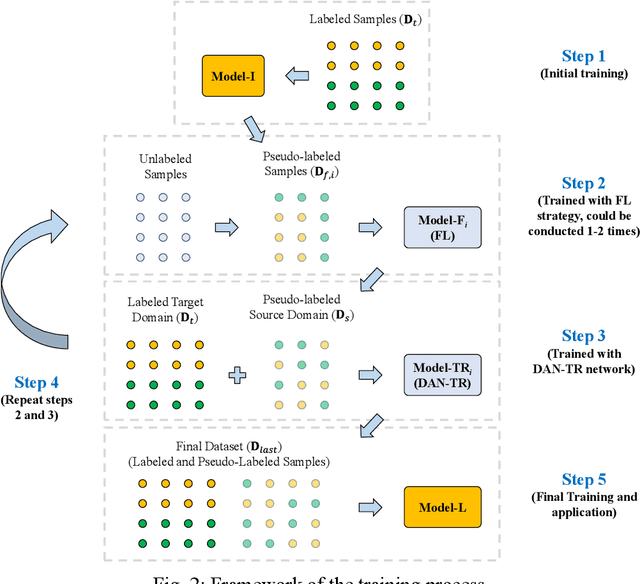
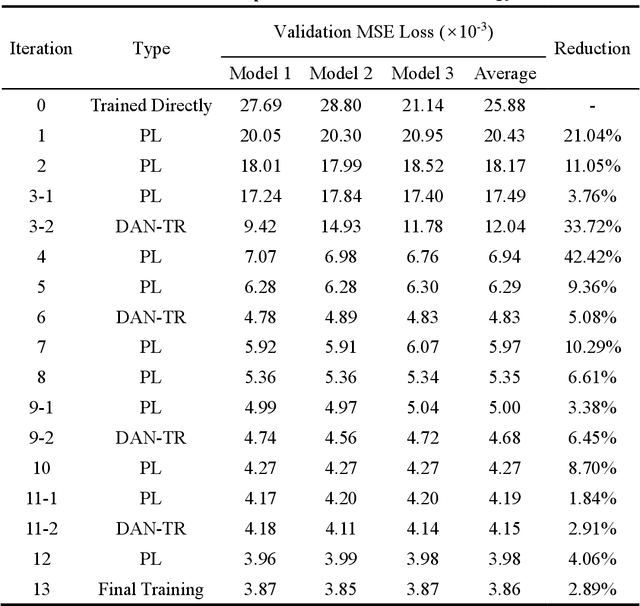
There are numerous advantages of deep neural network surrogate modeling for response time-history prediction. However, due to the high cost of refined numerical simulations and actual experiments, the lack of data has become an unavoidable bottleneck in practical applications. An iterative self-transfer learningmethod for training neural networks based on small datasets is proposed in this study. A new mapping-based transfer learning network, named as deep adaptation network with three branches for regression (DAN-TR), is proposed. A general iterative network training strategy is developed by coupling DAN-TR and the pseudo-label strategy, and the establishment of corresponding datasets is also discussed. Finally, a complex component is selected as a case study. The results show that the proposed method can improve the model performance by near an order of magnitude on small datasets without the need of external labeled samples,well behaved pre-trainedmodels, additional artificial labeling, and complex physical/mathematical analysis.
* 14 pages, 8 figures; Published on Journal of Computational Design and Engineering, 9(5), 2089-2102