 Add to Chrome
 Add to Firefox
 Add to Edge
BabyVision: Visual Reasoning Beyond Language
Jan 10, 2026
While humans develop core visual skills long before acquiring language, contemporary Multimodal LLMs (MLLMs) still rely heavily on linguistic priors to compensate for their fragile visual understanding. We uncovered a crucial fact: state-of-the-art MLLMs consistently fail on basic visual tasks that humans, even 3-year-olds, can solve effortlessly. To systematically investigate this gap, we introduce BabyVision, a benchmark designed to assess core visual abilities independent of linguistic knowledge for MLLMs. BabyVision spans a wide range of tasks, with 388 items divided into 22 subclasses across four key categories. Empirical results and human evaluation reveal that leading MLLMs perform significantly below human baselines. Gemini3-Pro-Preview scores 49.7, lagging behind 6-year-old humans and falling well behind the average adult score of 94.1. These results show despite excelling in knowledge-heavy evaluations, current MLLMs still lack fundamental visual primitives. Progress in BabyVision represents a step toward human-level visual perception and reasoning capabilities. We also explore solving visual reasoning with generation models by proposing BabyVision-Gen and automatic evaluation toolkit. Our code and benchmark data are released at https://github.com/UniPat-AI/BabyVision for reproduction.

Dynamic Rank Adjustment in Diffusion Policies for Efficient and Flexible Training
Feb 07, 2025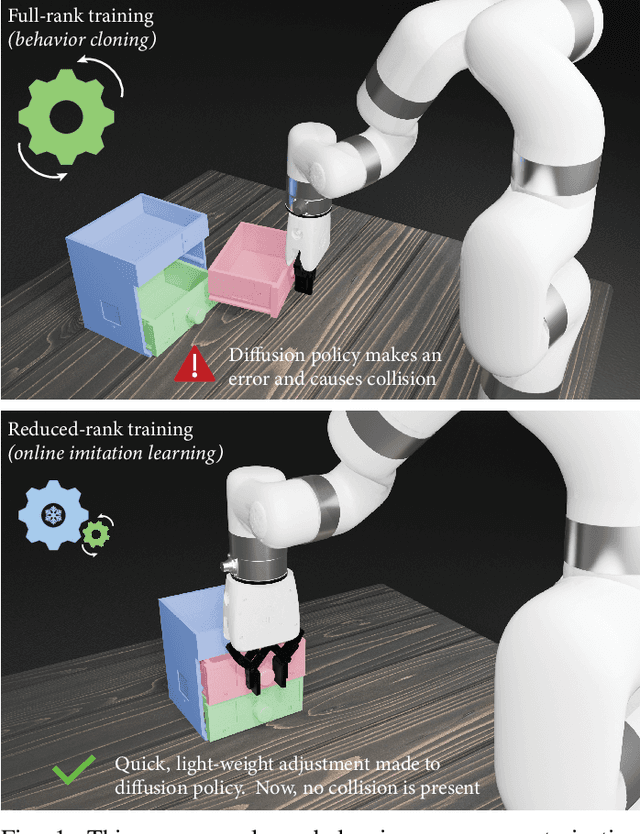
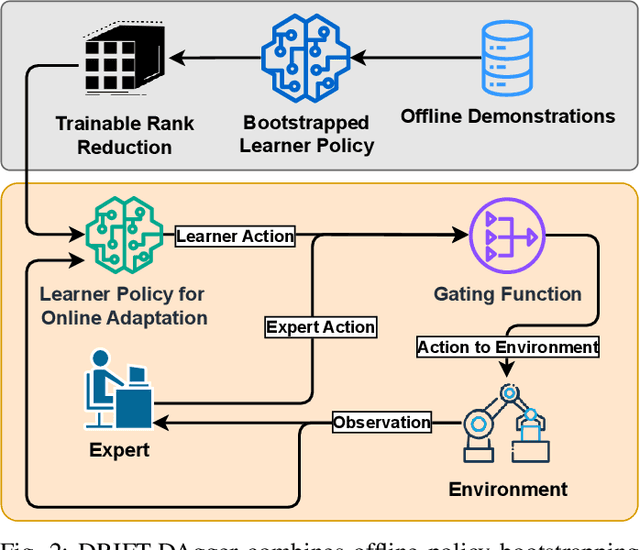
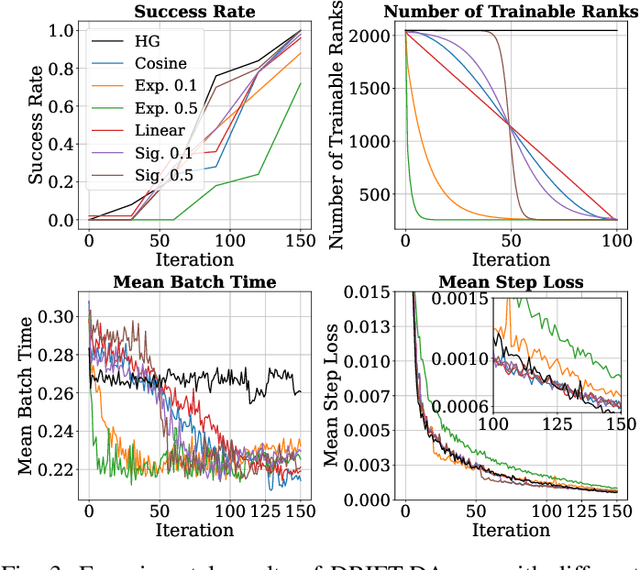
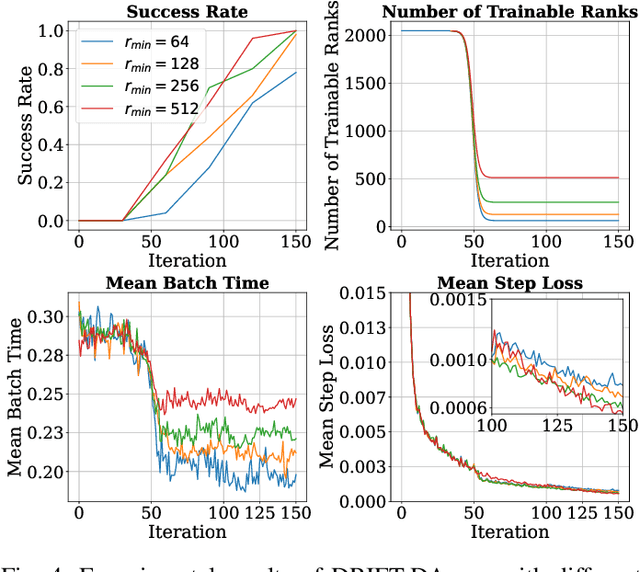
Diffusion policies trained via offline behavioral cloning have recently gained traction in robotic motion generation. While effective, these policies typically require a large number of trainable parameters. This model size affords powerful representations but also incurs high computational cost during training. Ideally, it would be beneficial to dynamically adjust the trainable portion as needed, balancing representational power with computational efficiency. For example, while overparameterization enables diffusion policies to capture complex robotic behaviors via offline behavioral cloning, the increased computational demand makes online interactive imitation learning impractical due to longer training time. To address this challenge, we present a framework, called DRIFT, that uses the Singular Value Decomposition to enable dynamic rank adjustment during diffusion policy training. We implement and demonstrate the benefits of this framework in DRIFT-DAgger, an imitation learning algorithm that can seamlessly slide between an offline bootstrapping phase and an online interactive phase. We perform extensive experiments to better understand the proposed framework, and demonstrate that DRIFT-DAgger achieves improved sample efficiency and faster training with minimal impact on model performance.