 Add to Chrome
 Add to Firefox
 Add to Edge
CoPHo: Classifier-guided Conditional Topology Generation with Persistent Homology
Dec 17, 2025
The structure of topology underpins much of the research on performance and robustness, yet available topology data are typically scarce, necessitating the generation of synthetic graphs with desired properties for testing or release. Prior diffusion-based approaches either embed conditions into the diffusion model, requiring retraining for each attribute and hindering real-time applicability, or use classifier-based guidance post-training, which does not account for topology scale and practical constraints. In this paper, we show from a discrete perspective that gradients from a pre-trained graph-level classifier can be incorporated into the discrete reverse diffusion posterior to steer generation toward specified structural properties. Based on this insight, we propose Classifier-guided Conditional Topology Generation with Persistent Homology (CoPHo), which builds a persistent homology filtration over intermediate graphs and interprets features as guidance signals that steer generation toward the desired properties at each denoising step. Experiments on four generic/network datasets demonstrate that CoPHo outperforms existing methods at matching target metrics, and we further validate its transferability on the QM9 molecular dataset.

View while Moving: Efficient Video Recognition in Long-untrimmed Videos
Aug 09, 2023
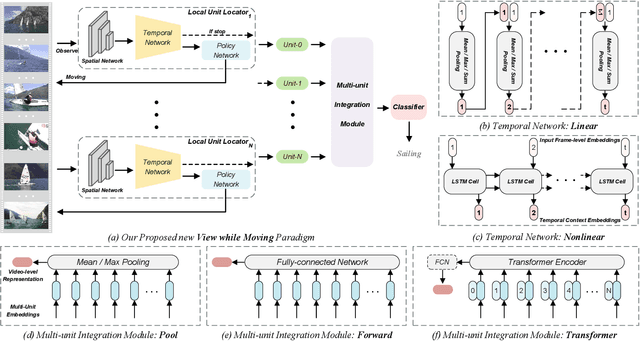
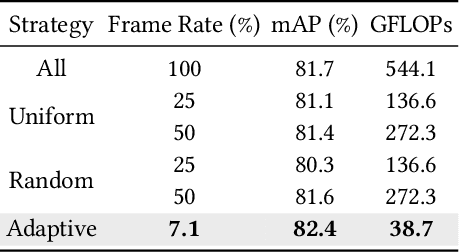
Recent adaptive methods for efficient video recognition mostly follow the two-stage paradigm of "preview-then-recognition" and have achieved great success on multiple video benchmarks. However, this two-stage paradigm involves two visits of raw frames from coarse-grained to fine-grained during inference (cannot be parallelized), and the captured spatiotemporal features cannot be reused in the second stage (due to varying granularity), being not friendly to efficiency and computation optimization. To this end, inspired by human cognition, we propose a novel recognition paradigm of "View while Moving" for efficient long-untrimmed video recognition. In contrast to the two-stage paradigm, our paradigm only needs to access the raw frame once. The two phases of coarse-grained sampling and fine-grained recognition are combined into unified spatiotemporal modeling, showing great performance. Moreover, we investigate the properties of semantic units in video and propose a hierarchical mechanism to efficiently capture and reason about the unit-level and video-level temporal semantics in long-untrimmed videos respectively. Extensive experiments on both long-untrimmed and short-trimmed videos demonstrate that our approach outperforms state-of-the-art methods in terms of accuracy as well as efficiency, yielding new efficiency and accuracy trade-offs for video spatiotemporal modeling.