 Add to Chrome
 Add to Firefox
 Add to Edge
Learning to Decode in Parallel: Self-Coordinating Neural Network for Real-Time Quantum Error Correction
Jan 14, 2026
Fast, reliable decoders are pivotal components for enabling fault-tolerant quantum computation (FTQC). Neural network decoders like AlphaQubit have demonstrated potential, achieving higher accuracy than traditional human-designed decoding algorithms. However, existing implementations of neural network decoders lack the parallelism required to decode the syndrome stream generated by a superconducting logical qubit in real time. Moreover, integrating AlphaQubit with sliding window-based parallel decoding schemes presents non-trivial challenges: AlphaQubit is trained solely to output a single bit corresponding to the global logical correction for an entire memory experiment, rather than local physical corrections that can be easily integrated. We address this issue by training a recurrent, transformer-based neural network specifically tailored for parallel window decoding. While it still outputs a single bit, we derive training labels from a consistent set of local corrections and train on various types of decoding windows simultaneously. This approach enables the network to self-coordinate across neighboring windows, facilitating high-accuracy parallel decoding of arbitrarily long memory experiments. As a result, we overcome the throughput bottleneck that previously precluded the use of AlphaQubit-type decoders in FTQC. Our work presents the first scalable, neural-network-based parallel decoding framework that simultaneously achieves SOTA accuracy and the stringent throughput required for real-time quantum error correction. Using an end-to-end experimental workflow, we benchmark our decoder on the Zuchongzhi 3.2 superconducting quantum processor on surface codes with distances up to 7, demonstrating its superior accuracy. Moreover, we demonstrate that, using our approach, a single TPU v6e is capable of decoding surface codes with distances up to 25 within 1us per decoding round.

Test-Time-Matching: Decouple Personality, Memory, and Linguistic Style in LLM-based Role-Playing Language Agent
Jul 23, 2025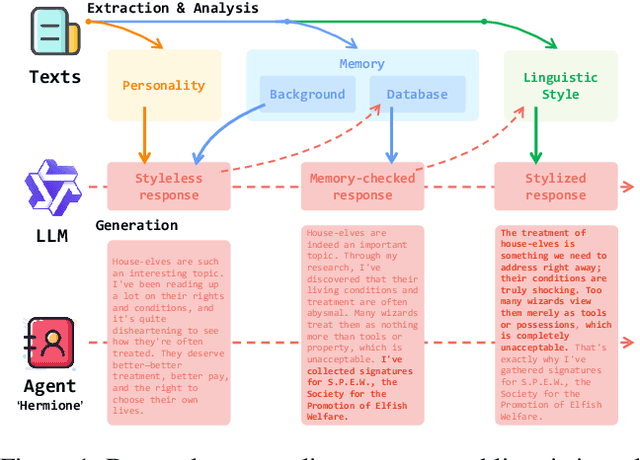
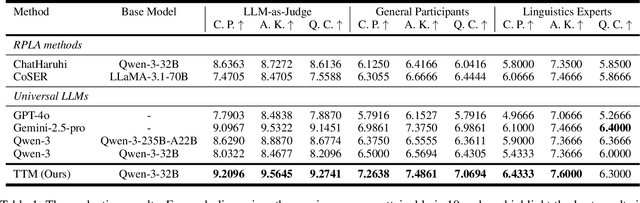
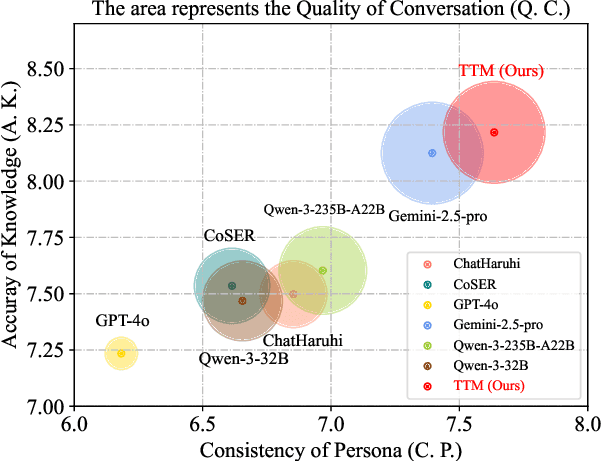
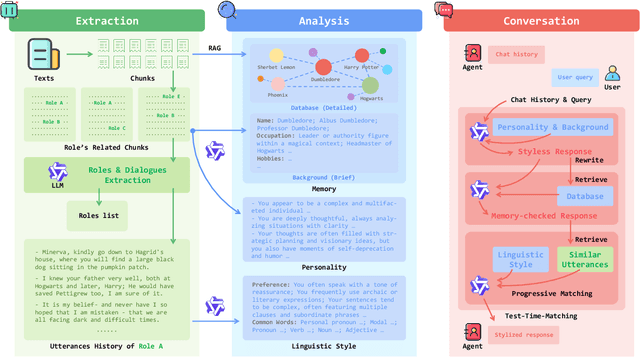
The rapid advancement of large language models (LLMs) has enabled role-playing language agents to demonstrate significant potential in various applications. However, relying solely on prompts and contextual inputs often proves insufficient for achieving deep immersion in specific roles, particularly well-known fictional or public figures. On the other hand, fine-tuning-based approaches face limitations due to the challenges associated with data collection and the computational resources required for training, thereby restricting their broader applicability. To address these issues, we propose Test-Time-Matching (TTM), a training-free role-playing framework through test-time scaling and context engineering. TTM uses LLM agents to automatically decouple a character's features into personality, memory, and linguistic style. Our framework involves a structured, three-stage generation pipeline that utilizes these features for controlled role-playing. It achieves high-fidelity role-playing performance, also enables seamless combinations across diverse linguistic styles and even variations in personality and memory. We evaluate our framework through human assessment, and the results demonstrate that our method achieves the outstanding performance in generating expressive and stylistically consistent character dialogues.
Semantic Human Mesh Reconstruction with Textures
Mar 05, 2024The field of 3D detailed human mesh reconstruction has made significant progress in recent years. However, current methods still face challenges when used in industrial applications due to unstable results, low-quality meshes, and a lack of UV unwrapping and skinning weights. In this paper, we present SHERT, a novel pipeline that can reconstruct semantic human meshes with textures and high-precision details. SHERT applies semantic- and normal-based sampling between the detailed surface (eg mesh and SDF) and the corresponding SMPL-X model to obtain a partially sampled semantic mesh and then generates the complete semantic mesh by our specifically designed self-supervised completion and refinement networks. Using the complete semantic mesh as a basis, we employ a texture diffusion model to create human textures that are driven by both images and texts. Our reconstructed meshes have stable UV unwrapping, high-quality triangle meshes, and consistent semantic information. The given SMPL-X model provides semantic information and shape priors, allowing SHERT to perform well even with incorrect and incomplete inputs. The semantic information also makes it easy to substitute and animate different body parts such as the face, body, and hands. Quantitative and qualitative experiments demonstrate that SHERT is capable of producing high-fidelity and robust semantic meshes that outperform state-of-the-art methods.