 Add to Chrome
 Add to Firefox
 Add to Edge
Adaptive Prompt Elicitation for Text-to-Image Generation
Feb 04, 2026
Aligning text-to-image generation with user intent remains challenging, for users who provide ambiguous inputs and struggle with model idiosyncrasies. We propose Adaptive Prompt Elicitation (APE), a technique that adaptively asks visual queries to help users refine prompts without extensive writing. Our technical contribution is a formulation of interactive intent inference under an information-theoretic framework. APE represents latent intent as interpretable feature requirements using language model priors, adaptively generates visual queries, and compiles elicited requirements into effective prompts. Evaluation on IDEA-Bench and DesignBench shows that APE achieves stronger alignment with improved efficiency. A user study with challenging user-defined tasks demonstrates 19.8% higher alignment without workload overhead. Our work contributes a principled approach to prompting that, for general users, offers an effective and efficient complement to the prevailing prompt-based interaction paradigm with text-to-image models.

An End-to-End Neural Network for Image Cropping by Learning Composition from Aesthetic Photos
Aug 07, 2019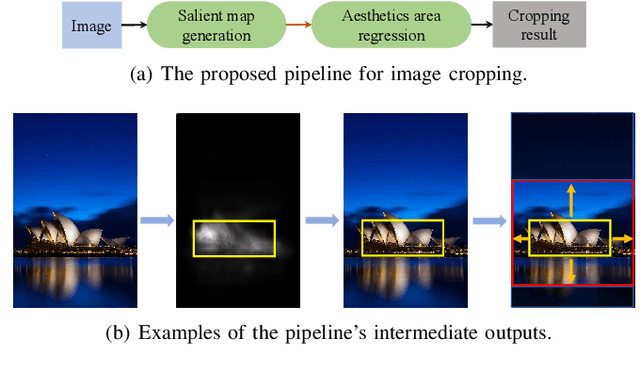
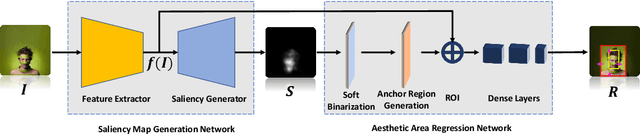
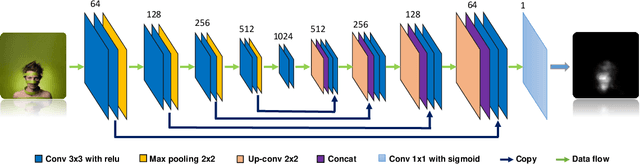
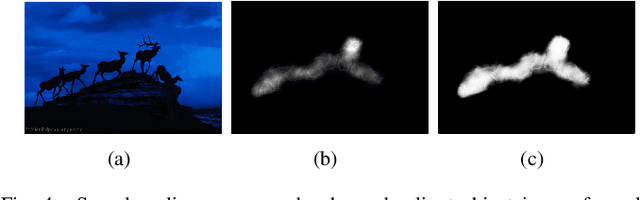
As one of the fundamental techniques for image editing, image cropping discards unrelevant contents and remains the pleasing portions of the image to enhance the overall composition and achieve better visual/aesthetic perception. In this paper, we primarily focus on improving the accuracy of automatic image cropping, and on further exploring its potential in public datasets with high efficiency. From this respect, we propose a deep learning based framework to learn the objects composition from photos with high aesthetic qualities, where an anchor region is detected through a convolutional neural network (CNN) with the Gaussian kernel to maintain the interested objects' integrity. This initial detected anchor area is then fed into a light weighted regression network to obtain the final cropping result. Unlike the conventional methods that multiple candidates are proposed and evaluated iteratively, only a single anchor region is produced in our model, which is mapped to the final output directly. Thus, low computational resources are required for the proposed approach. The experimental results on the public datasets show that both cropping accuracy and efficiency achieve the state-ofthe-art performances.