 Add to Chrome
 Add to Firefox
 Add to Edge
Virtual-Tube-Based Cooperative Transport Control for Multi-UAV Systems in Constrained Environments
Feb 05, 2026
This paper proposes a novel control framework for cooperative transportation of cable-suspended loads by multiple unmanned aerial vehicles (UAVs) operating in constrained environments. Leveraging virtual tube theory and principles from dissipative systems theory, the framework facilitates efficient multi-UAV collaboration for navigating obstacle-rich areas. The proposed framework offers several key advantages. (1) It achieves tension distribution and coordinated transportation within the UAV-cable-load system with low computational overhead, dynamically adapting UAV configurations based on obstacle layouts to facilitate efficient navigation. (2) By integrating dissipative systems theory, the framework ensures high stability and robustness, essential for complex multi-UAV operations. The effectiveness of the proposed approach is validated through extensive simulations, demonstrating its scalability for large-scale multi-UAV systems. Furthermore, the method is experimentally validated in outdoor scenarios, showcasing its practical feasibility and robustness under real-world conditions.

RflyMAD: A Dataset for Multicopter Fault Detection and Health Assessment
Nov 19, 2023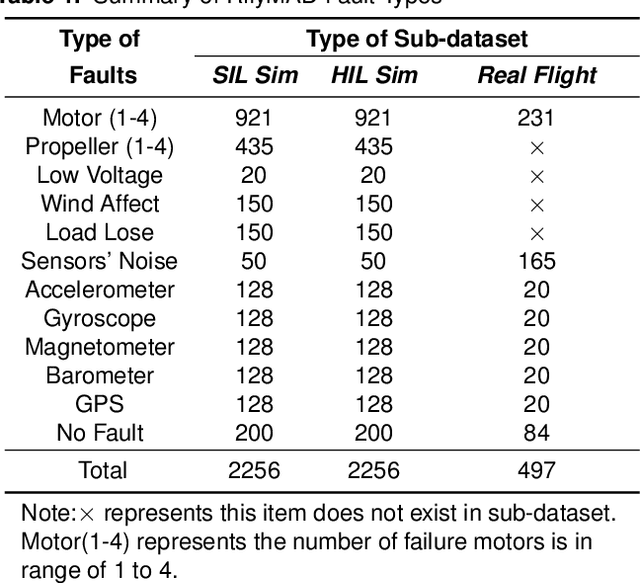
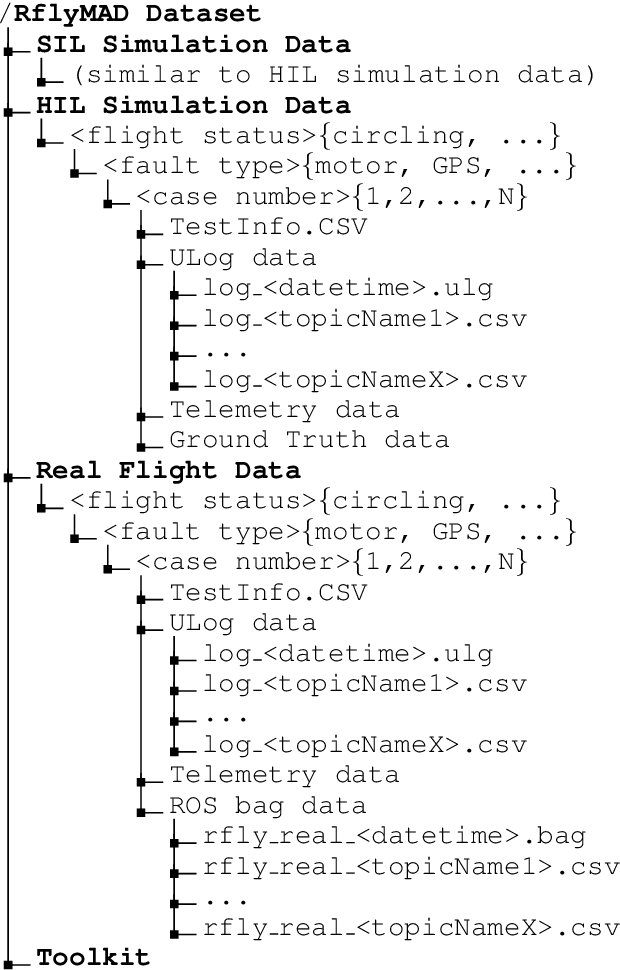
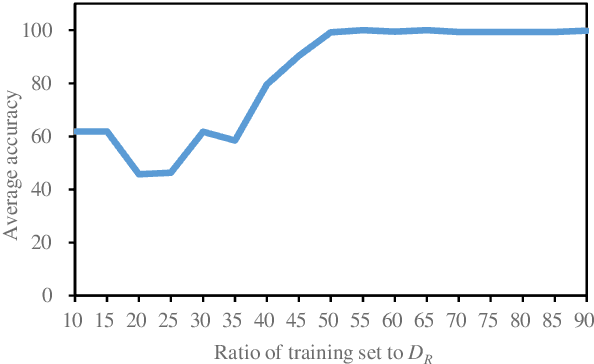
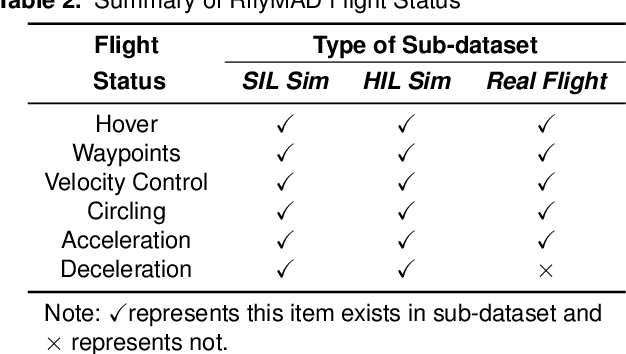
This paper presents an open-source dataset RflyMAD, a Multicopter Abnomal Dataset developed by Reliable Flight Control (Rfly) Group aiming to promote the development of research fields like fault detection and isolation (FDI) or health assessment (HA). The entire 114 GB dataset includes 11 types of faults under 6 flight statuses which are adapted from ADS-33 file to cover more occasions in which the multicopters have different mobility levels when faults occur. In the total 5629 flight cases, the fault time is up to 3283 minutes, and there are 2566 cases for software-in-the-loop (SIL) simulation, 2566 cases for hardware-in-the-loop (HIL) simulation and 497 cases for real flight. As it contains simulation data based on RflySim and real flight data, it is possible to improve the quantity while increasing the data quality. In each case, there are ULog, Telemetry log, Flight information and processed files for researchers to use and check. The RflyMAD dataset could be used as a benchmark for fault diagnosis methods and the support relationship between simulation data and real flight is verified through transfer learning methods. More methods as a baseline will be presented in the future, and RflyMAD will be updated with more data and types. In addition, the dataset and related toolkit can be accessed through https://rfly-openha.github.io/documents/4_resources/dataset.html.