 Add to Chrome
 Add to Firefox
 Add to Edge
Virtual-Tube-Based Cooperative Transport Control for Multi-UAV Systems in Constrained Environments
Feb 05, 2026
This paper proposes a novel control framework for cooperative transportation of cable-suspended loads by multiple unmanned aerial vehicles (UAVs) operating in constrained environments. Leveraging virtual tube theory and principles from dissipative systems theory, the framework facilitates efficient multi-UAV collaboration for navigating obstacle-rich areas. The proposed framework offers several key advantages. (1) It achieves tension distribution and coordinated transportation within the UAV-cable-load system with low computational overhead, dynamically adapting UAV configurations based on obstacle layouts to facilitate efficient navigation. (2) By integrating dissipative systems theory, the framework ensures high stability and robustness, essential for complex multi-UAV operations. The effectiveness of the proposed approach is validated through extensive simulations, demonstrating its scalability for large-scale multi-UAV systems. Furthermore, the method is experimentally validated in outdoor scenarios, showcasing its practical feasibility and robustness under real-world conditions.

An Efficient Real-Time Planning Method for Swarm Robotics Based on an Optimal Virtual Tube
May 02, 2025Swarm robotics navigating through unknown obstacle environments is an emerging research area that faces challenges. Performing tasks in such environments requires swarms to achieve autonomous localization, perception, decision-making, control, and planning. The limited computational resources of onboard platforms present significant challenges for planning and control. Reactive planners offer low computational demands and high re-planning frequencies but lack predictive capabilities, often resulting in local minima. Long-horizon planners, on the other hand, can perform multi-step predictions to reduce deadlocks but cost much computation, leading to lower re-planning frequencies. This paper proposes a real-time optimal virtual tube planning method for swarm robotics in unknown environments, which generates approximate solutions for optimal trajectories through affine functions. As a result, the computational complexity of approximate solutions is $O(n_t)$, where $n_t$ is the number of parameters in the trajectory, thereby significantly reducing the overall computational burden. By integrating reactive methods, the proposed method enables low-computation, safe swarm motion in unknown environments. The effectiveness of the proposed method is validated through several simulations and experiments.
Tube-RRT*: Efficient Homotopic Path Planning for Swarm Robotics Passing-Through Large-Scale Obstacle Environments
Apr 14, 2024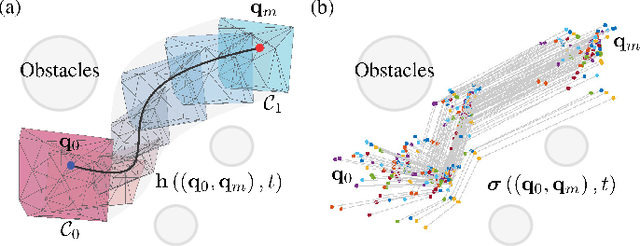

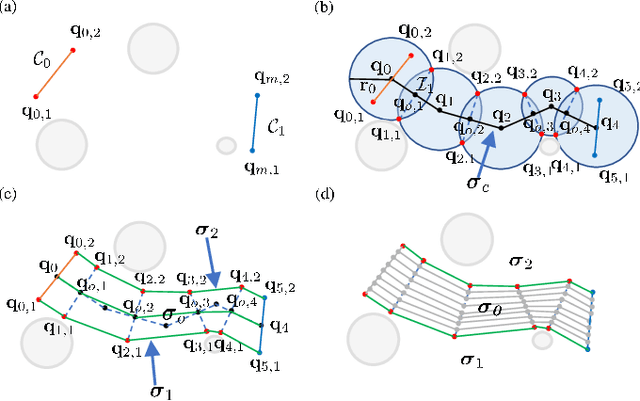
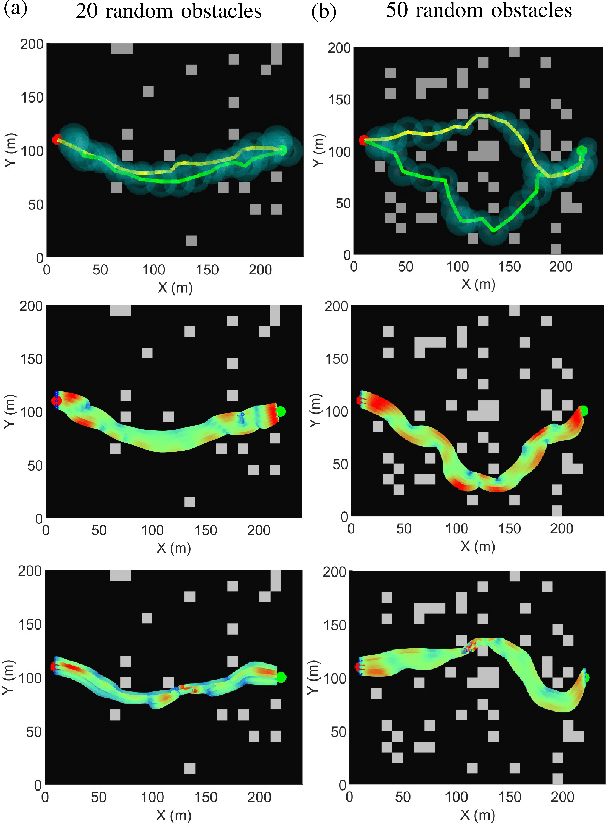
Recently, the concept of optimal virtual tube has emerged as a novel solution to the challenging task of navigating obstacle-dense environments for swarm robotics, offering a wide ranging of applications. However, it lacks an efficient homotopic path planning method in obstacle-dense environments. This paper introduces Tube-RRT*, an innovative homotopic path planning method that builds upon and improves the Rapidly-exploring Random Tree (RRT) algorithm. Tube-RRT* is specifically designed to generate homotopic paths for the trajectories in the virtual tube, strategically considering opening volume and tube length to mitigate swarm congestion and ensure agile navigation. Through comprehensive comparative simulations conducted within complex, large-scale obstacle environments, we demonstrate the effectiveness of Tube-RRT*.
Optimal Virtual Tube Planning and Control for Swarm Robotics
Apr 22, 2023This paper presents a novel method for efficiently solving trajectory planning problems for swarm robotics in cluttered environments. While recent research has demonstrated high success rates in real-time local trajectory planning for swarm robotics in cluttered environments, optimizing every trajectory for each robot is computationally expensive, with a computational complexity of $O\left(n^2\right)$ to $ O\left(n^3\right)$. To address this issue, we first propose the concept of the \emph{optimal virtual tube}, which includes infinite optimal trajectories. Under certain conditions, any optimal trajectory in the optimal virtual tube can be expressed as a convex combination of a finite number of optimal trajectories, with a computational complexity of $O\left(1\right)$. Afterward, a planning method of \emph{the optimal virtual tube} is proposed. In simulations and experiments, we show that the proposed method efficiently reduces calculation and is validated by comparison with traditional methods.