 Add to Chrome
 Add to Firefox
 Add to Edge
Transfer Learning Through Conditional Quantile Matching
Feb 02, 2026
We introduce a transfer learning framework for regression that leverages heterogeneous source domains to improve predictive performance in a data-scarce target domain. Our approach learns a conditional generative model separately for each source domain and calibrates the generated responses to the target domain via conditional quantile matching. This distributional alignment step corrects general discrepancies between source and target domains without imposing restrictive assumptions such as covariate or label shift. The resulting framework provides a principled and flexible approach to high-quality data augmentation for downstream learning tasks in the target domain. From a theoretical perspective, we show that an empirical risk minimizer (ERM) trained on the augmented dataset achieves a tighter excess risk bound than the target-only ERM under mild conditions. In particular, we establish new convergence rates for the quantile matching estimator that governs the transfer bias-variance tradeoff. From a practical perspective, extensive simulations and real data applications demonstrate that the proposed method consistently improves prediction accuracy over target-only learning and competing transfer learning methods.

Anomaly Detection in Large Scale Networks with Latent Space Models
Nov 13, 2019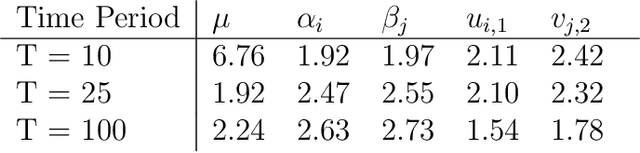
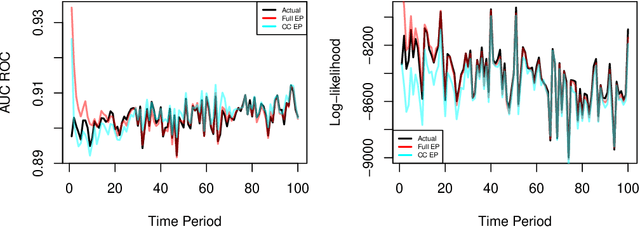
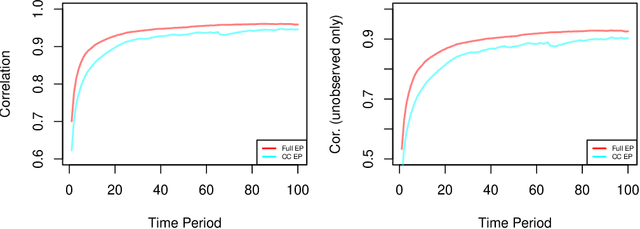
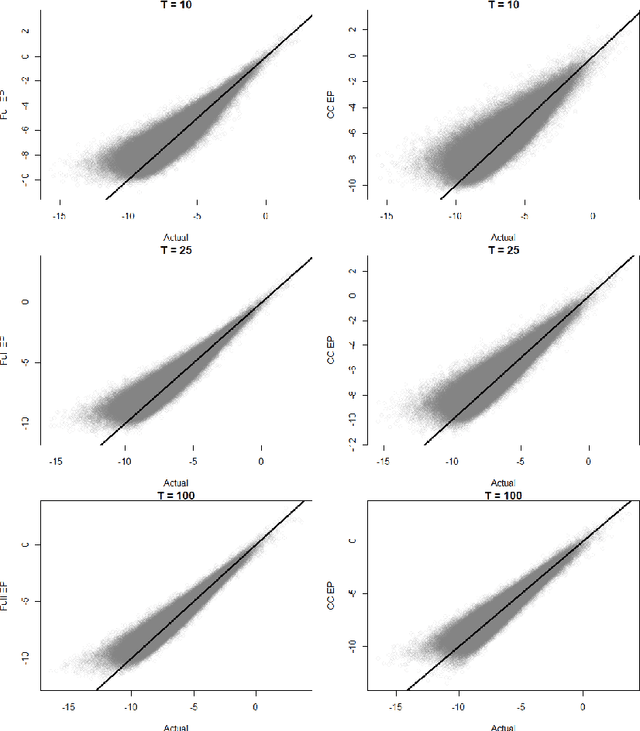
We develop a real-time anomaly detection algorithm for directed activity on large, sparse networks. We model the propensity for future activity using a dynamic logistic model with interaction terms for sender- and receiver-specific latent factors in addition to sender- and receiver-specific popularity scores; deviations from this underlying model constitute potential anomalies. Latent nodal attributes are estimated via a variational Bayesian approach and may change over time, representing natural shifts in network activity. Estimation is augmented with a case-control approximation to take advantage of the sparsity of the network and reduces computational complexity from $O(N^2)$ to $O(E)$, where $N$ is the number of nodes and $E$ is the number of observed edges. We run our algorithm on network event records collected from an enterprise network of over 25,000 computers and are able to identify a red team attack with half the detection rate required of the model without latent interaction terms.