 Add to Chrome
 Add to Firefox
 Add to Edge
Towards Real-world Lens Active Alignment with Unlabeled Data via Domain Adaptation
Jan 08, 2026
Active Alignment (AA) is a key technology for the large-scale automated assembly of high-precision optical systems. Compared with labor-intensive per-model on-device calibration, a digital-twin pipeline built on optical simulation offers a substantial advantage in generating large-scale labeled data. However, complex imaging conditions induce a domain gap between simulation and real-world images, limiting the generalization of simulation-trained models. To address this, we propose augmenting a simulation baseline with minimal unlabeled real-world images captured at random misalignment positions, mitigating the gap from a domain adaptation perspective. We introduce Domain Adaptive Active Alignment (DA3), which utilizes an autoregressive domain transformation generator and an adversarial-based feature alignment strategy to distill real-world domain information via self-supervised learning. This enables the extraction of domain-invariant image degradation features to facilitate robust misalignment prediction. Experiments on two lens types reveal that DA3 improves accuracy by 46% over a purely simulation pipeline. Notably, it approaches the performance achieved with precisely labeled real-world data collected on 3 lens samples, while reducing on-device data collection time by 98.7%. The results demonstrate that domain adaptation effectively endows simulation-trained models with robust real-world performance, validating the digital-twin pipeline as a practical solution to significantly enhance the efficiency of large-scale optical assembly.

One-Step Event-Driven High-Speed Autofocus
Mar 03, 2025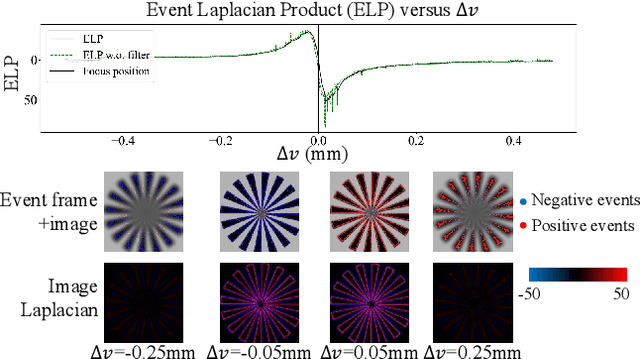
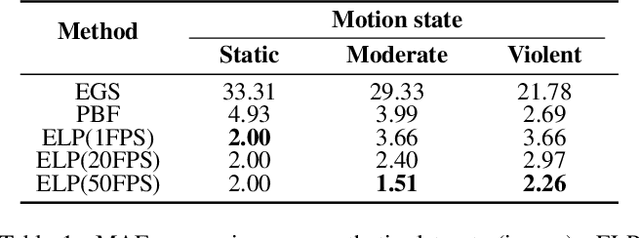
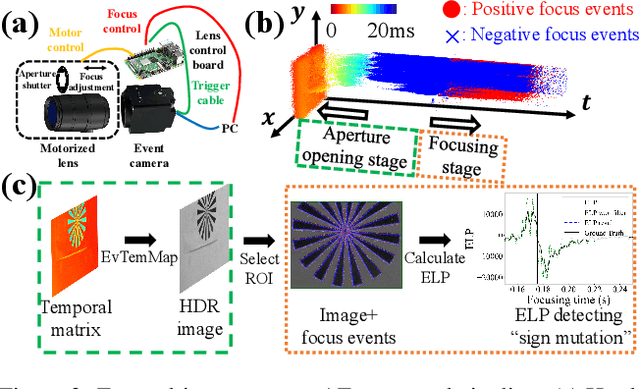
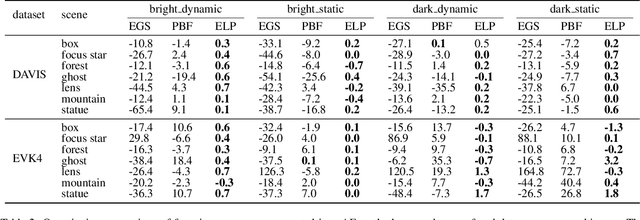
High-speed autofocus in extreme scenes remains a significant challenge. Traditional methods rely on repeated sampling around the focus position, resulting in ``focus hunting''. Event-driven methods have advanced focusing speed and improved performance in low-light conditions; however, current approaches still require at least one lengthy round of ``focus hunting'', involving the collection of a complete focus stack. We introduce the Event Laplacian Product (ELP) focus detection function, which combines event data with grayscale Laplacian information, redefining focus search as a detection task. This innovation enables the first one-step event-driven autofocus, cutting focusing time by up to two-thirds and reducing focusing error by 24 times on the DAVIS346 dataset and 22 times on the EVK4 dataset. Additionally, we present an autofocus pipeline tailored for event-only cameras, achieving accurate results across a range of challenging motion and lighting conditions. All datasets and code will be made publicly available.