 Add to Chrome
 Add to Firefox
 Add to Edge
Single-Edge Node Injection Threats to GNN-Based Security Monitoring in Industrial Graph Systems
Feb 01, 2026
Graph neural networks (GNNs) are increasingly adopted in industrial graph-based monitoring systems (e.g., Industrial internet of things (IIoT) device graphs, power-grid topology models, and manufacturing communication networks) to support anomaly detection, state estimation, and asset classification. In such settings, an adversary that compromises a small number of edge devices may inject counterfeit nodes (e.g., rogue sensors, virtualized endpoints, or spoofed substations) to bias downstream decisions while evading topology- and homophily-based sanitization. This paper formulates deployment-oriented node-injection attacks under constrained resources and proposes the \emph{Single-Edge Graph Injection Attack} (SEGIA), in which each injected node attaches to the operational graph through a single edge. SEGIA integrates a pruned SGC surrogate, multi-hop neighborhood sampling, and reverse graph convolution-based feature synthesis with a similarity-regularized objective to preserve local homophily and survive edge pruning. Theoretical analysis and extensive evaluations across datasets and defenses show at least $25\%$ higher attack success than representative baselines under substantially smaller edge budgets. These results indicate a system-level risk in industrial GNN deployments and motivate lightweight admission validation and neighborhood-consistency monitoring.

GLM-4.5: Agentic, Reasoning, and Coding (ARC) Foundation Models
Aug 08, 2025We present GLM-4.5, an open-source Mixture-of-Experts (MoE) large language model with 355B total parameters and 32B activated parameters, featuring a hybrid reasoning method that supports both thinking and direct response modes. Through multi-stage training on 23T tokens and comprehensive post-training with expert model iteration and reinforcement learning, GLM-4.5 achieves strong performance across agentic, reasoning, and coding (ARC) tasks, scoring 70.1% on TAU-Bench, 91.0% on AIME 24, and 64.2% on SWE-bench Verified. With much fewer parameters than several competitors, GLM-4.5 ranks 3rd overall among all evaluated models and 2nd on agentic benchmarks. We release both GLM-4.5 (355B parameters) and a compact version, GLM-4.5-Air (106B parameters), to advance research in reasoning and agentic AI systems. Code, models, and more information are available at https://github.com/zai-org/GLM-4.5.
CNN-Cap: Effective Convolutional Neural Network Based Capacitance Models for Full-Chip Parasitic Extraction
Jul 14, 2021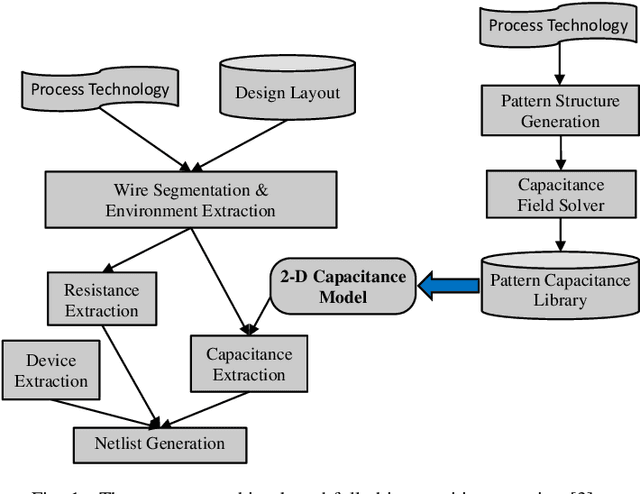
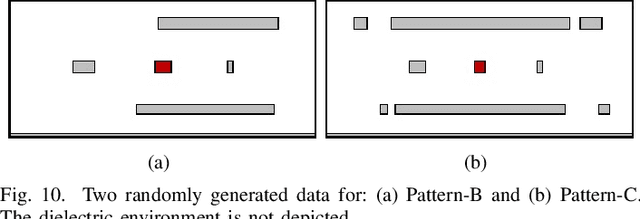
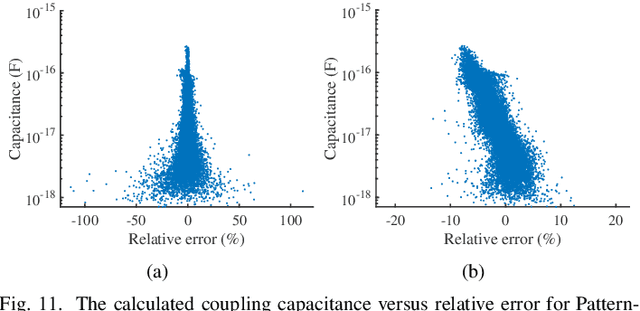
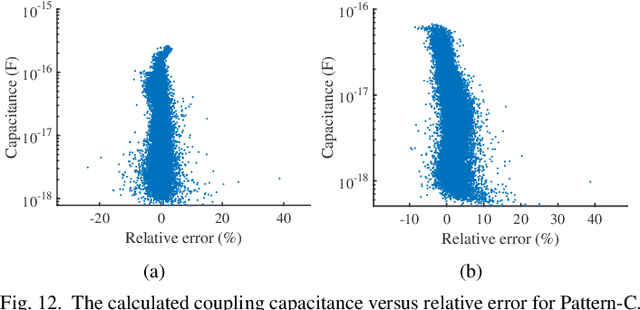
Accurate capacitance extraction is becoming more important for designing integrated circuits under advanced process technology. The pattern matching based full-chip extraction methodology delivers fast computational speed, but suffers from large error, and tedious efforts on building capacitance models of the increasing structure patterns. In this work, we propose an effective method for building convolutional neural network (CNN) based capacitance models (called CNN-Cap) for two-dimensional (2-D) structures in full-chip capacitance extraction. With a novel grid-based data representation, the proposed method is able to model the pattern with a variable number of conductors, so that largely reduce the number of patterns. Based on the ability of ResNet architecture on capturing spatial information and the proposed training skills, the obtained CNN-Cap exhibits much better performance over the multilayer perception neural network based capacitance model while being more versatile. Extensive experiments on a 55nm and a 15nm process technologies have demonstrated that the error of total capacitance produced with CNN-Cap is always within 1.3% and the error of produced coupling capacitance is less than 10% in over 99.5% probability. CNN-Cap runs more than 4000X faster than 2-D field solver on a GPU server, while it consumes negligible memory compared to the look-up table based capacitance model.