 Add to Chrome
 Add to Firefox
 Add to Edge
SHIELD: An Auto-Healing Agentic Defense Framework for LLM Resource Exhaustion Attacks
Jan 27, 2026
Sponge attacks increasingly threaten LLM systems by inducing excessive computation and DoS. Existing defenses either rely on statistical filters that fail on semantically meaningful attacks or use static LLM-based detectors that struggle to adapt as attack strategies evolve. We introduce SHIELD, a multi-agent, auto-healing defense framework centered on a three-stage Defense Agent that integrates semantic similarity retrieval, pattern matching, and LLM-based reasoning. Two auxiliary agents, a Knowledge Updating Agent and a Prompt Optimization Agent, form a closed self-healing loop, when an attack bypasses detection, the system updates an evolving knowledgebase, and refines defense instructions. Extensive experiments show that SHIELD consistently outperforms perplexity-based and standalone LLM defenses, achieving high F1 scores across both non-semantic and semantic sponge attacks, demonstrating the effectiveness of agentic self-healing against evolving resource-exhaustion threats.

Prompt-Induced Over-Generation as Denial-of-Service: A Black-Box Attack-Side Benchmark
Dec 29, 2025Large language models (LLMs) can be driven into over-generation, emitting thousands of tokens before producing an end-of-sequence (EOS) token. This degrades answer quality, inflates latency and cost, and can be weaponized as a denial-of-service (DoS) attack. Recent work has begun to study DoS-style prompt attacks, but typically focuses on a single attack algorithm or assumes white-box access, without an attack-side benchmark that compares prompt-based attackers in a black-box, query-only regime with a known tokenizer. We introduce such a benchmark and study two prompt-only attackers. The first is Evolutionary Over-Generation Prompt Search (EOGen), which searches the token space for prefixes that suppress EOS and induce long continuations. The second is a goal-conditioned reinforcement learning attacker (RL-GOAL) that trains a network to generate prefixes conditioned on a target length. To characterize behavior, we introduce Over-Generation Factor (OGF), the ratio of produced tokens to a model's context window, along with stall and latency summaries. Our evolutionary attacker achieves mean OGF = 1.38 +/- 1.15 and Success@OGF >= 2 of 24.5 percent on Phi-3. RL-GOAL is stronger: across victims it achieves higher mean OGF (up to 2.81 +/- 1.38).
The race to robustness: exploiting fragile models for urban camouflage and the imperative for machine learning security
Jun 26, 2023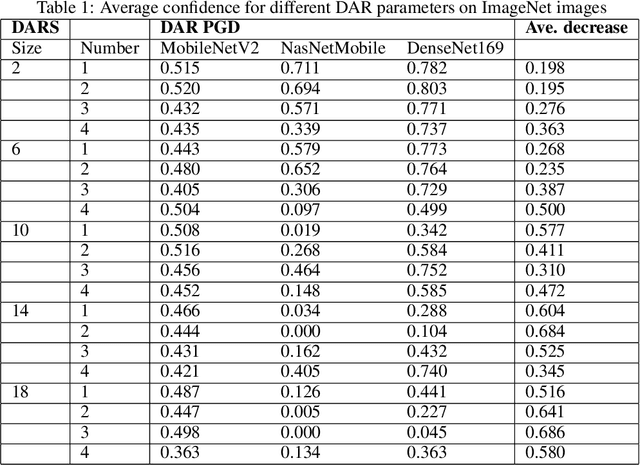
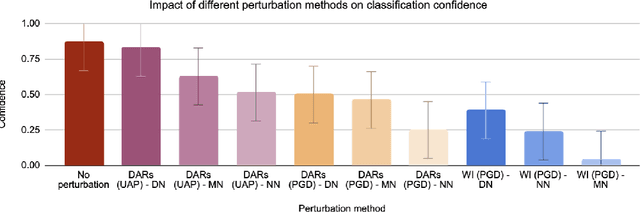
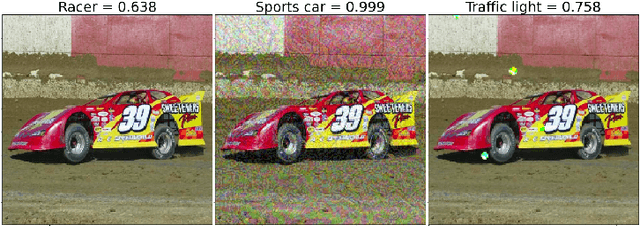
Adversarial Machine Learning (AML) represents the ability to disrupt Machine Learning (ML) algorithms through a range of methods that broadly exploit the architecture of deep learning optimisation. This paper presents Distributed Adversarial Regions (DAR), a novel method that implements distributed instantiations of computer vision-based AML attack methods that may be used to disguise objects from image recognition in both white and black box settings. We consider the context of object detection models used in urban environments, and benchmark the MobileNetV2, NasNetMobile and DenseNet169 models against a subset of relevant images from the ImageNet dataset. We evaluate optimal parameters (size, number and perturbation method), and compare to state-of-the-art AML techniques that perturb the entire image. We find that DARs can cause a reduction in confidence of 40.4% on average, but with the benefit of not requiring the entire image, or the focal object, to be perturbed. The DAR method is a deliberately simple approach where the intention is to highlight how an adversary with very little skill could attack models that may already be productionised, and to emphasise the fragility of foundational object detection models. We present this as a contribution to the field of ML security as well as AML. This paper contributes a novel adversarial method, an original comparison between DARs and other AML methods, and frames it in a new context - that of urban camouflage and the necessity for ML security and model robustness.