 Add to Chrome
 Add to Firefox
 Add to Edge
Efficient Token Pruning for LLaDA-V
Jan 28, 2026
Diffusion-based large multimodal models, such as LLaDA-V, have demonstrated impressive capabilities in vision-language understanding and generation. However, their bidirectional attention mechanism and diffusion-style iterative denoising paradigm introduce significant computational overhead, as visual tokens are repeatedly processed across all layers and denoising steps. In this work, we conduct an in-depth attention analysis and reveal that, unlike autoregressive decoders, LLaDA-V aggregates cross-modal information predominantly in middle-to-late layers, leading to delayed semantic alignment. Motivated by this observation, we propose a structured token pruning strategy inspired by FastV, selectively removing a proportion of visual tokens at designated layers to reduce FLOPs while preserving critical semantic information. To the best of our knowledge, this is the first work to investigate structured token pruning in diffusion-based large multimodal models. Unlike FastV, which focuses on shallow-layer pruning, our method targets the middle-to-late layers of the first denoising step to align with LLaDA-V's delayed attention aggregation to maintain output quality, and the first-step pruning strategy reduces the computation across all subsequent steps. Our framework provides an empirical basis for efficient LLaDA-V inference and highlights the potential of vision-aware pruning in diffusion-based multimodal models. Across multiple benchmarks, our best configuration reduces computational cost by up to 65% while preserving an average of 95% task performance.

LP-3DGS: Learning to Prune 3D Gaussian Splatting
May 29, 2024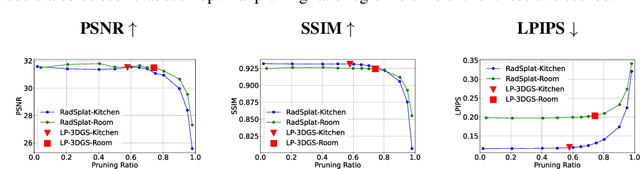
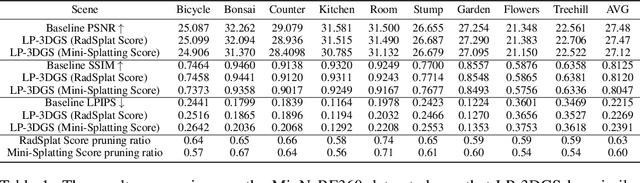
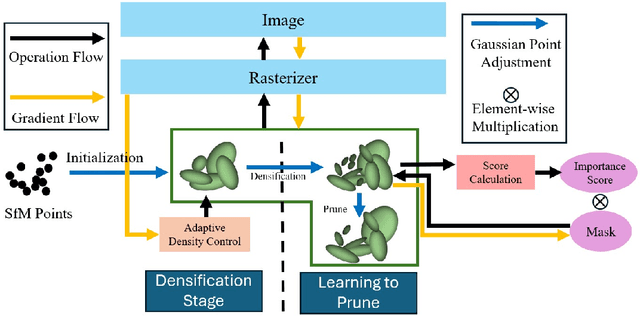
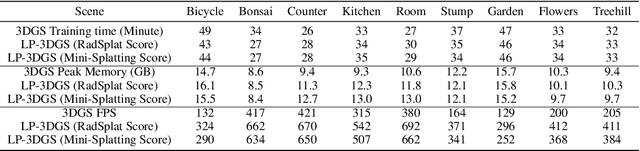
Recently, 3D Gaussian Splatting (3DGS) has become one of the mainstream methodologies for novel view synthesis (NVS) due to its high quality and fast rendering speed. However, as a point-based scene representation, 3DGS potentially generates a large number of Gaussians to fit the scene, leading to high memory usage. Improvements that have been proposed require either an empirical and preset pruning ratio or importance score threshold to prune the point cloud. Such hyperparamter requires multiple rounds of training to optimize and achieve the maximum pruning ratio, while maintaining the rendering quality for each scene. In this work, we propose learning-to-prune 3DGS (LP-3DGS), where a trainable binary mask is applied to the importance score that can find optimal pruning ratio automatically. Instead of using the traditional straight-through estimator (STE) method to approximate the binary mask gradient, we redesign the masking function to leverage the Gumbel-Sigmoid method, making it differentiable and compatible with the existing training process of 3DGS. Extensive experiments have shown that LP-3DGS consistently produces a good balance that is both efficient and high quality.