 Add to Chrome
 Add to Firefox
 Add to Edge
LearnAD: Learning Interpretable Rules for Brain Networks in Alzheimer's Disease Classification
Dec 30, 2025
We introduce LearnAD, a neuro-symbolic method for predicting Alzheimer's disease from brain magnetic resonance imaging data, learning fully interpretable rules. LearnAD applies statistical models, Decision Trees, Random Forests, or GNNs to identify relevant brain connections, and then employs FastLAS to learn global rules. Our best instance outperforms Decision Trees, matches Support Vector Machine accuracy, and performs only slightly below Random Forests and GNNs trained on all features, all while remaining fully interpretable. Ablation studies show that our neuro-symbolic approach improves interpretability with comparable performance to pure statistical models. LearnAD demonstrates how symbolic learning can deepen our understanding of GNN behaviour in clinical neuroscience.

Faster, Cheaper, Better: Multi-Objective Hyperparameter Optimization for LLM and RAG Systems
Feb 25, 2025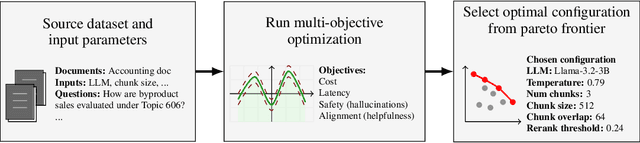
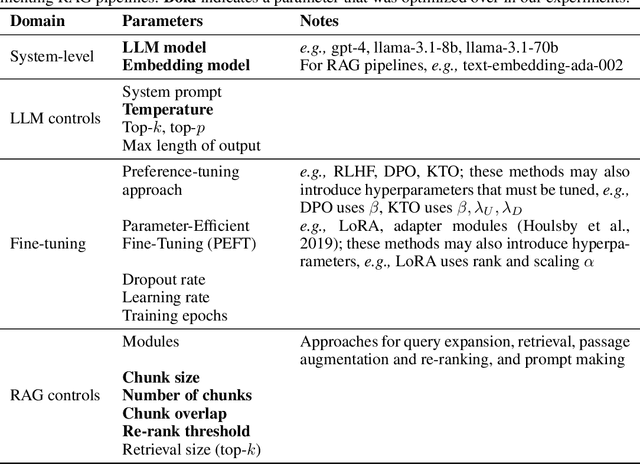
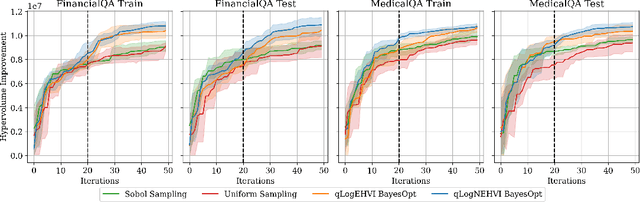
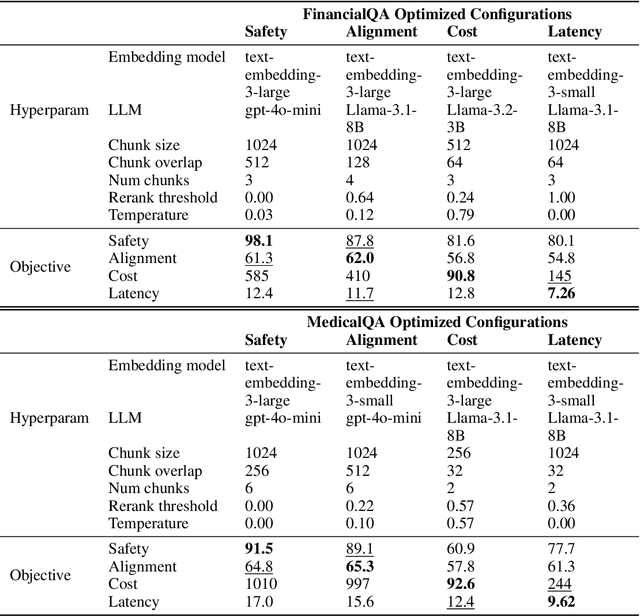
While Retrieval Augmented Generation (RAG) has emerged as a popular technique for improving Large Language Model (LLM) systems, it introduces a large number of choices, parameters and hyperparameters that must be made or tuned. This includes the LLM, embedding, and ranker models themselves, as well as hyperparameters governing individual RAG components. Yet, collectively optimizing the entire configuration in a RAG or LLM system remains under-explored - especially in multi-objective settings - due to intractably large solution spaces, noisy objective evaluations, and the high cost of evaluations. In this work, we introduce the first approach for multi-objective parameter optimization of cost, latency, safety and alignment over entire LLM and RAG systems. We find that Bayesian optimization methods significantly outperform baseline approaches, obtaining a superior Pareto front on two new RAG benchmark tasks. We conclude our work with important considerations for practitioners who are designing multi-objective RAG systems, highlighting nuances such as how optimal configurations may not generalize across tasks and objectives.