 Add to Chrome
 Add to Firefox
 Add to Edge
Fairness-informed Pareto Optimization : An Efficient Bilevel Framework
Jan 19, 2026
Despite their promise, fair machine learning methods often yield Pareto-inefficient models, in which the performance of certain groups can be improved without degrading that of others. This issue arises frequently in traditional in-processing approaches such as fairness-through-regularization. In contrast, existing Pareto-efficient approaches are biased towards a certain perspective on fairness and fail to adapt to the broad range of fairness metrics studied in the literature. In this paper, we present BADR, a simple framework to recover the optimal Pareto-efficient model for any fairness metric. Our framework recovers its models through a Bilevel Adaptive Rescalarisation procedure. The lower level is a weighted empirical risk minimization task where the weights are a convex combination of the groups, while the upper level optimizes the chosen fairness objective. We equip our framework with two novel large-scale, single-loop algorithms, BADR-GD and BADR-SGD, and establish their convergence guarantees. We release badr, an open-source Python toolbox implementing our framework for a variety of learning tasks and fairness metrics. Finally, we conduct extensive numerical experiments demonstrating the advantages of BADR over existing Pareto-efficient approaches to fairness.

Snacks: a fast large-scale kernel SVM solver
Apr 17, 2023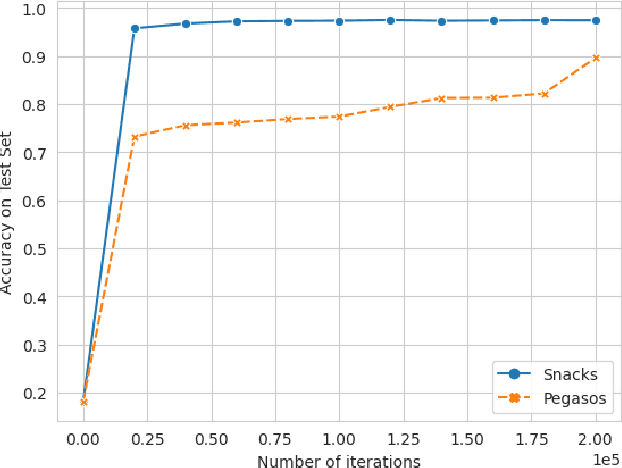

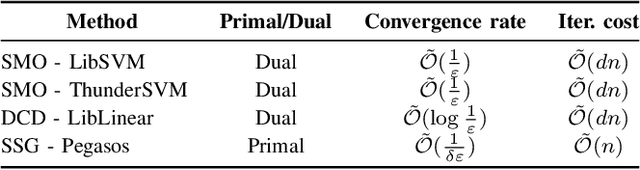
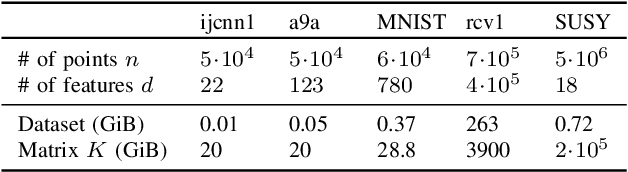
Kernel methods provide a powerful framework for non parametric learning. They are based on kernel functions and allow learning in a rich functional space while applying linear statistical learning tools, such as Ridge Regression or Support Vector Machines. However, standard kernel methods suffer from a quadratic time and memory complexity in the number of data points and thus have limited applications in large-scale learning. In this paper, we propose Snacks, a new large-scale solver for Kernel Support Vector Machines. Specifically, Snacks relies on a Nystr\"om approximation of the kernel matrix and an accelerated variant of the stochastic subgradient method. We demonstrate formally through a detailed empirical evaluation, that it competes with other SVM solvers on a variety of benchmark datasets.