 Add to Chrome
 Add to Firefox
 Add to Edge
Improving Methodologies for Agentic Evaluations Across Domains: Leakage of Sensitive Information, Fraud and Cybersecurity Threats
Jan 22, 2026
The rapid rise of autonomous AI systems and advancements in agent capabilities are introducing new risks due to reduced oversight of real-world interactions. Yet agent testing remains nascent and is still a developing science. As AI agents begin to be deployed globally, it is important that they handle different languages and cultures accurately and securely. To address this, participants from The International Network for Advanced AI Measurement, Evaluation and Science, including representatives from Singapore, Japan, Australia, Canada, the European Commission, France, Kenya, South Korea, and the United Kingdom have come together to align approaches to agentic evaluations. This is the third exercise, building on insights from two earlier joint testing exercises conducted by the Network in November 2024 and February 2025. The objective is to further refine best practices for testing advanced AI systems. The exercise was split into two strands: (1) common risks, including leakage of sensitive information and fraud, led by Singapore AISI; and (2) cybersecurity, led by UK AISI. A mix of open and closed-weight models were evaluated against tasks from various public agentic benchmarks. Given the nascency of agentic testing, our primary focus was on understanding methodological issues in conducting such tests, rather than examining test results or model capabilities. This collaboration marks an important step forward as participants work together to advance the science of agentic evaluations.

Fast Fair Regression via Efficient Approximations of Mutual Information
Feb 14, 2020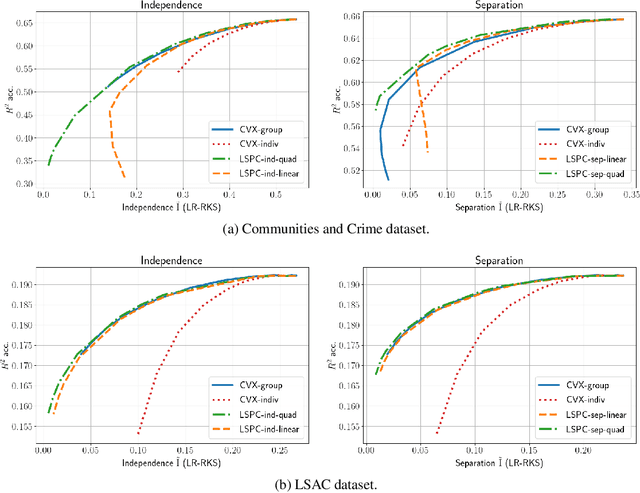
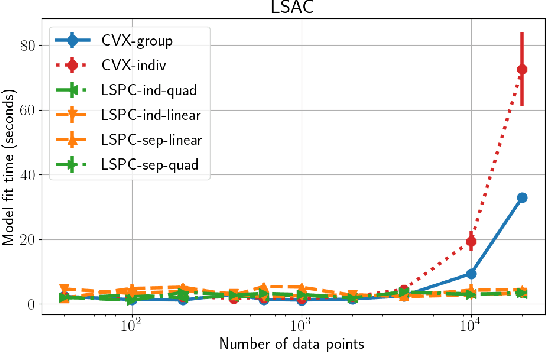
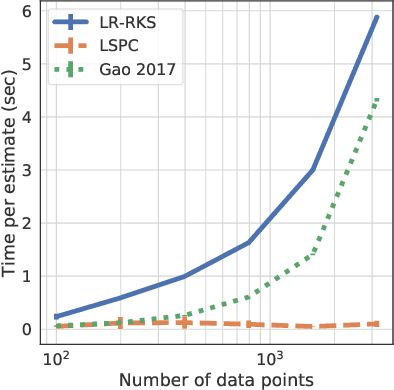
Most work in algorithmic fairness to date has focused on discrete outcomes, such as deciding whether to grant someone a loan or not. In these classification settings, group fairness criteria such as independence, separation and sufficiency can be measured directly by comparing rates of outcomes between subpopulations. Many important problems however require the prediction of a real-valued outcome, such as a risk score or insurance premium. In such regression settings, measuring group fairness criteria is computationally challenging, as it requires estimating information-theoretic divergences between conditional probability density functions. This paper introduces fast approximations of the independence, separation and sufficiency group fairness criteria for regression models from their (conditional) mutual information definitions, and uses such approximations as regularisers to enforce fairness within a regularised risk minimisation framework. Experiments in real-world datasets indicate that in spite of its superior computational efficiency our algorithm still displays state-of-the-art accuracy/fairness tradeoffs.
Fairness Measures for Regression via Probabilistic Classification
Jan 16, 2020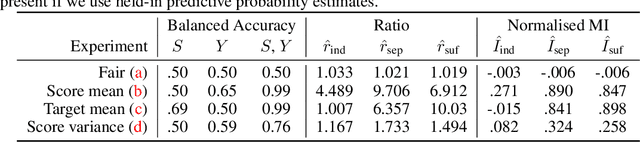
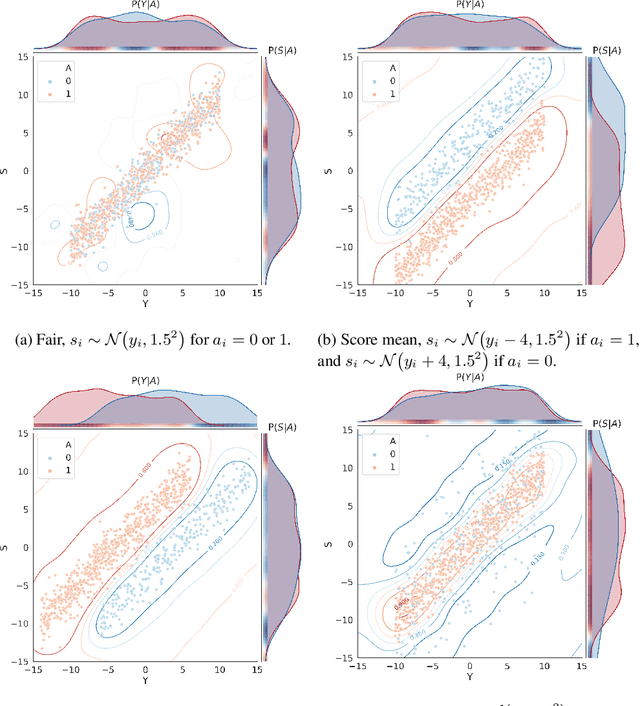
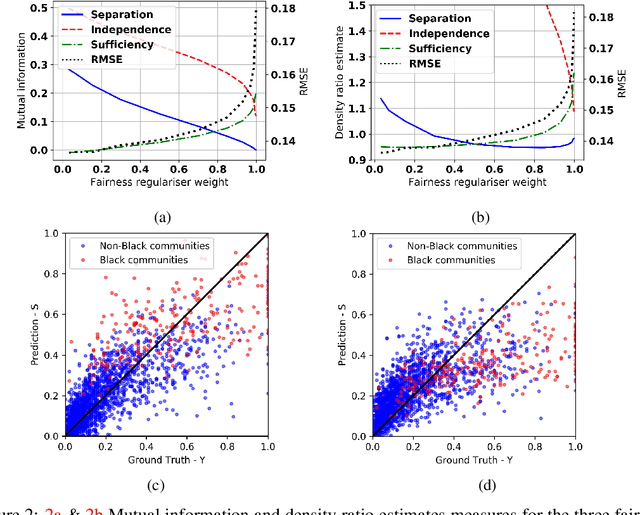
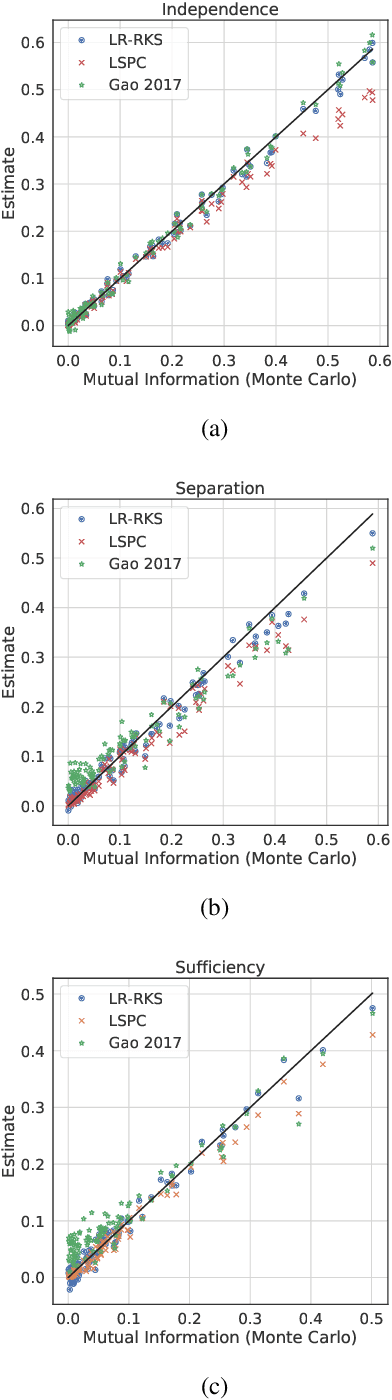
Algorithmic fairness involves expressing notions such as equity, or reasonable treatment, as quantifiable measures that a machine learning algorithm can optimise. Most work in the literature to date has focused on classification problems where the prediction is categorical, such as accepting or rejecting a loan application. This is in part because classification fairness measures are easily computed by comparing the rates of outcomes, leading to behaviours such as ensuring that the same fraction of eligible men are selected as eligible women. But such measures are computationally difficult to generalise to the continuous regression setting for problems such as pricing, or allocating payments. The difficulty arises from estimating conditional densities (such as the probability density that a system will over-charge by a certain amount). For the regression setting we introduce tractable approximations of the independence, separation and sufficiency criteria by observing that they factorise as ratios of different conditional probabilities of the protected attributes. We introduce and train machine learning classifiers, distinct from the predictor, as a mechanism to estimate these probabilities from the data. This naturally leads to model agnostic, tractable approximations of the criteria, which we explore experimentally.