 Add to Chrome
 Add to Firefox
 Add to Edge
Depth, Not Data: An Analysis of Hessian Spectral Bifurcation
Jan 31, 2026
The eigenvalue distribution of the Hessian matrix plays a crucial role in understanding the optimization landscape of deep neural networks. Prior work has attributed the well-documented ``bulk-and-spike'' spectral structure, where a few dominant eigenvalues are separated from a bulk of smaller ones, to the imbalance in the data covariance matrix. In this work, we challenge this view by demonstrating that such spectral Bifurcation can arise purely from the network architecture, independent of data imbalance. Specifically, we analyze a deep linear network setup and prove that, even when the data covariance is perfectly balanced, the Hessian still exhibits a Bifurcation eigenvalue structure: a dominant cluster and a bulk cluster. Crucially, we establish that the ratio between dominant and bulk eigenvalues scales linearly with the network depth. This reveals that the spectral gap is strongly affected by the network architecture rather than solely by data distribution. Our results suggest that both model architecture and data characteristics should be considered when designing optimization algorithms for deep networks.

Suspicious Alignment of SGD: A Fine-Grained Step Size Condition Analysis
Jan 16, 2026This paper explores the suspicious alignment phenomenon in stochastic gradient descent (SGD) under ill-conditioned optimization, where the Hessian spectrum splits into dominant and bulk subspaces. This phenomenon describes the behavior of gradient alignment in SGD updates. Specifically, during the initial phase of SGD updates, the alignment between the gradient and the dominant subspace tends to decrease. Subsequently, it enters a rising phase and eventually stabilizes in a high-alignment phase. The alignment is considered ``suspicious'' because, paradoxically, the projected gradient update along this highly-aligned dominant subspace proves ineffective at reducing the loss. The focus of this work is to give a fine-grained analysis in a high-dimensional quadratic setup about how step size selection produces this phenomenon. Our main contribution can be summarized as follows: We propose a step-size condition revealing that in low-alignment regimes, an adaptive critical step size $η_t^*$ separates alignment-decreasing ($η_t < η_t^*$) from alignment-increasing ($η_t > η_t^*$) regimes, whereas in high-alignment regimes, the alignment is self-correcting and decreases regardless of the step size. We further show that under sufficient ill-conditioning, a step size interval exists where projecting the SGD updates to the bulk space decreases the loss while projecting them to the dominant space increases the loss, which explains a recent empirical observation that projecting gradient updates to the dominant subspace is ineffective. Finally, based on this adaptive step-size theory, we prove that for a constant step size and large initialization, SGD exhibits this distinct two-phase behavior: an initial alignment-decreasing phase, followed by stabilization at high alignment.
KCES: Training-Free Defense for Robust Graph Neural Networks via Kernel Complexity
Jun 13, 2025Graph Neural Networks (GNNs) have achieved impressive success across a wide range of graph-based tasks, yet they remain highly vulnerable to small, imperceptible perturbations and adversarial attacks. Although numerous defense methods have been proposed to address these vulnerabilities, many rely on heuristic metrics, overfit to specific attack patterns, and suffer from high computational complexity. In this paper, we propose Kernel Complexity-Based Edge Sanitization (KCES), a training-free, model-agnostic defense framework. KCES leverages Graph Kernel Complexity (GKC), a novel metric derived from the graph's Gram matrix that characterizes GNN generalization via its test error bound. Building on GKC, we define a KC score for each edge, measuring the change in GKC when the edge is removed. Edges with high KC scores, typically introduced by adversarial perturbations, are pruned to mitigate their harmful effects, thereby enhancing GNNs' robustness. KCES can also be seamlessly integrated with existing defense strategies as a plug-and-play module without requiring training. Theoretical analysis and extensive experiments demonstrate that KCES consistently enhances GNN robustness, outperforms state-of-the-art baselines, and amplifies the effectiveness of existing defenses, offering a principled and efficient solution for securing GNNs.
Crafting Heavy-Tails in Weight Matrix Spectrum without Gradient Noise
Jun 07, 2024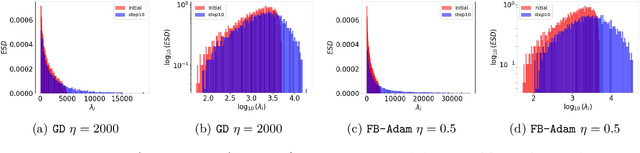

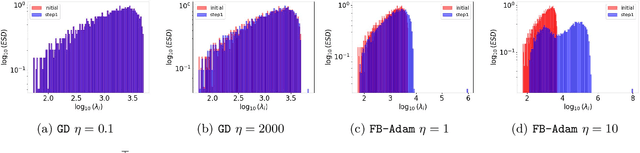
Modern training strategies of deep neural networks (NNs) tend to induce a heavy-tailed (HT) spectra of layer weights. Extensive efforts to study this phenomenon have found that NNs with HT weight spectra tend to generalize well. A prevailing notion for the occurrence of such HT spectra attributes gradient noise during training as a key contributing factor. Our work shows that gradient noise is unnecessary for generating HT weight spectra: two-layer NNs trained with full-batch Gradient Descent/Adam can exhibit HT spectra in their weights after finite training steps. To this end, we first identify the scale of the learning rate at which one step of full-batch Adam can lead to feature learning in the shallow NN, particularly when learning a single index teacher model. Next, we show that multiple optimizer steps with such (sufficiently) large learning rates can transition the bulk of the weight's spectra into an HT distribution. To understand this behavior, we present a novel perspective based on the singular vectors of the weight matrices and optimizer updates. We show that the HT weight spectrum originates from the `spike', which is generated from feature learning and interacts with the main bulk to generate an HT spectrum. Finally, we analyze the correlations between the HT weight spectra and generalization after multiple optimizer updates with varying learning rates.