 Add to Chrome
 Add to Firefox
 Add to Edge
StructAlign: Structured Cross-Modal Alignment for Continual Text-to-Video Retrieval
Jan 28, 2026
Continual Text-to-Video Retrieval (CTVR) is a challenging multimodal continual learning setting, where models must incrementally learn new semantic categories while maintaining accurate text-video alignment for previously learned ones, thus making it particularly prone to catastrophic forgetting. A key challenge in CTVR is feature drift, which manifests in two forms: intra-modal feature drift caused by continual learning within each modality, and non-cooperative feature drift across modalities that leads to modality misalignment. To mitigate these issues, we propose StructAlign, a structured cross-modal alignment method for CTVR. First, StructAlign introduces a simplex Equiangular Tight Frame (ETF) geometry as a unified geometric prior to mitigate modality misalignment. Building upon this geometric prior, we design a cross-modal ETF alignment loss that aligns text and video features with category-level ETF prototypes, encouraging the learned representations to form an approximate simplex ETF geometry. In addition, to suppress intra-modal feature drift, we design a Cross-modal Relation Preserving loss, which leverages complementary modalities to preserve cross-modal similarity relations, providing stable relational supervision for feature updates. By jointly addressing non-cooperative feature drift across modalities and intra-modal feature drift, StructAlign effectively alleviates catastrophic forgetting in CTVR. Extensive experiments on benchmark datasets demonstrate that our method consistently outperforms state-of-the-art continual retrieval approaches.

IOTA: Corrective Knowledge-Guided Prompt Learning via Black-White Box Framework
Jan 28, 2026Recently, adapting pre-trained models to downstream tasks has attracted increasing interest. Previous Parameter-Efficient-Tuning (PET) methods regard the pre-trained model as an opaque Black Box model, relying purely on data-driven optimization and underutilizing their inherent prior knowledge. This oversight limits the models' potential for effective downstream task adaptation. To address these issues, we propose a novel black-whIte bOx prompT leArning framework (IOTA), which integrates a data-driven Black Box module with a knowledge-driven White Box module for downstream task adaptation. Specifically, the White Box module derives corrective knowledge by contrasting the wrong predictions with the right cognition. This knowledge is verbalized into interpretable human prompts and leveraged through a corrective knowledge-guided prompt selection strategy to guide the Black Box module toward more accurate predictions. By jointly leveraging knowledge- and data-driven learning signals, IOTA achieves effective downstream task adaptation. Experimental results on 12 image classification benchmarks under few-shot and easy-to-hard adaptation settings demonstrate the effectiveness of corrective knowledge and the superiority of our method over state-of-the-art methods.
Continual Novel Class Discovery via Feature Enhancement and Adaptation
May 10, 2024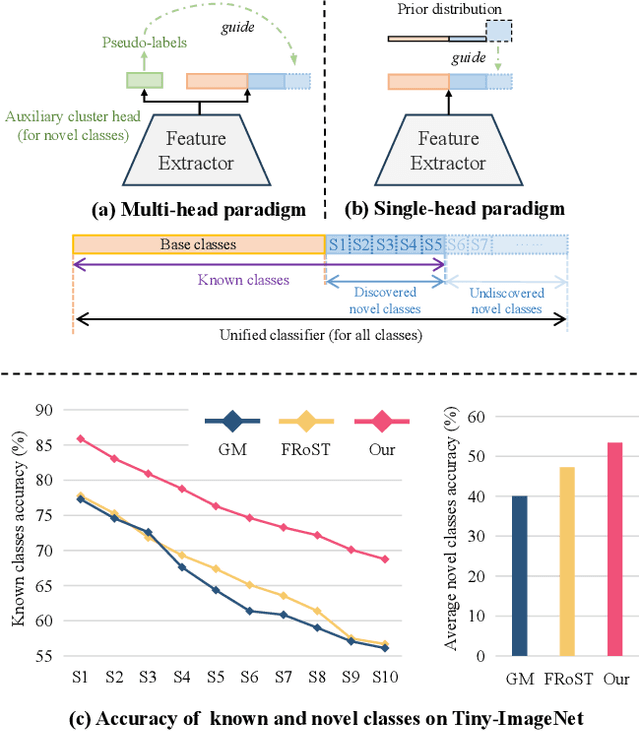
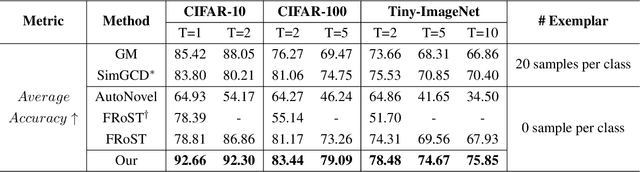
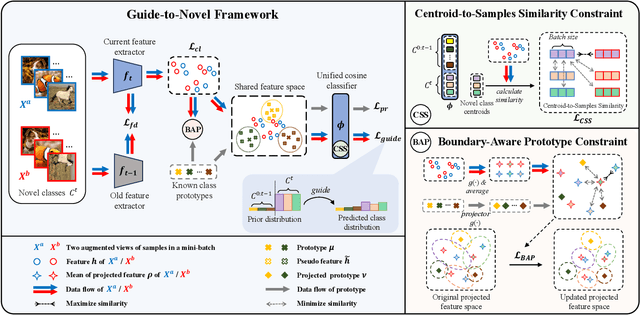
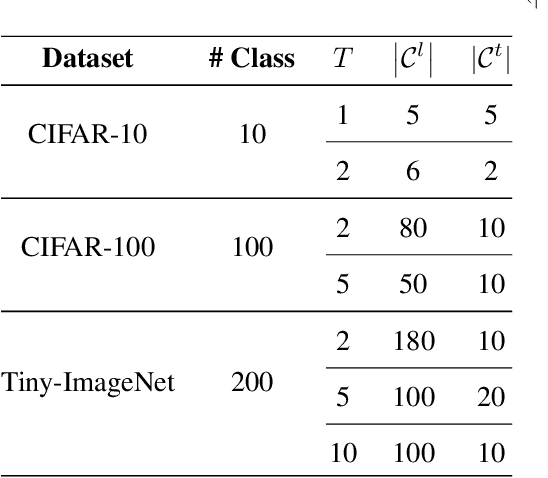
Continual Novel Class Discovery (CNCD) aims to continually discover novel classes without labels while maintaining the recognition capability for previously learned classes. The main challenges faced by CNCD include the feature-discrepancy problem, the inter-session confusion problem, etc. In this paper, we propose a novel Feature Enhancement and Adaptation method for the CNCD to tackle the above challenges, which consists of a guide-to-novel framework, a centroid-to-samples similarity constraint (CSS), and a boundary-aware prototype constraint (BAP). More specifically, the guide-to-novel framework is established to continually discover novel classes under the guidance of prior distribution. Afterward, the CSS is designed to constrain the relationship between centroid-to-samples similarities of different classes, thereby enhancing the distinctiveness of features among novel classes. Finally, the BAP is proposed to keep novel class features aware of the positions of other class prototypes during incremental sessions, and better adapt novel class features to the shared feature space. Experimental results on three benchmark datasets demonstrate the superiority of our method, especially in more challenging protocols with more incremental sessions.