 Add to Chrome
 Add to Firefox
 Add to Edge
MURAD: A Large-Scale Multi-Domain Unified Reverse Arabic Dictionary Dataset
Jan 29, 2026
Arabic is a linguistically and culturally rich language with a vast vocabulary that spans scientific, religious, and literary domains. Yet, large-scale lexical datasets linking Arabic words to precise definitions remain limited. We present MURAD (Multi-domain Unified Reverse Arabic Dictionary), an open lexical dataset with 96,243 word-definition pairs. The data come from trusted reference works and educational sources. Extraction used a hybrid pipeline integrating direct text parsing, optical character recognition, and automated reconstruction. This ensures accuracy and clarity. Each record aligns a target word with its standardized Arabic definition and metadata that identifies the source domain. The dataset covers terms from linguistics, Islamic studies, mathematics, physics, psychology, and engineering. It supports computational linguistics and lexicographic research. Applications include reverse dictionary modeling, semantic retrieval, and educational tools. By releasing this resource, we aim to advance Arabic natural language processing and promote reproducible research on Arabic lexical semantics.

The Path Ahead for Agentic AI: Challenges and Opportunities
Jan 06, 2026The evolution of Large Language Models (LLMs) from passive text generators to autonomous, goal-driven systems represents a fundamental shift in artificial intelligence. This chapter examines the emergence of agentic AI systems that integrate planning, memory, tool use, and iterative reasoning to operate autonomously in complex environments. We trace the architectural progression from statistical models to transformer-based systems, identifying capabilities that enable agentic behavior: long-range reasoning, contextual awareness, and adaptive decision-making. The chapter provides three contributions: (1) a synthesis of how LLM capabilities extend toward agency through reasoning-action-reflection loops; (2) an integrative framework describing core components perception, memory, planning, and tool execution that bridge LLMs with autonomous behavior; (3) a critical assessment of applications and persistent challenges in safety, alignment, reliability, and sustainability. Unlike existing surveys, we focus on the architectural transition from language understanding to autonomous action, emphasizing the technical gaps that must be resolved before deployment. We identify critical research priorities, including verifiable planning, scalable multi-agent coordination, persistent memory architectures, and governance frameworks. Responsible advancement requires simultaneous progress in technical robustness, interpretability, and ethical safeguards to realize potential while mitigating risks of misalignment and unintended consequences.
License Plate Super-Resolution Using Diffusion Models
Sep 21, 2023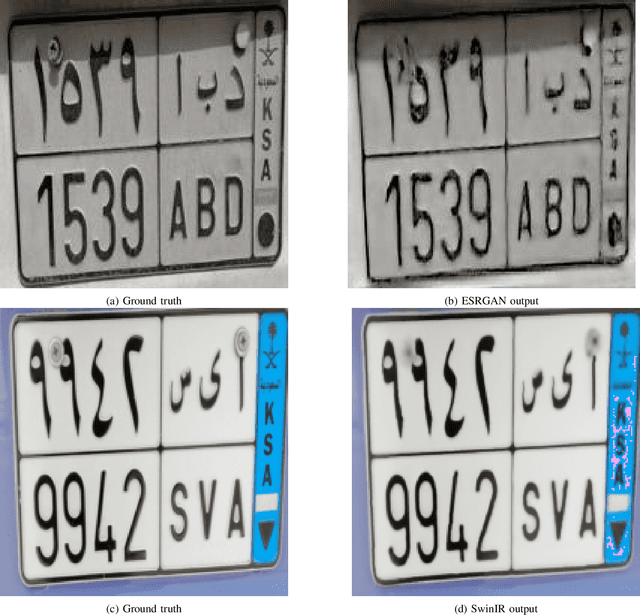


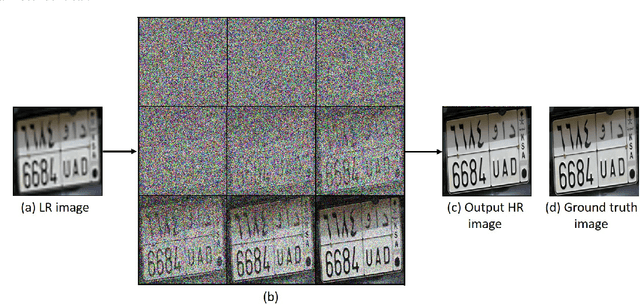
In surveillance, accurately recognizing license plates is hindered by their often low quality and small dimensions, compromising recognition precision. Despite advancements in AI-based image super-resolution, methods like Convolutional Neural Networks (CNNs) and Generative Adversarial Networks (GANs) still fall short in enhancing license plate images. This study leverages the cutting-edge diffusion model, which has consistently outperformed other deep learning techniques in image restoration. By training this model using a curated dataset of Saudi license plates, both in low and high resolutions, we discovered the diffusion model's superior efficacy. The method achieves a 12.55\% and 37.32% improvement in Peak Signal-to-Noise Ratio (PSNR) over SwinIR and ESRGAN, respectively. Moreover, our method surpasses these techniques in terms of Structural Similarity Index (SSIM), registering a 4.89% and 17.66% improvement over SwinIR and ESRGAN, respectively. Furthermore, 92% of human evaluators preferred our images over those from other algorithms. In essence, this research presents a pioneering solution for license plate super-resolution, with tangible potential for surveillance systems.