 Add to Chrome
 Add to Firefox
 Add to Edge
QuantumGS: Quantum Encoding Framework for Gaussian Splatting
Feb 04, 2026
Recent advances in neural rendering, particularly 3D Gaussian Splatting (3DGS), have enabled real-time rendering of complex scenes. However, standard 3DGS relies on spherical harmonics, which often struggle to accurately capture high-frequency view-dependent effects such as sharp reflections and transparency. While hybrid approaches like Viewing Direction Gaussian Splatting (VDGS) mitigate this limitation using classical Multi-Layer Perceptrons (MLPs), they remain limited by the expressivity of classical networks in low-parameter regimes. In this paper, we introduce QuantumGS, a novel hybrid framework that integrates Variational Quantum Circuits (VQC) into the Gaussian Splatting pipeline. We propose a unique encoding strategy that maps the viewing direction directly onto the Bloch sphere, leveraging the natural geometry of qubits to represent 3D directional data. By replacing classical color-modulating networks with quantum circuits generated via a hypernetwork or conditioning mechanism, we achieve higher expressivity and better generalization. Source code is available in the supplementary material. Code is available at https://github.com/gwilczynski95/QuantumGS

HuSc3D: Human Sculpture dataset for 3D object reconstruction
Jun 09, 2025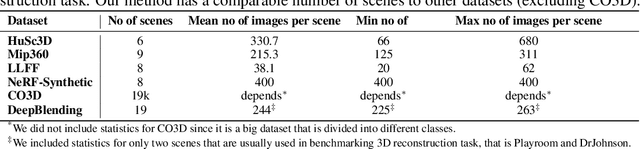
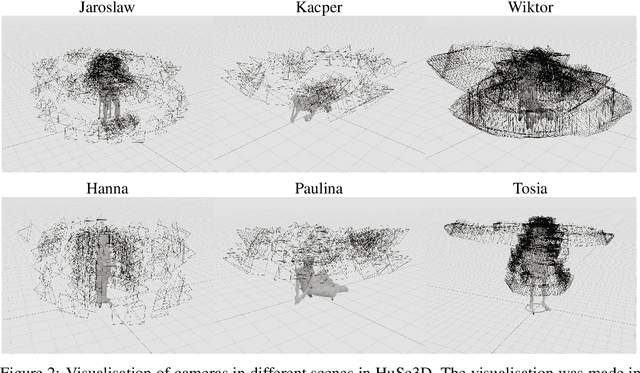
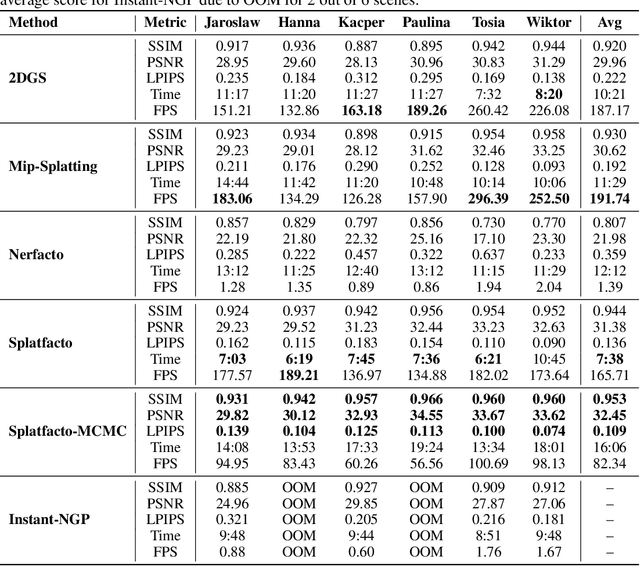
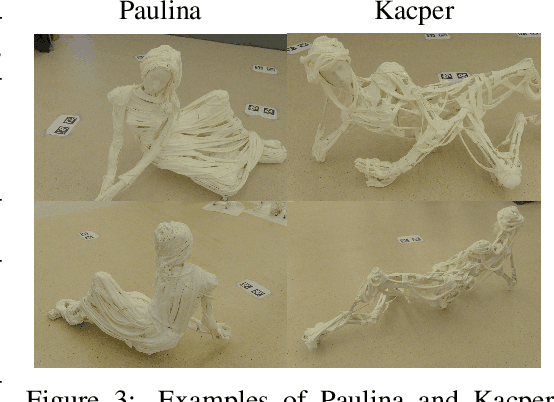
3D scene reconstruction from 2D images is one of the most important tasks in computer graphics. Unfortunately, existing datasets and benchmarks concentrate on idealized synthetic or meticulously captured realistic data. Such benchmarks fail to convey the inherent complexities encountered in newly acquired real-world scenes. In such scenes especially those acquired outside, the background is often dynamic, and by popular usage of cell phone cameras, there might be discrepancies in, e.g., white balance. To address this gap, we present HuSc3D, a novel dataset specifically designed for rigorous benchmarking of 3D reconstruction models under realistic acquisition challenges. Our dataset uniquely features six highly detailed, fully white sculptures characterized by intricate perforations and minimal textural and color variation. Furthermore, the number of images per scene varies significantly, introducing the additional challenge of limited training data for some instances alongside scenes with a standard number of views. By evaluating popular 3D reconstruction methods on this diverse dataset, we demonstrate the distinctiveness of HuSc3D in effectively differentiating model performance, particularly highlighting the sensitivity of methods to fine geometric details, color ambiguity, and varying data availability--limitations often masked by more conventional datasets.
MeshSplats: Mesh-Based Rendering with Gaussian Splatting Initialization
Feb 11, 2025Gaussian Splatting (GS) is a recent and pivotal technique in 3D computer graphics. GS-based algorithms almost always bypass classical methods such as ray tracing, which offers numerous inherent advantages for rendering. For example, ray tracing is able to handle incoherent rays for advanced lighting effects, including shadows and reflections. To address this limitation, we introduce MeshSplats, a method which converts GS to a mesh-like format. Following the completion of training, MeshSplats transforms Gaussian elements into mesh faces, enabling rendering using ray tracing methods with all their associated benefits. Our model can be utilized immediately following transformation, yielding a mesh of slightly reduced quality without additional training. Furthermore, we can enhance the reconstruction quality through the application of a dedicated optimization algorithm that operates on mesh faces rather than Gaussian components. The efficacy of our method is substantiated by experimental results, underscoring its extensive applications in computer graphics and image processing.